29, October 2025
Paul Biya’s state capture of Cameroon: a case of collective responsibility 0
In July 1994, Yahya Jammeh stormed into power in The Gambia with a soldier’s swagger and the usual promises of salvation. He vowed to restore democracy; instead, he converted the country into a private chamber of fear. His opponents were jailed, tortured and many vanished. Elections were jokes. After twenty-two years of tyranny, Jammeh was voted out in December 2016. For a moment, he conceded defeat on live television only to rescind his concession a week later, claiming irregularities in the vote. But when ECOWAS, the UN and AU called his bluff and his own soldiers refused to die for his delusion, Jammeh fled to Equatorial Guinea. The dictator fell not through divine intervention, but through the exhaustion of a people who had finally remembered they were free.
In Cameroon, its 92-year-old president, Paul Biya, has been in power since 1982. On 12 October 2025, he presided over yet another election, the sort of ritualized farce designed to reassure foreign donors that democracy is alive in that part of central Africa. Biya himself was comfortably in Switzerland during the campaign, surfacing once about five days before the election perhaps to remind everyone he was still among the living. Yet, as surely as night follows the day, the country’s constitutional council declared him victor with 53% of the vote.
Cameroon’s tragedy feels unique in its endurance, because for forty-three years, Paul Biya has perfected the art of state capture. In Cameroon, elections are not civic drills but rituals to gain legitimacy, and everyone from Yaoundé to Paris participates in the fiction. In 2025, due to the miracle of the internet, social media and smart phones, dictators no longer need tanks on the streets, all they require are ballot boxes on television and nodding international observers.
The decay beneath Mr Biya’s state capture is appalling. According to the World Bank, over 50% of Cameroonians live on less than two dollars a day. A few months ago, I travelled to the country to visit family and it was a dreadful experience. Roads are disintegrating death traps, hospitals operate with candles, and medicines are as rare in the country as justice is. This, in a country blessed with fertile soil, minerals, oil and natural gas. A nonagenarian in any rational society would be tending his grandchildren while waiting to meet his maker. In Cameroon, he is in charge of the treasury. Around him, parasitic elite invoke his name as both shield and excuse with phrases like-We Thank the Head of State.
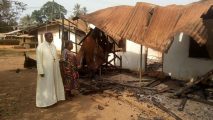
The Anglophone crisis of 2017 was the first genuine crack in Biya’s glass fortress. The English-speaking regions, long neglected and ridiculed, finally rebelled, declaring independence from a state that had treated them as an afterthought. The regime responded with predictable brutality, arrests, executions, imprisonments, abductions and burned villages. During the Anglophone crisis, French Cameroonians (the country’s 80% majority) watched in loud silence and complicity.
Cameroon’s institutions serve not the public but the man and his ruling class. The judiciary is an obedient choir and military courts are now a norm. The police and gendarmes are a network of ruffians while the military is a militia in uniform. The national broadcaster, the CRTV and other state-owned newspapers are theatres of absurdity praising the government’s ghost accomplishments with such fanaticism that even Joseph Goebbels may have found some of their positions preposterous.
To blame Biya alone is to study only half the portrait. His rule endures because Cameroonians by fear and lethargy have surrendered their agency. Bribery has become the national dialect and Cameroonian shave learned to navigate the system rather than confront it. Even the diaspora has perfected digital protests where intelligent people are mighty on WhatsApp forums and Facebook, but politically impotent in reality. AI-generated videos circulate frequently, often intended to stimulate laughter on forums about the ruling elite. It is truly a fascinating experience, and it would be funny if it were not so tragic.
After four decades of economic and moral decay, Biya’s most enduring legacy may be the industrial-scale production of alcoholics. The national pastime is no longer football but the consumption of lager. Men, women, and adolescents toast their hopelessness in pints. The country has found its anesthetic in booze.
Dictatorships do not thrive on cruelty alone; they flourish on the quiet complicity of the governed. For over four decades, Cameroonians have learned to live with their chains, with some, particularly French Cameroonians, even decorating their shackles with pride. The laughter and emojis on social media, the jokes about “We Thank the Head of State” are coping mechanisms and confessions of powerlessness. To speak of collective responsibility is not to vindicate Mr Biya and his ruling elite, but to indict the moral inertia that keeps him in power. A people’s silence is the dictator’s favourite hymn. Each shrug at injustice, cynical joke, emoji to arouse laughter at the depressing situation in the country is complicity.
Mr Biya himself, frail and fading, incapable of controlling his anal flatulence in public can barely walk unaided. Yet his image looms large and he is like an ancestor who refuses to die. To blame this relic alone for the nation’s rot is convenient but dishonest. Cameroonians may say they did not choose tyranny, but by adapting to it, they have normalized it and are therefore collectively responsible for the insanity.
Cameroon’s deliverance will not arrive by foreign rescue or spiritual intervention. It will begin the day Cameroonians grow tired of their amusement at their abuse. Dictators grow old; nations do not. Biya will one day pass, as all mortals must. The fall of Yahya Jammeh, is a reminder that the walls of fear, however ancient, are made of air. They collapse when enough people stop pretending they are rocks. No regime, however ruthless, can outlast a people that decide dignity is non-negotiable. Despots can jail, execute their opponents, kill protesters, jail journalists, burn villages, and rig elections but they cannot win against a determined people.
The story of Yahya Jammeh offers a mirror to Cameroon. For twenty-two years, Gambians endured a reign of fear, killing, torture, and electoral farce, convinced that Jammeh was unshakable. Yet in 2016, when the people refused to accept a stolen election and the army withdrew support, the dictator fell as the courage of the Gambian people met opportunity. Jammeh’s departure is a cautionary tale written in blood and determination. It is a fact that tyranny endures only as long as the people allow it. This may just be time for Cameroon to say enough is enough.
By Isong Asu


30, October 2025
Protests continue against phantom president-elect: Biya (92) cannot walk, talk or shake hands 0
When the Constitutional Council declared the 92 year-old Biya as winner of the October 12 presidential election, it made his grotesque presidency stranger than political fiction. Biya cannot walk, talk, shake hands or even receive visiting dignitaries. He has not been seen in public ever since he was declared victorious in the election.
Yet his acolytes are planning an inaugural for the phantom president-elect next week. Biya no longer have the same physical strength as in 1982 and the will to serve the country has left him. While campaigns were going on, Biya flew to Paris for medical care.
More mass protests have been organized throughout the country and several people have been killed by the military. It is shameful, disgusting and disgraceful watching young Cameroonians being killed because of a 92-year old man who ran a political campaign organizing rallies around large and framed portraits.
Fuel stations and government buildings have become targets for protesters. The military-backed regime is already showing signs of panic as it recently announced that the Holy Father Pope Leo is expected in Cameroon. The announcement has made matters worse.
Issa Tchiroma Bakary, the winner of the October 12 presidential election has ordered the entire political system to leave and to be replaced by a new democratic order.
The National Front for the Salvation of Cameroon (FSNC) reaffirmed on October 28 its rejection of the October 12, 2025 presidential election results and its leadership is drawing up a plan for political transition that would begin with a constituent assembly which would draft a new constitution to be approved by referendum, followed by legislative and council elections.
French President Emmanuel Macron who approved the ohne ende tenure for Biya during a visit to Cameroon now fears that in the event of violent conflict, millions would flee to Gabon and other neighboring countries including France because thousands of Francophone Cameroonians hold French nationality.
Paul Biya was chosen by the French in 1982 to end President Ahmadou Ahidjo’s reign and the Biya regime has stayed in power by sharing Cameroon’s oil and gas wealth with the French.
Coup d’états have bypassed Cameroon mainly because the population always claimed to dread instability and bloodshed.
The ruling CPDM crime syndicate is now run by the Minister-Secretary General at the presidency of the republic Ferdinand Ngoh Ngoh.
The Yaoundé regime long prepared the figures that were announced by the Constitutional Council and every Cameroonian is now aware that it’s all theatre and all fiction.
The fact that the 92-year-old man who they say won the election remains in hiding is an indication that their pre-ordained scenario is now threatened by mass protests.
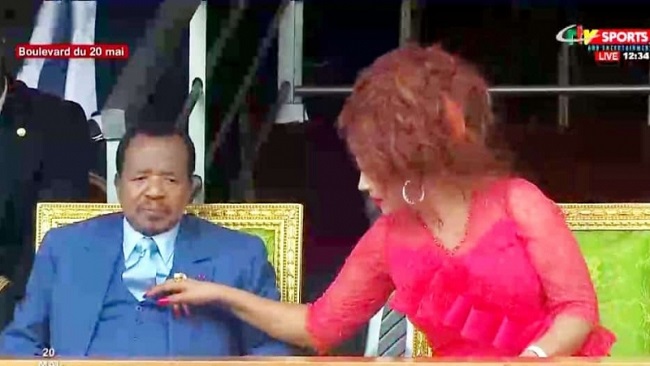
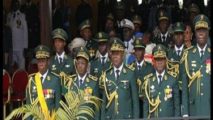
After 42 years of Paul Biya, and the humiliation of being governed by a first lady extremely lacking in political finesse, the security forces in Cameroon may also be ready for change.
By Soter Tarh Agbaw-Ebai