26, May 2021
Biden and Putin to hold their first summit in Geneva in June 0
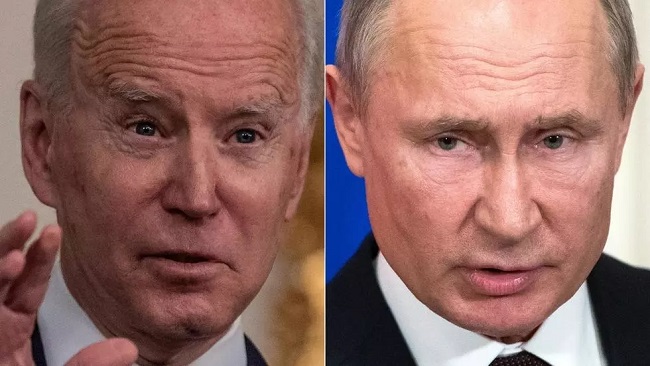
US President Joe Biden and Russia’s President Vladimir Putin will hold their first summit next month in Geneva, both sides said Tuesday, setting the stage for a new chapter in their fraught relationship.
The meeting in the Swiss city will be on June 16, White House Press Secretary Jen Psaki said.
“The leaders will discuss the full range of pressing issues, as we seek to restore predictability and stability to the US-Russia relationship,” she said.
The Kremlin confirmed the summit details and said in a statement that Putin and Biden would be discussing “issues of strategic stability,” as well as “resolving regional conflicts” and the Covid-19 pandemic.
Biden, making his first international trip as president, will go to Geneva immediately after separate summits with his key Western allies in the G7, NATO and the European Union.
The face-to-face meeting with the Kremlin leader comes amid levels of tension not seen for years, with Washington now dialling back its ambitions to little more than establishing a relationship in which both sides understand each other and can work together in specific areas.
Since taking office, Biden has launched new sanctions against Moscow over what US authorities say was the Russian role in the massive Solar Winds cyber attack and repeated meddling in the 2020 presidential election.
Washington has also harshly criticized Moscow for the near-death poisoning and subsequent imprisonment of one of the last open opponents to Putin, Alexei Navalny.
And where Biden told an interviewer that he agreed with the description of Putin as a “killer,” the Russian government has formally declared the United States to be an “unfriendly” country.
Moves to ease tension
The open recriminations are a long way from the often puzzling relationship between Trump and Putin.
The Geneva summit will come almost three years after Trump famously sided with the Kremlin leader over the US intelligence agencies on the question of whether Moscow interfered in the 2016 US presidential election.
However, both sides are working to calm the waters ahead of the Geneva summit, with the White House emphasizing hopes for working alongside Russia on well-defined strategic issues like nuclear weapons control and the Iran nuclear negotiations.
To prepare the ground, US Secretary of State Antony Blinken and veteran Russian Foreign Minister Sergei Lavrov met last week in Reykjavik, Iceland.
Kremlin spokesman Dmitry Peskov said after the Blinken-Lavrov meeting that repairing ties “will not be easy” but he saw “a positive signal.”
Moscow welcomed a US decision to waive sanctions that had been holding up completion of the Nord Stream 2 natural gas pipeline — a major energy supply route from Russia to Europe that US officials worry will make the EU overdependent on the Russians.
Source: AFP












26, May 2021
Mali’s ex-junta chief seizes power after military nabs interim president 0
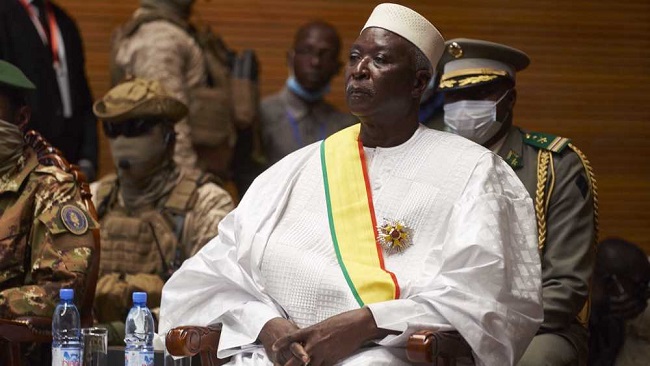
Mali’s military strongman Assimi Goita says the removal from power of the country’s interim president and vice president in recent days was the right move, alleging that the now detained leaders intended to sabotage the transition process with an uncalled for decision to reshuffle the cabinet.
Transitional President Bah Ndaw and Prime Minister Moctar Ouane – tasked with steering Mali to civilian rule nearly 10 months after a Goita-led coup — were taken into custody at a military base outside the capital Bamako on Monday evening, sparking an immediate reaction by former colonial power France.
French President Emmanuel Macron slammed the move as a “coup within a coup” and threatened to impose sanctions.
Former junta leader Goita, who was lately serving as interim vice president, justified the arrest of the interim leaders and seizure of power by claiming that the two had failed to consult him about a government reshuffle in which two former coup leaders lost their cabinet positions.
In a statement read on public television, Goita said Ndaw and Ouane had been stripped of their duties for seeking to “sabotage” the transition, which would “proceed as normal.”
“This kind of step testifies to the clear desire of the transitional president and prime minister to seek to breach the transitional charter,” he added, describing the move as a “demonstrable intent to sabotage the transition.”
In his statement, Goita further pledged to hold elections next year to restore an elected government as previously planned.
The United Nations
France, which continues to hold major political and military influence over Mali, joined the US, the European Union as well as the United Nations, African Union (AU) and Economic Community of West African States (ECOWAS) to condemn the detentions and demanded their immediate release.
The demand was further echoed on Tuesday by other Western governments such as Britain and Germany.
“We are prepared to take in the coming hours targeted sanctions against those” responsible, Macron declared during a press briefing at the end of an EU summit.
France has deployed more than 5,000 troops in Mali in a purported move to combat the growing presence of militants in the Sahel.
“Sanctions will be adopted against those who stand in the way of the transition,” EU’s foreign affairs chief Josep Borrell also warned in a Twitter post.
A delegation from the Economic Community of West African States (ECOWAS) arrived in Mali on Monday to help resolve the dispute. ECOWAS played a key role in the formation of the interim government after the August coup.
UN Security Council to meet on new Mali turmoil
The UN Security Council, meanwhile, is expected to hold an emergency meeting behind closed doors on Wednesday following the latest coup in Mali, diplomats stated on Tuesday.
The session was requested by France, Niger, Tunisia, Kenya and Saint Vincent and the Grenadines, all of which are current UNSC members, except France, which is a permanent member with veto power.
The development came after French Foreign Minister Jean-Yves le Drian declared earlier on Tuesday that a special UNSC meeting would be held following the “coup” in Mali, without stipulating when it would convene.
The situation could exacerbate instability in the West African country, where alleged al-Qaeda-linked militant groups control large areas of the north and center and stage frequent attacks on Mali’s military forces and civilians.
The problems in Mali are widely viewed as part of a recent democratic backslide in West and Central Africa, where strong military factions have taken control or presidents have extended their rule beyond allotted mandates.
Last month, a military council seized power in Chad after the battlefield death of president Idriss Deby. His son, Mahamat Idriss Deby, now runs the country and has promised a transition to civilian rule similar to Mali’s. The opposition and civil society insist that the military holds too much power and fear Deby will not relinquish control.
Mali’s young military officers ousted president Ibrahim Boubacar Keita in August 2020 after weeks of demonstrations over perceived government corruption and his handling of the growing insurgency by suspected al-Qaeda-linked militants.
ECOWAS, a 15-nation regional bloc, threatened sanctions, prompting the junta to hand power to a caretaker government that pledged to reform the constitution.
Source: Presstv