11, January 2020
US lawmakers reject Trump’s new claim that Soleimani targeted 4 US embassies in region 0
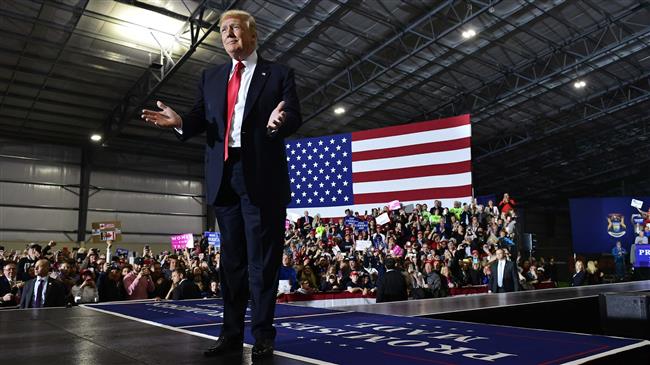
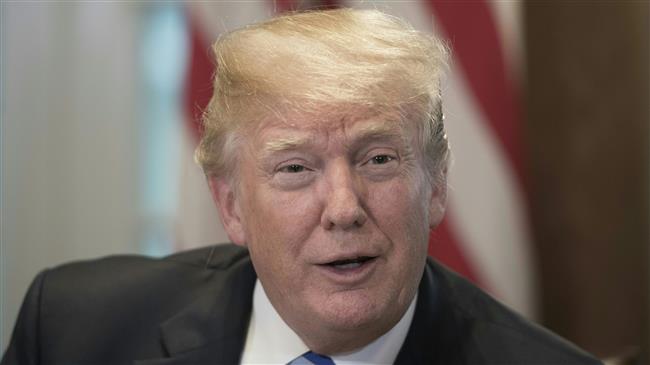
Several US lawmakers and officials have dismissed President Donald Trump’s new claim the US assassinated Iranian Lieutenant General Qassem Soleimani because he was planning an attack on four American embassies in the region, including the one in Iraq.
In an interview on Friday with Fox News, Trump said Iran probably had targeted the US embassy in Baghdad and was aiming to attack four US embassies when it killed Soleimani.
“We will tell you probably it was going to be the embassy in Baghdad,” Trump claimed. “I can reveal that I believe it would have been four embassies.”
But two unnamed senior officials, including one in the Defense Department, told The Washington Post that they were aware only of vague intelligence about a plot against the embassy in Baghdad.
Neither official mentioned any threats against other embassies in the region.
A source told the Post that the US embassy in Baghdad was never given a warning “commensurate” with the kind of threat described by Trump, which would have been standard procedure.
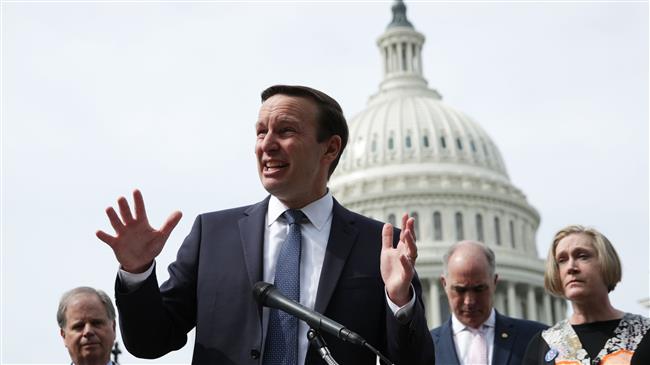
US Senator Chris Murphy, a Democrat from Connecticut, said nothing about planned attacks on four embassies was revealed to Congress and essentially accused Trump of making up the planned attacks.
US House Speaker Nancy Pelosi on Thursday called the killing “provocative and disproportionate,” and other members of Congress said they were unconvinced after a closed-door intelligence briefing provided by administration officials.
“President Trump recklessly assassinated Qasem Soleimani,” said US Representative Pramila Jayapal, a Democrat from Washington state.
“He had no evidence of an imminent threat or attack,” she said.
“Let’s be clear — if there was evidence of imminent attacks on four embassies, the Administration would have said so at our Wednesday briefing,” he tweeted. “They didn’t. So either Fox News gets higher level briefings than Congress … or … wait for it… there was no such imminent threat.”
The Trump administration had earlier claimed it carried out the assassination to avert an “imminent attack,” which has also been met with suspicion and skepticism in the US.
The US military carried out an airstrike on the direction of Trump at Baghdad’s international airport last Friday, assassinating Soleimani and the second-in-command of Iraq’s Popular Mobilization Units (PMU), Abu Mahdi al-Muhandis, as well as eight other companions.
Early on Wednesday, Iran responded to the assassination, striking the American airbase of Ain al-Assad in Anbar province in western Iraq and another in Erbil, the capital of Iraq’s semi-autonomous Kurdistan region.
A USA Today/Ipsos poll released Thursday found that Americans, by 55%-24%, said they believe the killing of General Soleimani has made the United States less safe, rejecting a fundamental argument the Trump administration has made that the assassination made the US safer.
Source: Presstv


















13, January 2020
Queen gathers royals for crisis meeting with Prince Harry 0
Queen Elizabeth II and other senior British royals were gathering for a meeting Monday with Prince Harry in an attempt to solve the crisis triggered by his bombshell announcement that he and wife Meghan were stepping back from the royal frontline.
Harry’s father Prince Charles and brother Prince William, with whom he has strained relations, will join the monarch at her private Sandringham estate in eastern England, according to British media.
Charles just flew back from Oman, where he attended a condolence ceremony following the death of Sultan Qaboos.
Meghan is expected to join the meeting via conference call from Canada as they attempt to work out the “next steps” towards a compromise and nip the growing crisis in the bud.
Issues up for debate include how much money the couple will still receive from Charles’s estate, their royal titles and what commercial deals they can strike, according to the Sunday Times.
The newspaper reported that William believes he and Harry are now “separate entities”, breaking the bonds forged following their mother’s tragic death.
“I’ve put my arm around my brother all our lives and I can’t do that any more; we’re separate entities,” the Times reported he told a friend.
The queen attended church at Sandringham on Sunday where supporters expressed sympathy for her, with some members of the public saying Harry and Meghan should not receive any more taxpayer money if they step back from the royal family.
The 93-year-old monarch on Thursday demanded that staff work with the couple to find urgently a “workable solution” that would take into account their demands for more freedom.
Harry, Meghan and son Archie spent Christmas in Canada, with the American former actress returning there this week.
Several Canadian media reported Meghan had returned to Vancouver Island off the country’s Pacific coast, where the family spent the year-end holidays and where baby Archie had remained with his nanny.
Senior royals were caught off guard by Wednesday’s announcement that the Duke and Duchess of Sussex wanted to seek a “progressive new role” and divide their time between Britain and North America.
– ‘Complicated issues’ –
The queen’s office issued a terse statement the same evening, saying there were “complicated issues that will take time to work through”.
Harry and Meghan said they intended to continue to “fully support” the queen and “collaborate” with senior royals.
They also want to keep their home on the queen’s Windsor Castle estate as their British base, while aiming to become financially independent.
Media reports said Harry and Meghan could conduct a potentially damaging television interview if they are unhappy with the outcome of Sunday’s meeting.
Writing for The Sunday Times, broadcaster Tom Bradby, a friend of Harry and William, said: “I have some idea of what might be aired in a full, no-holds-barred, sit-down interview and I don’t think it would be pretty.”
The younger prince, who has struggled with his role, last year revealed he has been growing apart from his brother, who as second in line to the throne is increasingly pursuing a different path.
Harry has been open about his mental health issues, and he and Meghan last year admitted to struggling with the spotlight following their wedding at Windsor Castle in May 2018 and Archie’s birth a year later.
The couple have also lashed out at negative news coverage — some of which Harry says was racist — in light of Meghan’s biracial heritage.
The British public currently appears to be siding with the family, with a Daily Mail poll showing that a majority believe Harry should give up his right to the throne and be stripped of cash support from the royals or taxpayers.
Source: AFP