28, December 2019
US: Trump impeachment trial in Senate stuck in limbo over rules 0
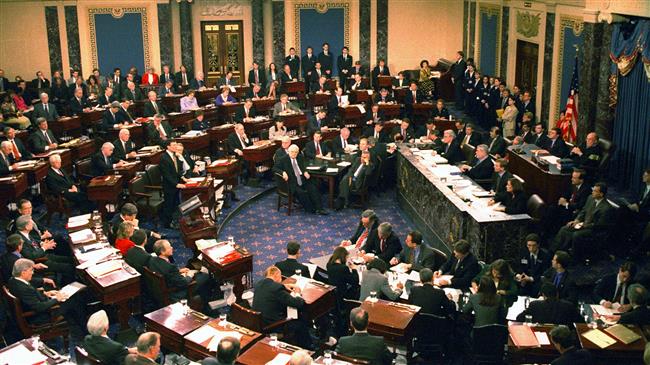
The US Senate remains deadlocked over how to proceed with an impeachment trial against President Donald Trump, more than a week after the Democratic-controlled House of Representatives impeached the Republican president on charges of abuse of power and obstruction of Congress.
Speaker of the House of Representatives Nancy Pelosi, a Democrat from California, is waiting until she receives more clarity from Senate Majority Leader Mitch McConnell, a Republican from Kentucky, about what an impeachment trial will look like.
McConnell, however, says he wants to start the Senate trial as soon as lawmakers return from the holiday recess in January.
Democrats are also outraged over McConnell’s pledge to coordinate the trial with the Trump administration and do everything he can to acquit the president.
Impeachment begins in the House. If the lower chamber of Congress approves articles of impeachment, a vote is then held in the Senate. A two-thirds majority vote would be needed in the Senate to remove the president from office.
Trump became the third president in US history to be impeached, following the impeachments of former Presidents Bill Clinton and Andrew Johnson. Neither Johnson nor Clinton were convicted by the Senate.
With Republicans in control of the Senate, Trump’s acquittal also seems likely.
In 1974, then President Richard Nixon resigned during his second term after it became certain he would be impeached by the House and convicted by the Senate over the Watergate scandal.
To formally launch a trial in the upper chamber of Congress, the 100-member Senate must pass a resolution with a simple majority authorizing the proceeding. But in order to do that, the House must first transmit the articles of impeachment.
Pelosi, however, says she will not deliver the documents until Democrats “know what sort of trial the Senate will conduct.” McConnell is refusing to agree to any of that in advance and cites the 1999 Clinton trial as a precedent.
In their dispute over how to move forward, both parties are citing the 1999 impeachment trial of Clinton, accusing each other of departing from what they view as precedents set by that trial.
Clinton’s trial in the Senate began on January 7, 1999, more than two weeks after he was impeached by the House on charges of perjury to a grand jury and obstruction of justice with regard to a sex scandal investigation.
Trump is showing signs of increasing frustration with the uncertainty surrounding his Senate trial. He spent the Christmas holiday complaining and blasting Democrats over the impeachment.
The House approved two articles of impeachment against Trump on December 18 on charges of abuse of power and obstruction of Congress.
An impeachment probe was launched in September after an anonymous intelligence community whistleblower accused the president of pressing Ukraine’s president to investigate Trump’s political rival, Joe Biden, and Biden’s son, as well as a debunked theory that Ukraine interfered in the 2016 US presidential election.
Source: Presstv














30, December 2019
North Korea’s Kim calls for ‘offensive’ security measures as nuclear deadline approaches 0
North Korean leader Kim Jong Un has convened a key meeting of top ruling party officials, state media said Sunday, ahead of a year-end deadline for Washington to shift its stance on stalled nuclear talks.
The plenary session, which opened on Saturday, follows widespread speculation that Pyongyang is preparing to test an intercontinental ballistic missile — as a threatened “Christmas gift” for Washington.
Kim presided over the meeting which discussed a new “transparent, anti-imperialist independent stand”, the official Korean Central News Agency (KCNA) reported.
The ruling Workers’ Party of Korea will also “discuss important matters arising… in the building of the state and national defence”, KCNA added.
Talks on denuclearising the Korean peninsula have been largely deadlocked since the second summit between Kim and US President Donald Trump collapsed in Hanoi at the start of this year.
The opening of the plenary comes a week after Kim held a meeting of top defence officials and discussed boosting military capabilities, and ahead of the leader’s New Year speech on January 1, a key political set-piece in the isolated country.
Pyongyang has carried out a series of static tests at its Sohae rocket facility this month, after a number of weapons launches in recent weeks — some of them described as ballistic missiles by Japan and others.
North Korea is under heavy US and United Nations sanctions over its nuclear programme, but it has been frustrated at the lack of relief after it declared a moratorium on nuclear and intercontinental ballistic missile (ICBM) tests.
Russia and China — North Korea’s main ally — have proposed easing sanctions in a bid to de-escalate tensions.
‘Imminent’ threat
The ongoing meeting could have Pyongyang announce “major policy shift” from its previous approach with the US, said Hong Min, a senior researcher at the South’s state-run Korea Institute for National Unification.
Earlier this month, North Korean media published pictures of Kim riding a white horse on a sacred mountain, imagery that experts said was heavy with symbolism and may indicate a policy announcement.
“We’ll find out what the surprise is and we’ll deal with it very successfully,” Trump said.
“Everybody’s got surprises for me, but let’s see what happens. I handle them as they come along.”
But Trump’s former national security advisor John Bolton — a longtime hawk on North Korea — has sharply criticised the president’s handling of the issue, and claimed that Pyongyang poses an “imminent” threat.
The US president has invested a huge amount of political capital in his attempt to persuade Kim to end North Korea’s isolation and give up its nuclear weapons.
There has been little progress, however, after three face-to-face meetings and numerous letter exchanges.
(AFP)