4, April 2023
Southern Cameroons Crisis: Archbishop Nkea says despite escalating violence reconstruction plan is working 0
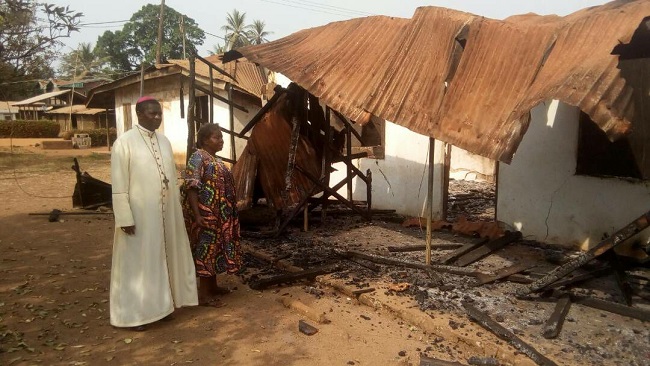
Cameroon’s reconstruction plan for the troubled English-speaking regions is working despite ongoing violence, according Archbishop Andrew Nkea Fuanya of Bamenda.
The plan was established on April 3, 2020, to rebuild infrastructure that have been shattered by a separatist war in the African country’s North West and South West regions.
Cameroon’s two English-speaking regions which constitute 20 percent of the country’s 27 million people has been the center of fighting to create a new country, which separatists call Ambazonia.
The crisis began in 2016, when teachers and lawyers in the two regions took to the streets to protest what they perceived as the over-bearing influence of French in British system schools and common law courts which have existed since the former British Cameroon joined with French Cameroon in 1961. (The two Cameroons had been a single German territory until the end of World War I, when it was divided by the two Allied powers.)
The government responded to the protests by firing on the demonstrations with live ammunition, leading to the separatist rebellion the next year. The separatist war has left at least 6000 people dead and over a million displaced, according to the International Crisis Group.
As of June 2019, at least 80 percent of schools in the two regions were closed, according to UNICEF, affecting over 700,000 children.
The health sector has also been hard hit. In 2020, the then-coordinator of the Presidential Plan for the Development of the two regions, Paul Tasong, told Crux that “in 2016, we had some 170 doctors in the hospitals and health centers. By 2019, that situation fell to 71 doctors, and the specialists became very rare. And we noticed that the rate of women giving birth to children at home in 2016 was slightly above 2 percent in the two regions, but unfortunately by 2019/2020, this situation degraded, and up to 9 percent of women gave birth to children at home. This is catastrophic. The same situation is reflected in the rate of vaccinations in the two regions.”
The Reconstruction Plan calls for the repair or replacement of 350 schools, 90 health centers, and 40 bridges. In addition, over 12,000 homes that have been destroyed will need to be replaced. Some 700 farmers will also have to be recapitalized and 200,000 people who lost official documents – including school certificates, national certificates and civil status documents –will have to be assisted in replacing them.
Speaking March 29 during a visit by Balungeli Confiance Ebune, the Chairman of the Steering Committee of the Presidential Plan, to the St. Joseph School in Bamenda, Nkea said the plan was ‘building back better.”
“We [the Catholic Church] have benefitted in a very big way from the renovation of schools, and to ensure that children go back to school in better conditions than before,” the archbishop said.
A typical example was the St. Joseph nursery and primary school in Bamenda’s Old Town. It had been destroyed, but has now been completely reconstructed.
“The reconstruction respects the principle of building back better,” Nkea said.
He noted that it wasn’t only the Catholic Church that has benefitted for the reconstruction plan. Other Christian denominations and religions have benefitted as well, including the city’s Islamic primary school.
The archbishop emphasized that “the plan is working, and those still skeptical should understand.”
He called on all to work together to ensure that “we get back our society in a better way than it was before.”
During an evaluation meeting to assess the level of reconstruction, Ebune called on young people to “continue to join the active forces of the nation for long lasting peace and development to be achieved.”
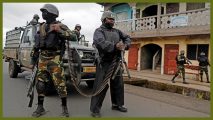
But experts have questioned the government’s decision to rebuild in the middle of continued fighting. On the same day the archbishop was making his remarks, the military was engaged in what critics have described as a scorched earth policy in Kumbo, one of the largest towns in Cameroon’s North West region.
A Catholic sister who requested not to be named for security purposes told Crux that “separatist fighters in Kumbo carried out deadly attacks targeting the military on March 29. The fighters detonated an explosive device that hit an armored car, and it was followed by a rocket-propelled grenade that they used on the military unit. The military retaliated by burning homes and property.”
Professor Verkijika Fanso of the University of Yaoundé told Crux that it was practically impossible to effectively carry out reconstruction while the fighting seems to be intensifying.
“Let them first stop the war,” he said. “Just [on March 29], several homes were burnt in Kumbo. How do you reconstruct while destroying at the same time?”
Source: Crux










10, April 2023
The Resurrection of Jesus: God’s Verb in the Grammar of Human Existence 0
When we studied English Grammar at St. Joseph’s Primary School in Mamfe, Cameroon several years ago, we were taught that a verb is a word that it used to describe an action, that is, the doing part of a sentence. A verb therefore connotes an occurrence. To say, therefore, that the Resurrection of Jesus of Nazareth is God’s verb in the grammar of human existence implies that the Resurrection is the action of God that fully captures, unravels, shapes, defines, and orients the meaning of human existence, of who we are in terms ofsource, purpose and the destiny of human being. The French philosopher, Blondel, pointedly asked in his phenomenology of human action: yes or no, does life make sense and does life have a meaning? To understand the Resurrection as God’s verb, God’s action in the totality of human existence points to the person of Jesus as the interpretive key to human existence.
To understand the Resurrection of Jesus one might find a helpful framework in the philosophical consciousness that came about, thanks to the problem of injustice, pain, misery, in fact, evil in the world. Plato offers a fitting capture of this in the Apology, as Boethius does in the Consolation. The protagonists in both texts are unjustly imprisoned. And so, the question appears on the radar: What is the outcome for the innocent who wrongly suffer in this world? Does evil, pain, injustice and the finality of evil, death, have the last word? Greek philosophy responded with a resounding NO! It explained itself by pointing to the immortality of the human soul, which it understood would outlive the body. Pain, suffering and death affect only the body and not the soul. The immortality of the soul is therefore philosophy’s solution to the human problem of evil, injustice, and death. And that explains Plato’s conviction that evil cannot afflict the good person, because evil cannot afflict the soul. But the immortality of the soul does not correspond to the reality of what Christianity understands by Jesus’ Resurrection from the dead, for it speaks only about half of the human reality, the soul, leaving the body to rot. Philosophy or human reason alone, therefore, cannot establish or bring about the reality of the Resurrection. Human reason encounters an unsurmountable barrier in this regard.
The next step is the consciousness that developed in the inner experience of Israel’s faith. Judaism, when confronted by the question of evil, pain, and death, gradually arrived at the consciousness of the reality of the Resurrection. The high mark of this consciousness is found in Ezekiel, Maccabees, and Daniel. The most explicit articulation of Biblical Israel’s understanding of the Resurrection, however, is embodied in the response that Martha makes to Jesus before the tomb of his deceased brother, Lazarus: Yes, I know that he would rise again on the last day (John 11:24). The understanding of the Resurrection in Judaism was therefore tied to the eschaton, to the last day. To talk of a Resurrection within history was entirely foreign to the Jewish religious imagination, and as Ratzinger points out in Jesus of Nazareth, this fact explains the Jewish rejection of the Resurrection of Jesus. If Jesus did in fact rise from the dead, then history was supposed to have come to an end. The Resurrection of the just meant God rewarding the good and punishing the bad. The problem of pain and evil would only be finally resolved at the end of history. Once again, as with Greek philosophy, Judaism as a religious experience, does not capture the full import of what Christianity understands when it professes faith in the Resurrection of Jesus. By limiting Resurrection to eschatology, Judaism misses out on what is most essential about faith in the Resurrection.
And this brings us now to the question, what is the nature of Jesus’ Resurrection. Aquinas captures this succinctly: Jesus bodily died. Jesus is bodily risen. In this way, Aquinas avoids the two pitfalls that can eclipse the true meaning of the Resurrection, namely, Platonization and Judaization. We must not delve too deep into the metaphysics of both positions here. Summarily, we can say two things: Firstly, that the Resurrection of Jesus is not the immortality of the soul. And secondly, that the Resurrection of Jesus cannot be limited to eschatology or more precisely, that Resurrection faith should not be restricted to the end of human history. Overcoming these two limitations brings us to the central nexus of the matter, which is, what difference, then, does the Resurrection of Jesus make?
A fitting response to this invites us to understand the Resurrection, not as noun but as a verb. God has done something in Jesus of Nazareth that has implications for the world. By raising Jesus from the dead, God has shown that God is interested in doing something about evil, pain, injustice, and sin in the world. God is not sitting on a distant sofa in heaven with a glass of red wine in his hand, watching humans wallow in pain, suffering, evil, and misery. With the Resurrection, God has shown that he is not a passive spectator. God has made an irrevocable intervention in history, which is no longer a series of neutral, disinterested events, but above all, salvation history.
With the Resurrection of Jesus, the Christian enters into a different time zone, in which salvation history permeates world history. This explains why John Paul II declared and rightly so, that we are an Easter people, and alleluia is our song. It means that with the Resurrection, we have the power of God to shape history from within. God did not wait for history to end. God acted in history regarding injustice and evil. And so must we. And that is the challenge and invitation of living the life of the Resurrection today. And that is why the Resurrection is essentially a verb and not a noun. German Idealism understood the Resurrection from a somewhat nominalist perspective that failed to engage the reality of the Resurrection. Kant reduced it to the resilience and survival of the moral law in Religion Within the Boundaries of Mere Reason. Hegel completely ignored it in his Life of Jesus. Both of them could not move from the noun to the verb.
But with the Resurrection understood as verb, God’s energy enters history and breaks the barriers of physics as put forth by Newton and Einstein. With the Resurrection, we enter, to use a category of Teilhard de Chardin, an evolutionary leap that while being quantitative and qualitative, still transcends the former and the latter. Hence, we can live differently, in the here and now. We do not have to wait for the eschaton to right wrongs and to do something about evil. We have power from beyond to make a positive difference in the world of the here and now. We have power to transform our world into the image and likeness of God. That is the mission and mandate that the verb of the Resurrection bestows on believers. And so, yes, we are truly an Easter people, and alleluia is our song (St John Paul II), because in the power of the Risen Christ, we can do something about evil, pain, misery, and injustice in the world, by living the Easter life which is a life of a different time zone in the here and now, a life that allows salvation history to permeate and shape world history, so much so that history becomes His-story, the story of Jesus Christ, the Risen Lord
By Fr Maurice Agbaw-Ebai