7, December 2021
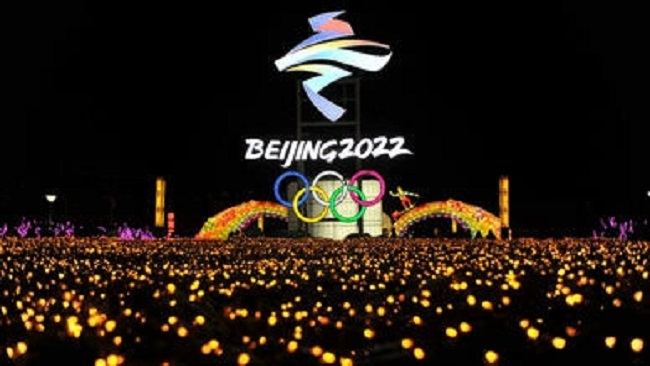
US announces diplomatic boycott of Beijing Winter Olympics but will send athletes 0
The United States Monday announced a diplomatic boycott of the 2022 Beijing Winter Olympics, a calibrated rebuke of China’s human rights record that stops short of preventing US athletes from competing.
The decision comes after Washington spent months wrangling with what position to take on the Games, hosted in February next year by a country it accuses of perpetrating “genocide” against Uyghur Muslims in the northwestern Xinjiang region.
There was no immediate reaction from Beijing, but the Chinese foreign ministry had earlier threatened “resolute countermeasures” to any such boycott.
The decision was broadly welcomed by rights groups and politicians in the US, where President Joe Biden has been under pressure to speak out against Chinese rights abuses.
White House Press Secretary Jen Psaki said the administration would send no diplomatic or official representation to the Games given China’s “ongoing genocide and crimes against humanity in Xinjiang and other human rights abuses.”
Sending official representation would signal that the Games were “business as usual,” Psaki said.
“And we simply can’t do that.”
“The athletes on Team USA have our full support. We will be behind them 100 percent as we cheer them on from home,” she added.
The International Olympic Committee said the sending or not of officials was a “purely political decision for each government, which the IOC in its political neutrality fully respects.”
The announcement “also makes it clear that the Olympic Games and the participation of the athletes are beyond politics and we welcome this,” an IOC spokesperson said.
Diplomatic high-wire act
US-China relations hit a low point under Biden’s predecessor Donald Trump, with a massive trade war and incendiary debate over how the Covid-19 virus first emerged in the Chinese city of Wuhan.
Biden has sought to re-engage with Beijing, while at the same time focusing on strengthening traditional US alliances to counter China’s ever-growing economic clout and military presence across the Indo-Pacific region.
The Olympics boycott is part of a complex diplomatic balancing act.
Biden’s administration has left Trump-era trade tariffs on China in place and continues to order naval patrols through sensitive international sea lanes that China is accused of trying to bring under its control.
However, with Biden also emphasising the need for dialogue, critics on the right say he is being too soft.
This makes the looming Olympic Games a political flashpoint.
Members of Team USA, their coaches, trainers and other staff will still receive consular and diplomatic security assistance, State Department spokesman Ned Price said.
When asked about calls for private businesses to end any Winter Games sponsorships, he stressed that the decision was up to them.
“It is not in this country — unlike other countries — the role of the government to dictate the practices that the private sector should adopt,” Price said.
‘Powerful rebuke’
Campaigners say that at least one million Uyghurs and other Turkic-speaking, mostly Muslim minorities have been incarcerated in camps in Xinjiang, where China is also accused of forcibly sterilising women and imposing forced labour.
Bob Menendez, the chair of the powerful US Senate foreign relations committee, welcomed the diplomatic boycott as “a powerful rebuke” of the “genocide in Xinjiang.”
He and top House foreign affairs Democrat Gregory Meeks called for other countries to follow the US lead.
Meeks warned the international community should not be helping China “whitewash its atrocities against Uyghurs and other minorities.”
But Republican Senator Tom Cotton called it a “half measure, when bold leadership was required.”
“The United States should fully boycott the Genocide Games in Beijing,” he said in a statement.
The last full boycott of the Olympics by the US was in 1980, when President Jimmy Carter withdrew in protest against the Soviet Union’s invasion of Afghanistan.
Human Rights Watch called the Biden administration’s decision “crucial” but urged more accountability “for those responsible for these crimes and justice for the survivors.”
Earlier Monday, Chinese foreign ministry spokesman Zhao Lijian warned the Games were “not a stage for political posturing and manipulation” — in response to reports a boycott could be imminent.
“If the US is bent on having its own way, China will take resolute countermeasures,” he vowed.
Liu Pengyu, the spokesperson for the Chinese embassy in the United States, said that politicians calling to boycott the Games “are doing so for their own political interests and posturing.”
“In fact, no one would care about whether these people come or not, and it has no impact whatsoever on the #Beijing2022 to be successfully held,” he tweeted.
Coming just six months after the pandemic-delayed Tokyo Summer Games, the Winter Olympics will be held from February 4 to 20 in a “closed loop” bubble because of Covid-19 restrictions.
“To be honest, Chinese are relieved to hear the news, because the fewer US officials come, the fewer viruses will be brought in,” tweeted the Chinese state-owned tabloid newspaper, Global Times.
Source: AFP














7, December 2021
2021 AFRICA CUP OF NATIONS: New doubts on Cameroon’s ability to host 0
A former Technical Director of the Confederation of African Football, Abdel Moneim Shatta has cast doubt over the hosting of the 2021 Africa Cup of Nations in Cameroon.
The Afcon is scheduled to be hosted by Cameroon and is expected to take place from January 9 to February 6, 2022.
The tournament was originally scheduled to be played in June and July 2021 but Caf announced on January 15, 2020, that due to unfavourable climatic conditions during this period, the tournament would take place from January 9 to February 6, 2021.
However, on June 30, 2020, Caf moved the tournament for the second time, then to January 2022 following the effects of the Covid-19 pandemic across the continent, whilst retaining the name 2021 Africa Cup of Nations for sponsorship purposes.
However, according to Shatta, the tournament is now facing uncertainty and could be cancelled because the host country is facing problems with finishing the preparations.
“The committees that went to Cameroon saw that the time was not enough to finish the preparations for the African Nations Cup, but Fifa is taking over this issue and opened an office there to run things,” Shatta told Al Hayah TV.
“Cameroon when it requested to host the Nations Cup, the number of participants in the tournament was 16 teams, not 24, and the opening stadium in Cameroon so far there is a great deal of confusion around it.
“If the tournament is not held on time, no country is able to host the tournament even if it is postponed for 3 or 4 months, and if it is not held on time, it will be cancelled.
“Things in the African Union are not acceptable to me, and no one gives us consideration here in the continent of Africa, and it was easy for the President of the International Football Association to find solutions to the conflict between the date of the Cup of Nations and the Club World Cup, there’s huge disrespect to the tournament and Africa playing the two tournaments at the same time’.”
Shatta also revealed the possibility of the tournament being moved to Qatar if Cameroon fails to beat the deadline.
“Caf is led by Fifa now since the appearance of Fatma Samoura on the scene, everything is possible, and it’s up to Fifa to approve that the Afcon be held outside the continent.”
With the Afcon expanded from 16 to 24 teams, at least six venues are expected to be used across five Cameroonian cities.
The six stadiums selected to host matches are the Olembe Stadium and Stade Ahmadou Ahidjo in the capital Yaounde, the Japoma Stadium in Douala, the Limbe Stadium in Limbe, the Kouekong Stadium in Bafoussam and the Roumde Adjia Stadium in Garoua.
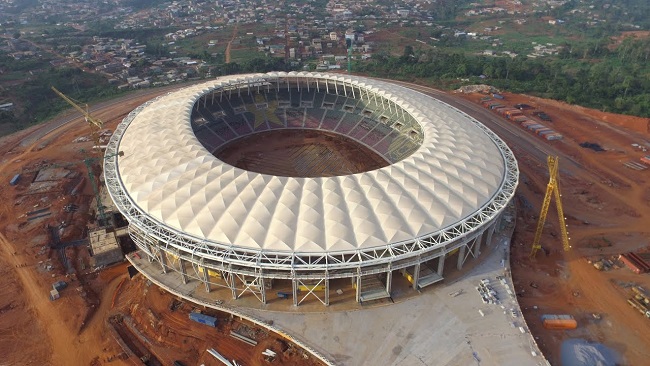
The opening match of the tournament between Cameroon and Burkina Faso and the final are set to take place at the newly built 60,000 seater Olembe Stadium in Yaounde.
Source: Goal.com