3, April 2026
Cameroon, Switzerland sign MoU positioning Obala Institute as Central Africa Agri-Research Hub 0
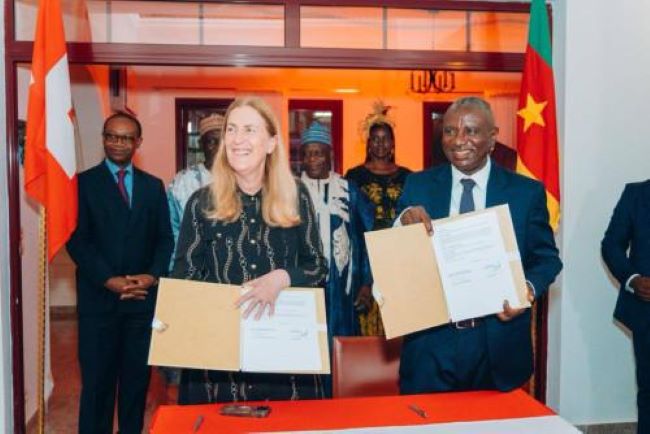
Cameroon and Switzerland have signed a memorandum of understanding (MoU) in Yaounde, marking a new phase of agricultural cooperation and positioning the Agricultural Institute of Obala (IAO) as a key partner in research, training and agribusiness in Central Africa. Signed on March 25 at the Swiss Residence, the agreement brings together the IAO and three Swiss institutions: Agroscope, FiBL and the Fondation Rurale Interjurassienne (FRI). The ceremony, held during a reception for Switzerland’s State Secretary for Economic Affairs Helene Budliger Artieda, was attended by senior Cameroonian officials on the sidelines of the WTO’s 14th Ministerial Conference (MC14).
The MoU establishes a framework to deepen technical cooperation by facilitating the mobility of researchers and students, strengthening institutional linkages and expanding joint research programmes. It designates the IAO as Switzerland’s main partner for agricultural research in Central Africa and builds on more than two decades of cooperation with the Obala-based institute, which currently trains over 2,000 students.
The partnership is expected to enhance capacity development in agronomy, support knowledge transfer in organic and productivity-focused farming systems, and reinforce links between training institutions and Swiss companies operating in Cameroon. The focus on research, training and applied innovation aligns with efforts to improve agricultural productivity, value chains and market access, areas considered critical to the sector’s economic contribution.
Speaking at the event, Switzerland’s State Secretary for Economic Affairs, Helene Budliger Artieda, highlighted the shared priorities underpinning the partnership.
“As we do not have as much land as Africa, we focus on productivity so that agriculture benefits the farmer and their business. We have understood that education is crucial for success. That is why we share common ideals with the IAO, which has a long tradition in agriculture and in training young people,” she said.
On his part, the founding director of the IAO, Louis Ndjie, underscored the operational approach of the partnership, stating: “What is interesting with Swiss cooperation is that it works over the long term. They are very demanding in terms of quality and governance.”
According to officials, the agreement comes at a time when Cameroon is seeking to strengthen its agricultural sector through improved yields, skills development and integration into regional and international value chains. The designation of the IAO as a regional partner also positions the institute as a hub for collaboration with international stakeholders, with potential spillovers for agribusiness development and employment.
The initiative extends longstanding bilateral ties between Cameroon and Switzerland into areas with direct economic relevance for food production, trade and rural enterprise development.
Source: Business in Cameroon



















27, August 2026
Cameroon says 5G groundwork nearly complete 0
Cameroon’s preparations for fifth-generation mobile technology are nearing completion, but commercial deployment will still depend on operators completing network investments and on several infrastructure constraints being addressed.
The Telecommunications Regulatory Board (TRB) says most of the preliminary work required before the rollout of 5G has been completed. No date has yet been announced for a commercial launch. ART Director General Prof Philémon Zo’o Zame outlined the progress during an interview with State broadcaster CRTV on August 18. He said the regulator had consulted the Presidency of the Republic, the Prime Minister’s Office and the Ministry of Posts and Telecommunications as part of the preparations.
TRB has also reviewed operators’ investment plans and inspected data centres and network sites to verify whether announced spending commitments were being implemented.
“We have worked with operators on their investments and visited the field to verify whether the announced investments were effective. We have practically completed the entire process required before launching 5G,” Prof Zo’o Zame said.
What Still Stands Between Cameroon and 5G
Despite that progress, several requirements remain before commercial deployment can begin. Reliable electricity supply is one of the constraints identified byTRB. The regulator has held discussions with energy suppliers because mobile sites, data centres and other network infrastructure require stable power.
Fibre-optic capacity is another priority. TRB said it has consulted passive infrastructure operator IHS Cameroon and State-owned telecoms operator CAMTEL, with discussions involving CAMTEL focusing particularly on the fibre infrastructure needed to carry the higher volumes of data expected from 5G services.
Spectrum management also remains part of the preparatory work. TRB is addressing interference caused by television, radio and other installations operating without appropriate frequencies, which Prof Zo’o Zame said can disrupt mobile networks. The regulator is also working on the frequency bands to be assigned to operators and the technical conditions needed to maintain network stability before and during deployment.
Operators, meanwhile, are being required to step up investment in networks and equipment. MTN Cameroon has already announced an investment programme of nearly $300 million for the 2025-2027 period. During an ART inspection of the operator’s facilities in Douala in April 2026, MTN said the programme would support network expansion, stronger service reliability and technologies such as IMS-VoLTE as part of its preparations for 5G.
The spending comes as demand for mobile data continues to rise. TRB’s 2024 Electronic Communications Market Observatory shows that investment in the sector increased by more than 35% to nearly CFAF194.5 billion. Total industry revenue exceeded CFAF1.022 trillion, up 18% from the previous year, while the sector’s contribution to gross domestic product rose from 2.92% in 2023 to 3.16% in 2024, according to the regulator.
Source: Business in Cameroon