21, September 2018
Southern Cameroons Crisis: Military brutality makes school resumption impossible 0
For more than two years, schools in Cameroon’s English-speaking regions have been closed following a peaceful demonstration by lawyers and teachers in 2016 against injustice and widespread marginalization.
The demonstrations were followed by the violent military action and this has pushed the country into a military conflict with government troops killing more than 3,000 civilians. The schools are bound to remain closed as government troops are killing students and teachers.
Last week a teacher of the Cameroon Protestant College (CPC) Bali, Mr. Ndeh Blaise, was gunned down by a trigger happy soldiers for no reason. The teacher, who was going to town to run some errands, was stopped by soldiers on patrol. He was asked to present his national identity card, which he promptly did. He was asked by one of the soldiers to undress. He reluctantly did that given that there were some passengers around some of whom were women.
He was later ordered by the soldier to face a wall which he did without question. He was shortly after shot to the leg by the soldier and while lying on the ground, the other passengers rushed to help him, but the said soldier ordered them to stay away or they would be killed. The other passengers were ordered to leave and a moment after, they heard gunshots. It was Mr. Ndeh who had taken a bullet to the chest, a bullet that killed him instantly.
With situations like this, it is hard for schools to resume. Parents are scared of sending their children to school and teachers are reluctant to go to school as both the country’s military and Southern Cameroonian fighters have made them their target.
Many teachers and students in the English-speaking regions have simply migrated from the region for fear of being killed. The conflict in the region has taken unacceptable proportions and the population is moving out.
Last week, things took a turn for the worse. Huge crowds could be seen traveling from the English regions to East Cameroon where they hoped they would find a safe place. The situation was overwhelming and even the South West governor, Okala Bilai, who once called the people of his region “dogs”, had to plead with the residents to cancel their trips. But his pleas fell on deaf ears.
The fear was prompted by threats by Southern Cameroonian fighters to implement a strict movement of goods and persons within the region from September 20, 2018 to October 7, 2018. It should be indicated that Cameroon will be having presidential elections on October 7, 2018 and this has ignited a new wave of fighting and killing in the region as the government seeks to mop up the environment.
Campaigns for presidential elections scheduled for October 7, are currently underway and it is generally held that Mr. Biya, considered by the ruling crime syndicate as its natural candidate, will emerge as the winner in an election that has already been rigged.
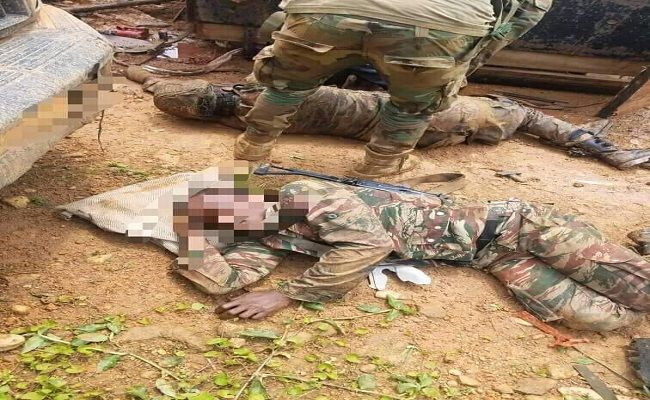
The movement of the population has prompted new tensions in the cities vacated by the population. As the crowd moves out of Southern Cameroons, the country’s military has transformed the place into a slaughterhouse. Pictures from Njikwa and Bafut speak to the type of carnage that is taking place in towns deserted by the population.
While the majority of the population is out, those who do not have relatives out of their main towns have opted to stay and this is costing them their lives. Government militias dressed in the country’s military fatigue are on a rampage. The government has trained a group of Beti killers and unleashed them on the Southern Cameroonian population. A massacre of a global scale is unfolding in many villages and towns in the English-speaking regions.
Pictures emerging from the region are too graphic to be shown. The story is hard to tell. Young men hiding in their homes have been reduced to a mass of flesh as army soldiers move from house to house to carry out a mission they have been handed by Defense Minister, Joseph Beti Assomo, and Territorial Administration Minister, Paul Atanga Nji.
A source close to the government has hinted that the ministers of defense and territorial administration have hatched a plan to end the fighting through brute force. They believe that once many people are killed; there will be no need for an inclusive dialogue. They want to keep the system as it is, even when Cameroonians are complaining and feel that reforms are necessary.
“They have trained killers to kill young able-bodied Southern Cameroonians in the region. This is not the right time for any young man to be in the Southwest and northwest regions. The government has decided to cleanse the region and its militia and military are working hand in glove to implement a plan put in place by the defense minister and his collaborators,” the source said.
“The days ahead will be the bloodiest. The government has no respect for human life. I am really ashamed to be called a Cameroonian. I wish I could express myself in public, but the position I hold makes it hard for me to speak. I am dying in silence. Our country is going through the toughest moments in its history. How can a complaint by a peace-loving people be allowed to degenerate into a civil war,” he added.
The source, which elected anonymity, asked why the international community was not taking this issue seriously. “Why has the international community abandoned Southern Cameroonians? When will they come in to end this carnage? There is a massacre unfolding in many parts of the English-speaking region. The world has to act before the militia and military kill everybody,” he said.
While the killings are going on, the Yaoundé government has decided to seal its leaps. The massacre speaks to a well-orchestrated genocide. The government of Cameroon has decided to wipe out all adult males from certain communities as a move to end any opposition it might face in the region.
With presidential elections on the horizon and October 1 which is considered by many Southern Cameroonians as their independence day, the government is hard at work to ensure that it faces no challenges in the two English-speaking regions of the country.
Ever since the slaughtering of Southern Cameroonians started in October 2017, the country’s president, Paul Biya, who is also known as the monarch, has not expressed any regret about what is happening in his country.
Even with the influx of Southern Cameroonians into East Cameroon, the Yaoundé government has not made any public statements regarding the welfare of those fleeing the conflict in the region.
On the contrary, the defense minister has only issued a press statement indicating that among those who have fled the carnage in the Southwest and Northwest regions to Yaoundé, are some terrorists who have to be neutralized.
The press statement therefore implies that government security forces will be carrying out attacks and searches in neighborhoods inhabited by Southern Cameroonians. The government seems to be rolling out its genocide plan and it is clear that Southern Cameroonians are not safe even in the nation’s capital.
The Southern Cameroons crisis which started as a demonstration by teachers and lawyers in Cameroon’s English-speaking regions has finally migrated to East Cameroon, as thousands flee Southern Cameroons following threats from Southern Cameroonian fighters to stage sporadic attacks on soldiers and punish civilians who have been cooperating with the Yaoundé government.
All major cities in Southern Cameroons have become ghost town as helpless civilians struggle to find a safe place before the expiry of the deadline given by the fighters. Buea, Mamfe, Limbe, Bamenda and Kumba have all witnessed huge crowds struggling to leave, following warnings from Southern Cameroonian fighters that from September 20, 2018, all roads will be blocked and there will be no movement in the region.
The crisis in Cameroon will not be coming to an end anytime soon. The devil is at work in that part of the world. Government troops and the fighters are all committing atrocities that could not have been associated with Cameroon a few years back. The world has to step in if the carnage must stop. Mr. Biya has finally achieved his goal – leave Cameroon with a civil war once he leaves the stage. The country has finally inherited the dictator’s legacy that has affected many countries on the continent.
By Kingsley Betek in Bamenda


21, September 2018
Cameroon’s Worsening Anglophone Crisis Highlights Need for Dialogue and Inclusion 0
Anglophone Crisis – Though Boko Haram’s lethality and tactical innovation, al-Shabaab’s resilience, and the brokering of partnerships by al-Qaeda in the Islamic Maghreb (AQIM) have rightfully dominated analysis of political violence in Africa, other situations are also increasingly relevant for those concerned with political violence in Africa.
With the escalation of the crisis in Anglophone Cameroon and the October general elections presenting a risk of further increased tensions, the evolution of the country’s conflict and its implications for political violence across the continent is worth noting.
Much can be learned about conflict escalation from the Cameroonian government’s reaction to the calls of Anglophone activists, which has pushed the country towards violent conflict and has made the prospects for peaceful dialogue ever dimmer. The Cameroonian government, historically, has not effectively integrated and engaged its Anglophone population through inclusive governance practices. And since protests erupted nearly two years ago, the Biya administration has not seemed inclined to engage in peaceful dialogue to draw down the crisis. Taken together, these suggest that the scale of the conflict, and its lethality, are likely to escalate.
Origins of the Crisis
The origin of friction between Anglophone and Francophone populations in Cameroon can be traced back to the colonial era. Originally under German rule, Cameroon was partitioned between the French and British into two territories, both governed as trusts. Anglophone and Francophone Cameroonians were unified under a federal system in 1961 after a plebiscite was held in which voters were given a choice to join either Nigeria or Cameroon. It is worth mentioning that, among Anglophone Cameroonians, nearly 60 percent of Anglophones in the majority-Muslim northern region voted to join Nigeria, while roughly 70 percent of Anglophones in the majority-Christian southern region voted to join Cameroon.
In 1972, under President Ahmadou Ahidjo, the federal system was discarded in favor of a united, bilingual republic. To this day, however, Anglophone regions are governed by Common Law, whereas the rest of the country is governed by a civil code. Debates over the extent to which the country is dominated by Francophones, what sub-national authorities that the two Anglophone regions should be granted, and various cultural matters, have resulted in a proliferation of Anglophone activist groups and general politicking around the issue. Groups that may seem at face value to be apolitical—including teachers’ unions and legal associations—have taken up Anglophone issues as a part of political campaigns.
Anglophones currently make up roughly 20 percent of the country’s population and are undeniably under-represented in President Paul Biya’s government. Since taking power in 1982, less than 11 percent of the ministers appointed by Biya have been Anglophones. At present, just three of the 33 generals in the country and six of the 63-person cabinet members are Anglophones. Even within Anglophone districts, government jobs are often given to Francophone appointees.
Escalation of the Crisis
Though longstanding, the conflict between Anglophone and Francophone Cameroonians took a lethal turn in 2016 when widespread, peaceful protests and strikes emerged. Media reports focused on the role of Common Law lawyers advocating to abandon the Cameroonian Bar Association. Other groups, including the country’s teachers, then joined the protests. After weeks of strikes, gendarmes used tear gas against protesters. Shortly thereafter, four people were killed in clashes with security forces during a protest in Bamenda that arose after the Cameroon Teacher’s Trade Union called for a strike. Reports also emerged in late November of sexual violence against students at the University of Buea by Cameroonian security forces.
As the protests continued, the Biya government also began detaining and arresting Anglophone activists and journalists and shutting down newspapers and radio stations. Beginning in January 2017 the government cut or greatly slowed down internet services in Anglophone regions. The internet shutdown ended up being one of the longest recorded in sub-Saharan Africa, lasting just under 100 days. The shutdown was economically harmful—given the region’s reputation as “Silicon Mountain”—and also hamstrung efforts to keep track of events in the region.
At the same time, the government also engaged in some conciliatory measures. A National Commission on the Promotion of Bilingualism and Multiculturalism was established and was accompanied in short order by the “appointing [of] Anglophone magistrates and bilingual teachers, and [the] releasing from prison some Anglophone civil society leaders and activists.” According to Amnesty International, however, “these moves were viewed by the Anglophone movements as being too limited,” and the protests continued.
The groups that have emerged to advance Anglophone rights have advocated different means and different ends. The vast majority of Anglophone activists advocate for peaceful resolution of the conflict, but as government repression has intensified, groups who advocate secession, or worse, violence, have become more significant. Some groups advocate for more federalism, while others call for secession and the establishment of an independent state called “Ambazonia.” A number of armed separatist groups also formed an umbrella organization, the Ambazonia Recognition Collaboration Council (ARCC), claiming to have thousands of fighters.
Through the spring and summer of 2017, however, Anglophone protesters steadily escalated their tactics. Over this period, at least 42 schools and a number of market stalls in Anglophone Cameroon were burned down. A recent report catalogued a number of instances in which Anglophone separatists targeted civilians who did not engage in the demonstrations. The Biya government imposed curfews and increased the security sector’s presence in the region in response. Despite this, Anglophone separatists declared independence on October 1, 2017; in clashes with the state security forces that day, reports indicated that at least a dozen people were killed and 40 arrested.
By November 2017, separatists were making attacks on the government more frequently and brazenly. In the Northwest province, for example, they began targeting police with homemade explosive devices. The Biya government stepped up its repression and arrests, labeled the separatists “terrorists” by comparing them to Boko Haram, and declared war on them.
Actions taken by armed separatist groups and the government continued to worsen. Separatists are suspected to have kidnapped nine employees of a construction firm and in response to the arrest and repatriation of Anglophone activists that fled to Nigeria, an armed separatist group called the Ambazonian Defence Force (ADF) began abducting government officials. Soon thereafter, a Tunisian national living in Cameroon was abducted and killed, after which the government organized a rescue mission to release 18 hostages, including 12 Europeans. Just this May, a radio journalist and Anglophone activist, Mancho Bibixy, was sentenced to 15 years in prison under the country’s anti-terrorism law in a military court. Four journalists had previously been held under the act until President Biya issued a presidential decree for their release. Bibixy’s conviction has prompted speculation about what sentences could be handed down to the other detained activists and journalists.
Throughout this escalation, more than 20,000 people have fled the country for neighboring Nigeria and an estimated 150,000 have been internally displaced. The escalation has transformed a generally peaceful, albeit contentious, debate over the extent and nature of federalism in modern Cameroon into a violent, potentially-existential crisis over the future of the Cameroonian state.
What Lies Ahead?
Though a number of the characteristics of this conflict are specific to Cameroon, the events of the past few years highlight the importance of inclusive governance measures and the ramifications of heavy-handed security responses to political dissidents. In particular, the Cameroonian experience points to the need to engage moderate political dissidents early and earnestly. In waiting months before attempting to work with the Anglophone community and doing so after violence began to escalate, the Biya administration allowed hardliners and separatists within the movement to mobilize effectively and gain influence. Had the government engaged the initial protests, led by lawyers and teachers, the escalation of the crisis may have been averted.
In October, Cameroon will hold elections, which could result in increased tensions. Anglophone territories have previously thrown their support behind the Social Democratic Front (SDF), which currently controls 18 of the 180 seats in parliament. If any perception of illegitimacy in the electoral process takes hold, the current level of violence could take an even deadlier turn. Avoiding an escalation of this kind, and ultimately changing the tone of the current situation, requires dialogue between prominent moderate, non-violent Anglophone activists and the government.
www.searchzima.com