24, April 2020
EU agrees trillion euro Covid-19 rescue deal 0
European Union leaders agreed on Thursday to build a trillion euro emergency fund to help recover from the coronavirus pandemic, avoiding another all-night bust-up but leaving divisive details until the summer.
With the EU’s Brussels headquarters under lockdown – along with most of Europe – the 27 leaders held a four-hour video conference to consider proposals, rallying around a bigger common budget for 2021-27 with a recovery programme.
At around 1% of the EU’s economic output, the multi-year common budget has long been one of the most contentious subjects of debate for its members. Expanding it will not be easy, even if Italy’s Prime Minister Giuseppe Conte hailed “great progress” after the summit ended.
French President Emmanuel Macron said differences continued between EU governments over whether the fund should be transferring grant money, or simply making loans.
“Divisions remain,” Macron told reporters in Paris.
“I’m saying this sincerely: if Europe raises debt to loan to others, that won’t live up to the response we need,” he said, adding that it would saddle already heavily-indebted countries, such as Italy, Belgium and Greece, with yet more debt.
Europe is facing a severe economic shock from the spread of COVID-19, the respiratory disease caused by the novel coronavirus, which has also led to border closures across the bloc and left member states fighting over medical supplies.
European Central Bank Governor Christine Lagarde told the leaders the pandemic could cut between 5% and up to 15% of euro zone economic output, officials and diplomats said.
The euro zone’s economic growth for 2020 is forecast to contract 5.4%, which would make it the worst year since the common currency was introduced in 1999, according to a Reuters poll. That is still better than the International Monetary Fund’s latest forecast for a decline of 7.5%.
‘Political emergency’
After weeks of squabbling, the leaders approved half-a-trillion euros worth of an immediate rescue scheme to protect jobs, businesses and offer cheap credit to governments.
But with Italy and Spain hit far harder than Germany by the crisis, old enmities have surfaced across the bloc. Reaching agreement among euro zone finance ministers two weeks ago on the smaller euro rescue scheme was torturous, as the Netherlands refused an Italian demand to issue common debt.
Conte told leaders that a recovery fund should be 1.5 trillion euros in size and provide grants to EU governments to stop countries heading towards economic collapse and thereby threatening the viability of the bloc’s internal market.
“Grants are essential,” Conte said, according to diplomats who were on the video conference. “The sanitary emergency has quickly become a social emergency. But now we are facing a political emergency as well.”
Austria’s Chancellor Sebastian Kurz took the opposite view, saying on Twitter that, while Vienna was ready to show solidarity, “we should do this through loans”.
Kurz said he would coordinate with “like-minded countries”, a reference to wealthy but cautious northern countries such as Denmark, Sweden, Finland and the Netherlands, who resent having to pay for poorer southern countries they see as fiscally irresponsible.
Spain, one of the world’s worst hit countries, backs Italy’s view that a fund must issue grants, rather than loans, while France has argued for a fund that could issue common EU debt, hoping its temporary nature will calm passions.
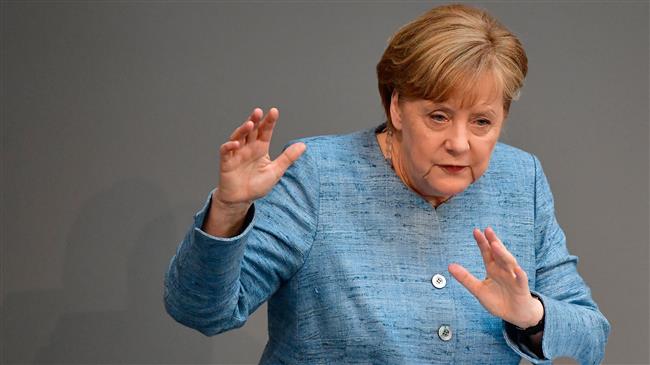
German Chancellor Angela Merkel took a conciliatory stance as she publicly called for a major recovery fund after the summit. “Things can only go well for Germany if they go well for Europe,” she said.
Leaders tasked the European Commission, the EU executive, to present detailed proposals by May 6, diplomats said.
Commission President Ursula von der Leyen said EU countries had so far handed out state aid worth 1.8 trillion euros to cushion the economic hit and that the new recovery fund would be in the order of magnitude of a trillion euros.
She said the solution was to increase the amount that each EU government would be liable to pay into a recovery fund if needed, raising it to 2% of gross national income (GNI), from 1.2% today. GNI is the EU’s preferred measure of economic output.
Most significantly, that means an implicit guarantee needed from EU governments for the Commission to issue bonds, a kind of “contingent liability”.
The Commission has a triple-A credit rating, issuing against the security of the next EU long-term budget.
“We are slowly heading towards some form of joint debt. We’ll never call it ‘coronabonds’ or ‘eurobonds’ and it will be raised by the Commission, rather than member states together,” said a senior EU diplomat involved in the summit.
Source: REUTERS























24, April 2020
Trump suggests injecting disinfectant to treat coronavirus 0
US President Donald Trump has hinted that “disinfectant” can be used to cure people infected with the coronavirus after previously suggesting chloroquine and hydroxychloroquine as treatment, which the EU said could kill patients.
Speaking during his daily briefing on Thursday night, Trump suggested injecting disinfectant into the bodies of humans to cure covid-19 patients.
“I see the disinfectant that knocks it out in a minute, one minute. And is there a way we can do something like that by injection inside or almost a cleaning,” the president said.
However, a senior health official later told reporters that federal laboratories are neither considering nor trying to develop such a treatment option.
Yet Trump, appearing to refer to the disinfectant idea, continued to say, “You see it gets in the lungs and it does a tremendous number [on the] lungs, so it would be interesting to check that.”
“We’re going to have to use medical doctors, but it seems interesting to me.
This comes as his much touted drugs – chloroquine and hydroxychloroquine – are said to have fatal side effects.
The European Medicines Agency, the EU’s drug regulator, repeated concerns on Thursday that the two drugs being prescribed in the US and some other countries as treatments for the covid-19, have yet to demonstrate any medical benefits and, therefore, should not be used outside trials or national emergency use programs.
“Recent studies have reported serious, in some cases fatal, heart rhythm problems with chloroquine or hydroxychloroquine, particularly when taken at high doses or in combination with the antibiotic azithromycin,” read a statement by the Amsterdam-based EMA.
The drugs could also cause low blood sugar, liver and kidney problems as well as nerve cell damage that can lead to seizures.
The statement came days after the largest study on drugs, commissioned by the US government, found that the two drugs had no effects on the virus and instead, hydroxychloroquine was associated with more deaths among the patients.
Trump also doubled down on his claim that sunlight kills the coronavirus, with his vice president Mike Pence saying there was “encouraging” news about how “heat and sunlight” affect the virus. However, such a claim has been rejected by experts, including, Deborah Birx, one of Trump’s coronavirus task force members.
So far, the coronavirus has affected more than 878,000 people in the US and killed over 49,700 across the country.
Source: Presstv