
11, March 2020
German footballer contracts coronavirus 0
A second division footballer was on Wednesday the first player to test positive for coronavirus in Germany as RB Leipzig became the last Bundesliga side to annouce that they would hold their weekend match behind closed doors.
Hanover 96 revealed that defender Timo Huebers had tested positive for COVID-19, saying in a statement that they insisted that no further infections were expected, as Huebers had avoided contact with his colleagues.
Their full squad and training staff were however being tested as a precaution.
“As soon as he found out that someone with whom he had been at an event was tested positive, Timo went straight to the doctor and put himself into isolation,” said Hanover’s sporting director Gerhard Zuber.
Leipzig’s announcement that their clash with Freiburg would be closed to fans comes after similar announcements involving title rivals Bayern Munich and Borussia Moenchengladbach earlier on Wednesday.
“Despite very few infected people in the Leipzig area, we want to minimise the health risk,” said sporting director Oliver Mintzlaff in a statement.
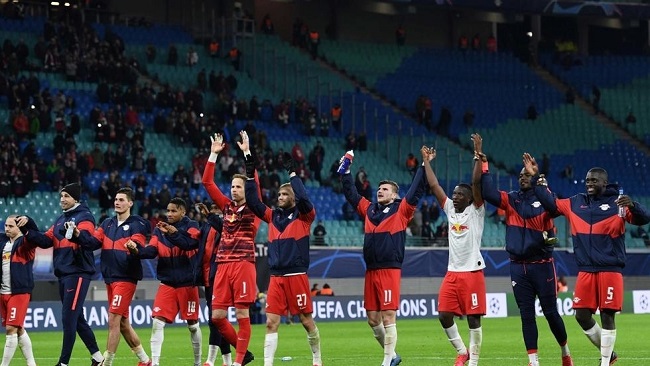
Leipzig allowed fans to attend their Champions League victory over Tottenham on Tuesday night, even after authorities elsewhere in the country ordered stadium closures.
As the number of confirmed infections in Germany continues to rise, federal states in the country are taking measures to cancel public events and slow the spread of the virus.
On Sunday, German health minister Jens Spahn called for all events with more than 1,000 people to be cancelled “until further notice”.
But the decision to close stadium doors rests ultimately with regional authorities and is made on a case-by-case basis.
Fans will also be absent for Bayern Munich’s visit to Union Berlin on Saturday, after officials in the German capital ordered the club to close its doors on Wednesday.
Elsewhere, Eintracht Frankfurt announced Wednesday that they would play their Bundesliga home clash with Borussia Moenchengladbach on Sunday without fans.
Yet in a joint press conference with city health officials, the club also said that the stadium would remain open for Thursday’s Europa League clash with Swiss side Basel.
Moenchengladbach’s home ground is in North Rhine-Westphalia state, where the biggest number of coronavirus infections in Germany have been reported.
Of 1,296 infections across the country, 484 were registered in the state, which is Germany’s most populous.
Other games affected in North-Rhine Westphalia this week include the Ruhr derby between Borussia Dortmund and Schalke and the Rhine derby between Moenchengladbach and Cologne.
The latter game, scheduled for Wednesday night, will be the first in the history of the German league to be played without fans.
Source: AFP






















11, March 2020
Southern Cameroons Crisis: Galim Attack Sows Panic in French Cameroun 0
There is an uneasy calm in Cameroon’s French-speaking towns and villages that share a border with the English-speaking regions after separatist fighters supporting the creation of an English-speaking state crossed into the French-speaking regions last weekend, killed government troops and left with huge consignments of weapons and ammunition. Civilians say they are not sure the military can protect them from the wrath of the separatists as the government claims.
Alima Matembompo, a 33-year-old farmer, cries as her husband is buried in Cameroon’s western French-speaking village of Galim on the border with the English-speaking northwest region.
Her husband, a cattle rancher who was returning from selling cattle in their village market, was killed Saturday night or early Sunday morning.
Among the nearly 20 people who have come out to bury the man is 47-year-old cattle feed supplier John Tatah, who says that since the attack took place, the village market has been closed.
“Most of us that we are doing businesses, all the businesses are grounded, so we pray for a solution to this crisis,” he said.
Tatah said most businesspeople who were about to leave the village when the attack occurred, escaped to the surrounding hills and bushes and have not been seen since.
Many villagers have also escaped to safer localities out of their village, especially to the neighboring French-speaking town of Mbouda.
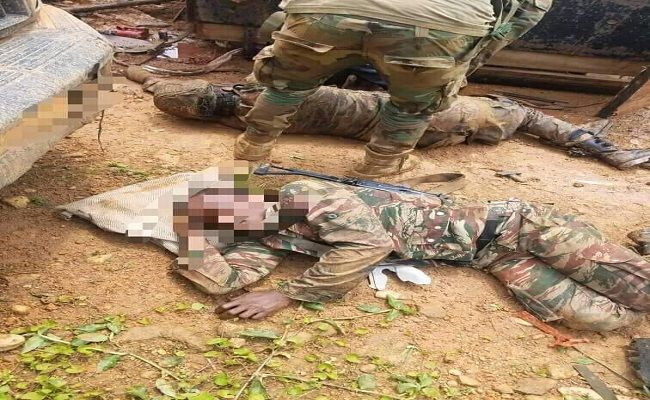
Daniel Eyoum, the most senior government official in Galim, an administrative unit in the French-speaking western region of Cameroon, said more than 60 armed separatist fighters crossed from the English-speaking region, shooting indiscriminately and creating panic. He says they interrupted the power supply and plunged the village into darkness before attacking military positions for supplies.
Eyoum said the simultaneous attacks on the military and police stations in Galim lasted for more than an hour and a half, and peace started returning only when the separatist fighters had crossed back to the English-speaking northwest region where they came from. He said four civilains, two policemen and two gendarme officers were killed. He said locals should remain vigilant and trust their military that has been deployed to protect them.
Eyoum said the separatists left with weapons and ammunition the seized from government depots. The Cameroon military confirmed the seizure but said that it had deployed additional troops to protect civilians and arrest or kill the attackers.
A video shared by the separatists on social media showed their fighters displaying at least 30 military rifles, huge quantities of ammunition and a motorcycle with a Cameroon police registration number plate they claim they also seized during the attack. In the video, the separatists say they will continue attacking the Cameroon military for supplies.
Separatist spokesperson Tapang Ivo Tanku, who is based in the United States, said in a video that their troops attacked Galim and the video they shared is that of the weapons seized from the Cameroon army. Tanku said a bomb attack was carried out by their forces in Bamenda against women who had defied their instructions not to commemorate International Women’s Day Sunday.
Deben Tchoffo, governor of the English-speaking northwest region, said a soldier was killed and eight people were wounded in the blast. He urged locals to be calm as the military has been instructed to find the culprits and protect civilians.
“We are appealing to the population to rally behind our patriotic citizens and armed forces, and I am giving my word here that measures will be taken to sanction them (the attackers), to punish them so that it should not occur any more here in Bamenda,” Tchoffo said.
The locally made explosive planted along a commercial avenue in Bamenda by the suspected separatists who had vowed to disrupt International Women’s Day activities was the largest since the separatist violence started.
At Galim, it was the fourth time the attackers had operated there. They have also been crossing over and attacking markets, schools and military positions in the neighboring French-speaking west region.
Cameroon’s anglophone rebels have been fighting since 2017 to create an independent English-speaking state in the majority French-speaking country’s western regions.
The U.N. says the conflict has cost more than 3,000 lives and forced half a million people to flee to French-speaking regions of Cameroon or into neighboring Nigeria.
Source: VOA