
3, June 2019
Southern Cameroons War: The soul on the lone star on fire 0
This is not a celebration of a tragedy. It is about the lessons to draw from the capricious nature of fire as a weapon of war. Impunity plants the seeds of tragedy in the soul of humanity. The symbolism of fire as an official weapon of war and atrocity crimes against Southern Cameroonians is evident in the fire that gutted the SONARA fire resources bank of the war against the Southern Cameroons. How can fire be this capricious?
A person on the driver seat of impunity loves being worshipped and glorified. He is worshipped as a magician of time, possessing absolute power of life and death over his people. Some called him a god, others a messiah and others, the master and controller of time. He accepted all the and rewarded the blasphemers with political and administrative positions to encourage others to join the sycophantic train. He is feared and revered not for his good services to humanity but for the impunity and ruthlessness with which he compels allegiance.
His ability to mystify and magnify his temporal and spiritual domination of the souls of ordinary frail humans is wrapped in a mythical flag of impunity. With this, he wages war against peaceful, armless people in need of peace and justice. Two grand masters of the mystical world were invited to re-enforce these powers in the full glare of all and sundry. , To his dismay, the 57 years colonised and dominated people of Southern Cameroons, with profound faith in God and the justice of their case, like St Paul, took the bait, confronted and rebuked the driving spirit of Bar-Jesus that empowers and directs his policies of impunity and criminality. In anger, he declared war against the Southern Cameroons. Fire was then decided by the civilian and military commanders under his supreme command to use fire as a cost-effective weapon to enforce the planned genocide on the Southern Cameroons. The policy was to execute the genocide against the owners with the proceeds of the oil wealth plundered from the territory and refined in SONARA. Bar Jesus was a counsellor to Sergius Paulus, the Roman Proconsul on Cyprus whom St Paul who was full of the Spirit, accused of trickery, deceit, and perverting the ways of the Lord and rebuked.
Hell is real so the Holy Bible says. This biblical truth is sacrosanct. The reality of life in hell purposively keeps the individual and collective excesses of humanity in check. Has it?
Playing a costly trick on history, the Republic of Cameroon chose the colours of its flag to be green, red, yellow with a single star conspicuously on the centre on the red. Whatever the symbolism of this flag as currently laid out, the truth that the soul of the lone star on the red is terminally disturbed, cannot be disputed. This fact is obvious even to the jaundiced eye.
A quick google search of the symbolism of the red colour, reveals that red is a colour of extremes; from the passionate to the atrocious. Within the context of many cultures and traditions, red is seen as the colour of fire and blood. In this contextual crime environment or polity, Cameroun, where an official policy exists for the perpetration of atrocity crimes with impunity, the two extremes may complement each other. In that context, atrocity crimes are committed with passionate zeal and reckless arrogance.
There is a strong symbolism about the fire which has gutted down the installations of SONARA in the town of Victoria, Southern Cameroons, Gulf of Guinea, West Africa. The economic cost of the damage caused by the fire has not been assessed yet. It is projected to be monumental.
Because this fire has torched the political and economic nerve centre of the petrol-dollar economy of Cameroun, and its affiliated partners, its occurrence no matter how, will be strongly felt. The loss suffered may be regretted by its beneficiaries and its impact strongly felt. For a while, the government of Cameroun will feel the painful impact of fire on its war economy. It will feel the loss of one of the wealth generating channels which sustained its war economy. SONARA is perceived by Southern Cameroonians as a cash-cow and symbol of colonial rule over the Southern Cameroons.
The wealth procured from SONARA and the oil resources in the Southern Cameroons sustains the regime of personal power in Cameroun and facilitates the procurement of arms and ammunitions to prosecute a meaningless war of choice that Cameroun’s President declared against the then peace plant carrying Southern Cameroons armless civilian justice and peace crusaders. SONARA is an emblematic symbol of the political and economic staying power of the regime in power in Cameroun.
The fire of hatred, aggression and arrogance of power that a leader relies on to command and superintend the perpetration of atrocity crimes with passionate alacrity may not relent after the SONARA fire incident. Since the targeting of armless civilians, women, men, children, the weak and the vulnerable is motivated by the fire of impunity from the soul and the heart, the burning of civilian settlements will continue unabated.
This official policy of targeting civilian settlement with fire and the deportation of victims from their ancestral homes, came early shortly after the declaration of war against the Southern Cameroons. It was one of the first-choice weapons of war used by Cameroun soldiers to prosecute the genocide of the Southern Cameroons. The Senior Divisional Officer for Manyu, one Oum II signed an order which was widely publicised over the radio and print media ordering the deportation of the civilian population of some thirteen villages in Manyu to make way for a scheduled military operation in those villages.
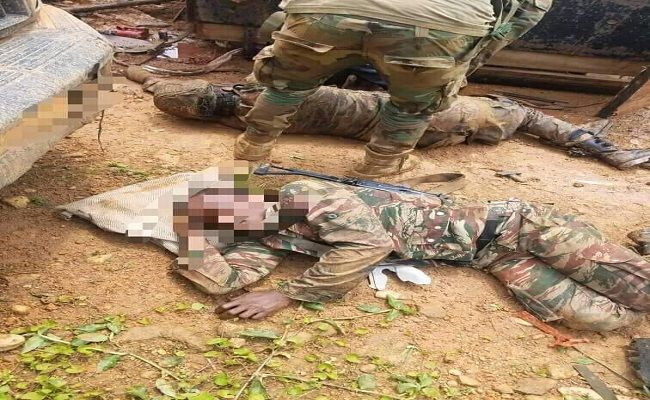
In the execution of the forced deportation order, thousands of Southern Cameroonians fled across the border to Nigeria for safety. The marauding soldiers pursued the refugees to Nigeria where many were slaughtered, and others abducted. A distinctive Cameroun government official war policy of torching civilians’ settlements was experimented through the burning down of the ancestral civilian settlements of the endangered refugees who were deported to Nigeria. By the last count, Human Rights organisations in published reports stated that about 207 towns and villages have been burnt down by Cameroon soldiers on the orders of their civilian and military commanders.
In the face of this heart wrenching record of atrocity crimes, the civilian and military commanders of the Cameroon soldiers deployed to prosecute the war have publicly praised the professionalism of the marauding soldiers in the implementation of the scorched earth policy. The charred bodies of helpless old, weak, sick, vulnerable victims of the fire devastation in villages torched by Cameroon soldiers have shocked the conscience of humanity. Far or near, we are all primary or secondary victims of the trauma of this culture of impunity, and the policy of devastating fires used by the government and army of Cameroon as weapons of war.
The world must therefore not analyse the SONARA devastating fire no matter the cause, in the abstract or as an isolated event in its symbolism. The fire and devastation of the atrocity crimes that are consuming the lives and property of Southern Cameroonians carries the same symbolism as the fire that has gutted down SONARA installations. The fire of hatred and criminal arrogance that Satan has planted into the hearts of men and women of power to enable them play “three cards” with the lives of the weak, the powerless and the vulnerable will consume them and their colonial power architecture in the Southern Cameroons and beyond. People who have chosen fire as a weapon to prey on the Southern Cameroons victims of genocide, have a lot to learn in the SONARA fire disaster, about the capricious nature of fire, its symbolism and its unbending exclusive loyalty to nobody.
Lest we forget, Mami Apey’s hut in which she was burnt to death was valuable to her far more than SONARA. Indeed, the villages and ancestral lands and property that have been devasted by the fire and impunity of atrocity crimes are more valuable to every victim dead or alive than SONARA. Theirs was their legacies and their humanity. The SONARA fire disaster is a painful symbolism that highlights the less reported or less recognised but more significant symbolism of the devastation caused by every fire and the accompanying atrocity crimes on victims and generations unborn.
For the Alices in Wonderland of one and indivisible Cameroon, the symbolism may be a strong signal and symbolism that, at long last the soul of the lone star on the central red of the Cameroon flag is irredeemably on fire. The symbolism is a rude reminder to those who have overplayed and manipulated the fire of impunity, that the moment to account for the painful reality and responsibility for the devastation they have caused or are causing is almost here.
The use of fire as a weapon of war and the devastation it has caused could have been avoided. Rather it is praised. With its security apparatus in place and a President with near omnipotent powers of impunity, could the fire have been prevented? The fact is that it was not. Indeed, the worldly power of impunity has limit. If anyone doubts, read again the encounter between St Paul and Bar Jesus.
In conclusion, I hope that the international community with the UN leading, will not wait until the entire Gulf of Guinea is on fire before they intervene. With their slow to intervene policy, this fire may ignite an inferno whose impact may be felt in all parts of the world. That will be an unpardonable betrayal of the pledge which the civilised made in 1945. In that eventuality, the pledge of “Never again” will be an empty slogan deriding the foibles and follies of a world at war with its very soul.
By Chief Charles A. Taku














3, June 2019
Thousands Defy Police in Cameroon, Demanding Kamto’s Release 0
At least 73 people have been arrested in demonstrations in Cameroon as thousands of supporters of Maurice Kamto, the man who says he won the October 7 presidential election, have defied a heavy police presence and are staging protests in several towns of the central African state. They are seeking the immediate release of their party leader, among other things, and scores of his supporters have been jailed since January.
During a protest on Saturday in Yaounde, businessman Moustapha Ali, 27, said he will continue protesting until they find justice, which he said is being denied to them by Cameroon President Paul Biya, his government and the institutions he has created.
He said no one will stop them from pressing for freedom for Kamto and those supporters arrested at the beginning of the year. He said even though Kamto has not been inaugurated, he nonetheless is legitimately the president of Cameroon.
At least a dozen people, including Kamto’s first vice president, Mamadou Mota of the MRC party, have been arrested and detained in Yaounde and Douala.
The strong police presence and their anti-riot equipment did not deter demonstrators in several towns, including Douala, Banjoun, Bafoussam and Bouda. Cameroon had banned protests in most of its cities, saying it was a threat to peace.
Lejeune Mbella Mbella, Cameroon’s minister of External Relations, warned last week during a meeting with diplomats, United Nations staff and international NGO’s that the planned protests would not be tolerated.
Mbella Mbella said any political action or initiative that questions the legitimacy and legality of Paul Biya as president of Cameroon is tantamount to undermining Cameroon state sovereignty and is intended to disrupt public peace. He says the country’s constitutional council examined and threw out as baseless all petitions filed by those who contested the election and Cameroon’s institutions.
Fidel Djoumessi, an official of Kamto’s MRC party, said the protests will continue until Kamto and his supporters are freed, the government opens up dialogue to resolve the crisis that has claimed close to 2,000 lives, and investigations are opened into why the Confederation of African Football seized hosting rights of the 2019 Africa Football Cup of Nations from Cameroon.
He said it is a scandal the government of Cameroon would decide to prohibit peaceful protests, which are a constitutional right. He said he does not understand why simple demonstrations to ask for electoral reforms and talks to return to the restive English-speaking regions should be described by the government as a threat to national security.
Police arrested Kamto, nine of his party officials and close to 200 of their supporters last January after days of peaceful protests in cities, including the political capital Yaounde and the economic capital Douala.
Similar protests took place in various Cameroon embassies around the world, including Paris and Berlin, where the pictures of president Biya were shattered.
Kamto and his colleagues were accused of inciting the protesters and now are facing eight charges, including treason, inciting violence, and disruption of public peace.
Rights groups Amnesty International and Human Rights Watch have been calling on Cameroon to release all peaceful protesters, including Kamto.
Source: VOA