
29, May 2019
Trump reiterates stance on Biden’s IQ 0
US President Donald Trump has defended siding with North Korean leader Kim Jong Un, insisting that former Vice President Joe Biden is a “low IQ” person as Kim has said.
The US President toll to Twitter Wednesday to continue the fight with his Democratic opponent in the 2020 presidential election.
“I was actually sticking up for Sleepy Joe Biden while on foreign soil. Kim Jong Un called him a ‘low IQ idiot,’ and many other things, whereas I related the quote of Chairman Kim as a much softer “low IQ individual.’ Who could possibly be upset with that?” the president tweeted.

Trump was criticized earlier in the day by a Biden aide for siding with Pyongyang on Memorial Day on foreign soil.
“To be on foreign soil, on Memorial Day, and to side repeatedly… against a fellow American and former vice president speaks for itself,” Biden deputy campaign manager Kate Bedingfield said in a statement timed after Trump’s return to the White House.
During his visit to Japan, Trump did not put aside political races back at home and promoted Kim’s description of President Barack Obama’s vice president.
“Kim Jong Un made a statement that Joe Biden is a low-IQ individual. He probably is, based on his record. I think I agree with him on that,” Trump said during a press conference with Japanese Prime Minister Shinzo Abe.
The American commander in chief initially said he agreed with Kim on Twitter.
“North Korea fired off some small weapons, which disturbed some of my people, and others, but not me. I have confidence that Chairman Kim will keep his promise to me, & also smiled when he called Swampman Joe Biden a low IQ individual, & worse. Perhaps that’s sending me a signal?” Trump tweeted.

White House press secretary Sarah Huckabee Sanders even acknowledged late Saturday that Trump agrees with the North Korean leader.
Biden has not reacted to the comments but campaign officials have brushed off the attack.
Source: Presstv



















29, May 2019
Southern Cameroons Crisis: Jailed Leader Fights Back 0
Southern Cameroons President, Julius Tabe Ayuk, is calling on Southern Cameroonians to be vigilant as some shady government agents are working hard to derail their revolution.
Mr. Julius Tabe Ayuk made the call in a message to the Cameroon Concord News Group from his jail cell in Yaounde with the objective of fighting false allegations leveled against him by some mischievous and questionable characters whose intention is to derail the revolution and perpetuate the people’s suffering.
In a message sent to the Cameroon Concord News Group Chairman, Soter Tarh Agbaw-Ebai, the determined Southern Cameroons leader alleged that Elie Smith, the self-styled federalist and journalist, was behind the malicious and mendacious messages which have been going around and casting slurs on Mr. Julius Tabe Ayuk’s reputation, alleging that the beloved Ambazonian leader had been compromised by the Yaounde government.
The message which was shared with the Cameroon Concord News Group Board Chairman, Dr. Joachim Arrey, also alleged that Elie Smith had promised, on several occasions, to visit Mr. Julius Tabe Ayuk in jail, but had not been seen in the four walls of the maximum security facility where Southern Cameroonian leaders are being illegally held by the dictatorial regime in Yaounde.
President Julius Tabe Ayuk said that he and his team had not gone that far only to be comprised by a regime whose ultimate goal is to destroy the culture and lifestyle of the indigenous people of Southern Cameroons.
Media reports have it that “Elie Smith is constantly in touch with Messrs. Chris Anu and Kometa and his trips in and out of the country without challenges raise serious questions about his relationship with the ruling CPDM,”
From the message, Mr. Julius Tabe Ayuk alleged that Mr. Elie Smith was a barefaced liar whose love for the spotlight is transforming him into a helpless and desperate propagandist for the corrupt Yaounde government, adding that “he claims to have spoken to the CPDM Director of Cabinet and they confirm that they have paid money to me.”
“We know the game he is playing. If this confusion persists, the federalists will have an upper hand. The people of Ambazonia are watching him,” the message underscored.
It should be recalled that Mr. Julius Tabe Ayuk had a stellar career both at the national and international levels and his dedication to the Southern Cameroonian cause is unquestionable. He is a man with sterling qualities and his dogged determination and steadfast loyalty to the people of Southern Cameroons have endeared him to many minds.
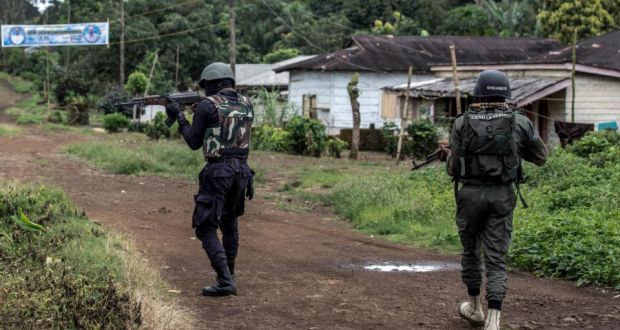
Meanwhile, as the conflict in the two English-speaking regions rages on, the country’s economy is taking some deadly blows. Many state-owned corporations have gone under and thousands of people are out of work, as restoration and government forces engage in a bloody and brutal exchange of fire.
The conflict has also created thousands of internally displaced persons and refugees in Cameroon’s neighboring countries. Nigeria alone is hosting close to 100,000 refugees while Equatorial Guinea and Gabon have seen hordes of refugees flowing across their borders.
Recently, the government of Equatorial Guinea used the United Nations Security Council’s meeting on Cameroon to urge the corrupt Central African nation to call for an inclusive dialogue as the only means to resolve the conflict that has lasted for three years and is generating a lot of challenging problems in neighboring countries.
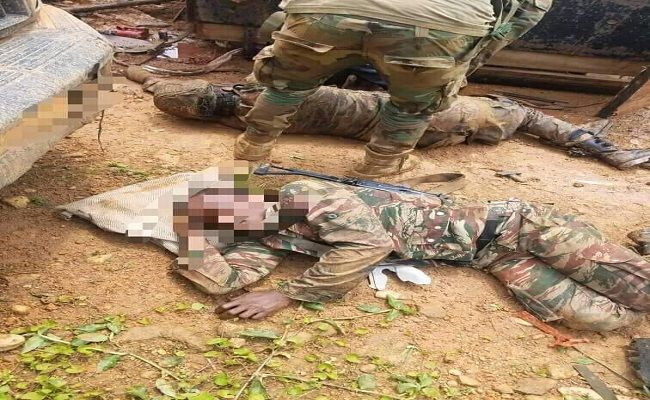
Despite appeals for the Yaounde government to address the root cause of the conflict, the country’s military has continued to kill ordinary soldiers in a bid to achieve a military success.
Last week, government forces killed an entire family in Bali, a small town some 30 miles from the city of Bamenda. In Muyuka in the Southwest region, an army soldier shot a four-month-old baby in a family home after adults fled for cover as soldiers marched into the compound to find separatist fighters.
Without any proper investigation, the government through its spokesperson, Rene Sadi, who doubles as the county’s communication minister, issued a press release indicating that separatist fighters killed the little girl because her father had quit the ranks.
This story was promptly debunked by the girl’s father who is today living in the bushes for fear of his life. Government troops have been looking for him with the objective of silencing him forever. Once more, the government’s credibility has been called to question and Americans and their allies are using all these inconsistencies on the government’s part to prove that it is incapable and unwilling to lay to rest the crisis that is very likely to split the country.
The Yaounde government which is under enormous international pressure has been issuing many press releases indicating that it is seeking a long-lasting solution to the problem, but its rhetoric is clearly at variance with the reality on the ground.
Yesterday, the country’s foreign affairs minister, Lejeune Mbella Mbella, rambled all day on national television in search of sympathy. He used the occasion to urge Cameroonians to support their ailing president who from every indication is no longer in control of things in the country.
He reminded the world that Cameroon was a sovereign nation and that issues facing the country could only be addressed internally. But from every indication, the government is at its wit’s end. It lacks the political will and honesty to address the issues that have made it a laughing stock across the globe.
The government simply wants to stick to power and it is out of options. It is a government that is not used to dialogue and the current conflict has clearly exposed it as an incompetent and ineffective government whose cardinal objective is to feed fat on the people’s resources.
The world has to continue to breathe down the government’s neck. For 37 years, it has not posted any impressive results. Its president is currently suffering from memory loss and his usual diseases – distended heart and prostate – are conniving with Alzheimer’s disease to mess up his life.
The government is under enormous pressure. There is total panic in Yaounde as Americans and their allies close in on a government that is at best inefficient and at worst useless. The pressure must continue. The recreation is over. The old system has failed the people of Cameroon and it is time to send it to the ash heap of history.
By Soter Tarh Agbaw-Ebai at the Cameroon Concord News Group’s global headquarters in the United Kingdom.