18, April 2026
Douala: The Holy Father challenges wealth distribution amid rampant corruption 0
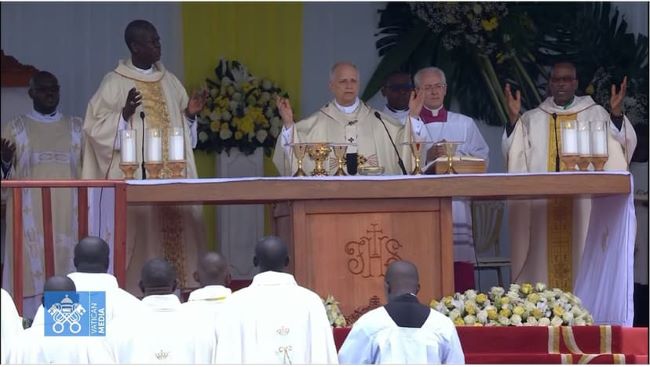
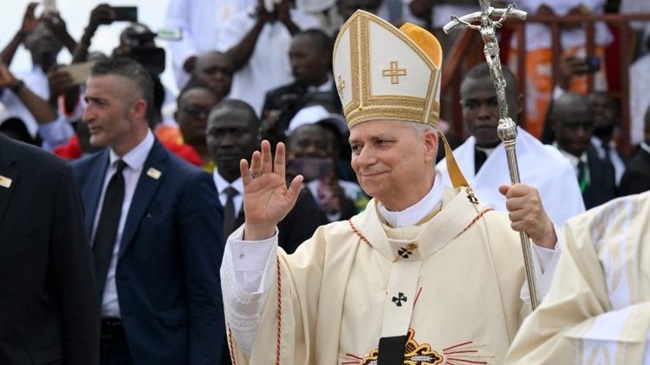
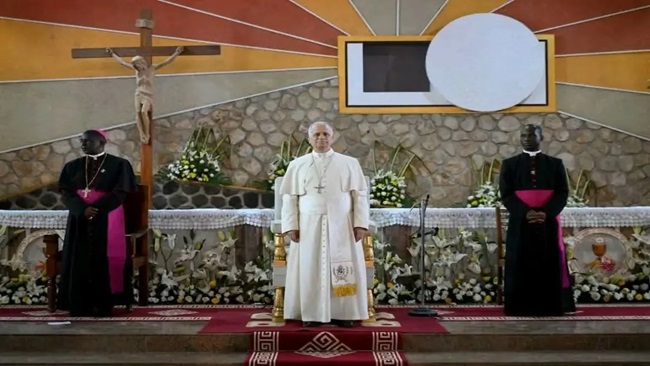
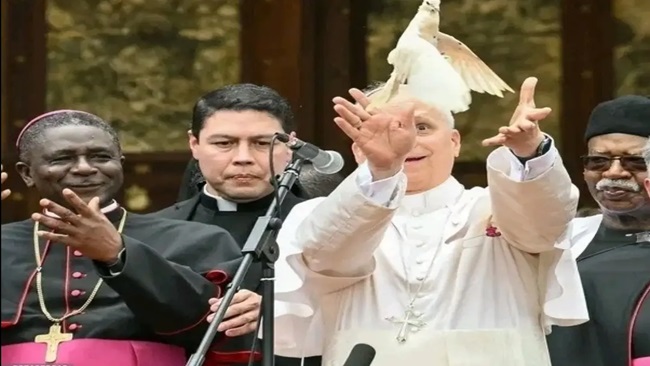
In a half-day visit to the economic capital of Cameroon Friday, Pope Leo offered the local population an extended reflection on the just and equitable distribution of resources in a country notorious for corruption.
In his April 17 homily at Japoma Stadium in Douala, the pope framed his message in the context of the day’s Gospel reading recounting Jesus’s multiplication of the loaves and fish upon discovering there was not enough food to feed the hungry crowd gathered to hear him preach.
Seeing the problem of inadequate resources, he said, “Jesus asks us today, just as he asked his disciples then: How will you solve this problem? Look at all these hungry people, weighed down by fatigue. What will you do?”
“This question is posed to each one of us,” Leo said, saying it applies to families trying to make ends meet, as well as the pastors of the church and to “those who bear social and political responsibility for the people and seek their well-being.”
Every person, strong or weak, rich or poor, has the same hunger, and nourishment is necessary in order to live, he said, asking, “where is God in the face of people’s hunger?”
Jesus offers his own answer to this question when he took the loaves and fish, gave thanks to God, and distributed them among the crowd.
“A serious problem was solved by blessing the little food that was present and sharing it with all who were hungry. The multiplication of the loaves and the fish happened while sharing: that is the miracle,” the pope said, saying, “There is bread for everyone if it is given to everyone.”
There is enough bread for everyone, Pope Leo said, “if it is taken, not with a hand that snatches away, but with a hand that gives.”
He highlighted Jesus’s act of gratitude to God before performing the miracle, saying this is what made the food abundant.
“It was not rationed out of necessity. It was not stolen in strife. It was not wasted by those who gorge themselves in the presence of those who have nothing to eat,” but rather, passing from Jesus, to his disciples, and then to the people, “the food increased for everyone; indeed, it was superabundant.”
When the crowds immediately declaring Jesus to be a prophet, Jesus, Leo said, “did not use those words for personal gain. He did not want to become king, because he had come to serve with love, not to dominate,” but to serve the good of all.
Pope Leo spoke on his third day in Cameroon, which is part of a broader April 13-23 tour of Africa that began in Algeria, and which will also take him to Angola and Equatorial Guinea.
He will celebrate Mass in the capital city of Yaoundé Saturday before flying to the Angolan capital of Luanda.
A consistent appeal
Pope Leo, whose very name and magisterium so far are seeped in issues of social justice, spent over two decades as a missionary in Peru, serving in the country’s most impoverished regions in the north during a massive financial and political crisis, leading to terrorism and widespread social instability.
Throughout the nearly complete first year of his pontificate, Leo has condemned income inequalities and the unjust distribution of wealth, saying in an exclusive interview for this journalist’s biography of his life, Pope Leo XIV: The Biography, set for publication in English later this month, that employers now make around 600 times more than their employees.
In that interview, he questioned extreme wealth concentrated in the hands of a few, noting that last summer Elon Musk was declared the first trillionaire in the world, saying, “What does that mean and what’s that about? And if that is the only thing that has value anymore, then we’re in big trouble. We have to talk about these things.”
Later, in a general audience Dec. 17, he condemned bloated, “out of control” investment portfolios of the extremely wealthy, while vast portions of the global population live in poverty.
“In the heart that true treasure is kept, not in earthly safes, not in large financial investments, which today more than ever before are out of control and unjustly concentrated at the bloody price of millions of human lives and the devastation of God’s creation,” he said on that occasion.
Continuing to drive this point, this time speaking from a continent whose lands are notoriously exploited by foreign powers and extractive industries for resources while their populations live in poverty, indicates this will be a consistent major talking point for the American missionary pontiff.
A message to Cameroon
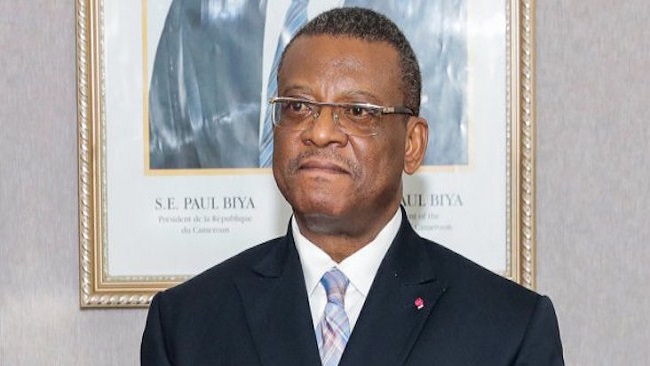
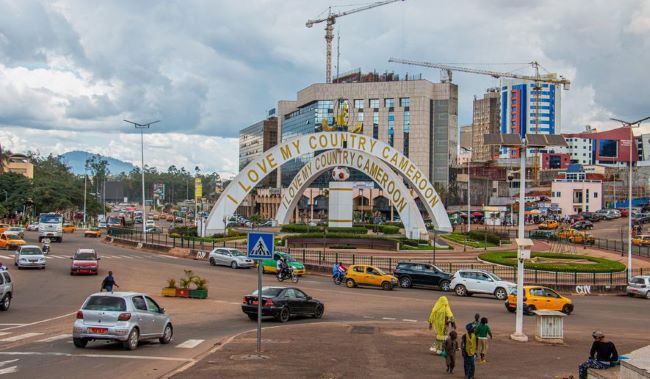
Pope Leo’s visit to Douala for Mass took him to the economic capital of Cameroon, which is currently afflicted by violent protests and paralysis over President Paul Biya’s disputed re-election last October.
Barricades, looting, and violent clashes with security forces have afflicted the city for the past six months, threatening the national economy and general social stability in a nation already gripped by violence amid the ongoing Anglophone Crisis.
One of central Africa’s largest ports, Douala has been the site of its own spat of violence as authorities resorted to forceful measures to quell protests against Biya’s election, and the population is still reeling.
Some Cameroonians feared the papal visit could lend support to Biya, 93, who has ruled since 1982 and is the world’s oldest head of state. Pope Leo met with Biya privately on his first day in Cameroon.
Cameroon, notorious for corrupt practices such as bribery, embezzlement, and nepotism, is rich in natural resources such as oil, timber, cocoa, coffee and minerals, which for decades have been pillaged by both large foreign firms and local elites.
Some 600,000 people were expected to turn out for the pope’s Mass in Douala; however, the crowds were notably smaller, perhaps due to extreme heat and tight security.
Catholics in Cameroon make up around a third of the population of 30 million, and play a fundamental role in the country’s social life. After Mass, the pope is set to visit Saint Paul’s Catholic hospital before returning to Yaoundé, where he will meet with university students and professors.
Equality as rooted in love
In his homily, symbolically delivered in both French and English, the pope said Jesus’s multiplication of the loaves and fish was done primarily as an act of love for the people, which is why it is seen as a foreshadowing of the Eucharist.
“It shows us not only how God provides humanity with the bread of life, but how we can share this sustenance with all men and women who, like ourselves, hunger for peace, freedom and justice,” he said.
Each act of solidarity and forgiveness and every effort to improve one’s circumstances, he said, “becomes a morsel of bread for humanity in need of care.”
“Yet this alone is not enough,” he said, saying it must also be accompanied by acts of charity that feed the soul, forming the conscience and sustaining people “in dark hours of fear and amid the shadows of suffering.”
In this regard, Leo stressed the importance of the sacraments, especially the Eucharist, which he said, “does not merely revive a distant memory; it brings about a ‘companionship’ that transforms us because it sanctifies us.”
The Eucharist, he said, is “a proclamation of hope amid the trials of history and the injustices we see around us.”
“By becoming man to save us, he chose to share in the simplest and most everyday needs of humanity. Hunger thus speaks to us not only of our poverty but, above all, of his love,” he said.
Pope Leo urged attendees to remember this whenever they see someone who lacks life’s basic necessities.
“Through their eyes, the question that Jesus posed to his disciples is repeated: ‘What are you going to do for all these people?’” he said.
He cautioned that being a true witness to Christ and imitating his love for others implies facing certain difficulties and obstacles, “from without and from within us, where pride can corrupt the heart.”
The pope then offered a special message to young people, who make up the majority of the African continent, telling them to be “the first faces and hands that bring the bread of life to your neighbors.”
He told youth to provide others primarily “with the food of wisdom and deliverance from all that does not nourish them but rather obscures good desires and robs them of their dignity.”
In this regard, Leo lamented that despite Cameroon’s wealth of natural resources, “many experience both material and spiritual poverty.”
“Do not give in to distrust and discouragement. Reject every form of abuse or violence, which deceives by promising easy gains but hardens the heart and makes it insensitive,” he said.
Pope Leo likewise told youths not to let themselves “be corrupted by temptations that waste your energies and do not serve the progress of society.”
He noted that Jesus carried out his ministry in spite of threats, persecution and urged them to continue proclaiming the Gospel even amid difficulty, saying, “Christian proclamation changes our lives, transforming minds and hearts.”
“Proclaiming the risen Jesus means leaving signs of justice in a suffering and oppressed land, signs of peace amid rivalry and corruption, signs of faith that free us from superstition and indifference,” he said, closing his remarks.
Source: Crux


18, April 2026
Manyu: We must play as a team! 0
It is not unusual for people of Manyu descent to talk and openly demonstrate, albeit hypocritically, that they love each other. We have Manyu associations all over the world where we eat and dance as if without the other person, our lives will be incomplete.
Orally, our love of the land given to us by God is immeasurable but genuine love is never measured in words. It is measured by our actions and deeds, and an assessment of our actions as a people clearly falls short of our own expectations. We usually get deceived by our oral profession of love for Manyu. But if we scratch beyond the surface, we will always figure out that the foundation of our unity and love for Manyu is shaky. We have been paying lip service to the notion of Manyu unity for far too long and it is time for us to engineer a mindset shift.
The first crack in the dam always shows up when someone else is in the spotlight. The demon in our minds will always rear its ugly head when one of us is stealing the show. The taste of the pudding is always in the eating and, on many occasions, we have fallen short of our own expectation. Our ego is our worst enemy. It will, on many occasions, stand in the way of collective action. Nothing destroys unity like a bloated ego and nothing ruins lives like the love of the spotlight.
For decades, concerned Manyu citizens have been asking why our oral love cannot be leveraged to give Manyu development a shot in the arm.
Our formal education is supposed to inject a deep sense of humility and collective action in us, unfortunately it has only shattered our hope for unity. Many of us are usually unwilling to participate in flagship development projects because we do not like or agree with those who are leading the charge. We have the nasty habit of throwing away the child with the bath water because of our warp thinking.
We live in the permanent and morbid fear of project leaders being known. We feel diminished when others get known. We spend a lot of time and resources just to deny those among us who can lead our Division into a new and modern era. Gossiping and defamation have become our favorite sports. If we cannot get the prize, then none of us should have it.
Until we purge our minds of this negative mindset that has bred visceral hatred in us, we, as a people, will not make any giant strides forward. Progress, if not collective and generational, will not see the light of day, or if it does, it will not stand the test of time.
Over the last thirty years, real development has suffered in Manyu Division, though the Division’s human development index has grown exponentially. This unfortunate situation has been exacerbated over the last ten years due to the socio-political crisis which has killed many and left thousands in the throes of a devastating financial crisis.
Our towns and villages are today shadows of their former selves. At best, they look more like war zones waiting for a messiah with sound town planning knowledge and skills to step in to engineer a modern urbanization solution.
The Division’s economy has taken a nosedive, causing thousands of our young men and women to flee their ancestral land for greener pastures in other parts of the country or the world.
However, rather than focus on the issues which have strapped us to poverty and underdevelopment in Manyu Division, it will be smart for us to identify possible solutions which can help us detach our self from the claws of underdevelopment. Of course, our insidious disunity has constrained our ability to unlock Manyu’s sophisticated development potential but it is time for us to collectively face our demons in order to bring about transformative change in Manyu Division..
Manyu is blessed with many formally educated people in various domains. Our academic prowess and achievements have never been questioned. Our personal academic achievements speak to our determination to be at the zenith of the intellectual world. Many development experts are usually fast to point out that no community or country can make giant development strides forward without soundly educated minds.
Strangely, Manyu’s physical development achievements are at variance with the educational narrative that has become our hallmark.
Our villages are chaotic. Despite our high-sounding academic titles, development outcomes on the ground in our Division demonstrate that in spite of our academic titles, our minds are still bereft of that structural thinking that is born of deep philosophical thoughts.
The true proof of our educated minds is how we think and how we perceive collective action, leadership and the spotlight. We are chaotic naturally like most species on the face of the earth. We like to lead without having followed. True, reliable and experienced leaders are usually those who have learned the ropes and have humbly followed others who have shown the light for them to follow.
Strangely, most people of Manyu descent confuse academic achievement with leadership. We hold that if we hold high-sounding academic titles, then we are natural leaders. That is absolutely not true!
Leadership is about character. It is about selflessness. It is about playing by established rules to set the right examples so that others can follow without questioning the order of things. Leadership is the courage to serve and not the power to command. It is not about being in the spotlight. It is about playing a key role in joint efforts without seeking to crush others. It is about disagreeing without being disagreeable. It is not about hurting others just because we want to attain personal goals.
Our perception of leadership is warped. We think leaders know it all and when they make mistakes we become so disappointed. Leaders are humans. Until we see them as being fallible, we will not stop fighting them. We are supposed to support our leaders, especially our political leaders who are putting their best foot forward while playing our roles in whatever we are collectively doing. Every one of us has a role in Manyu’s development efforts and regardless of what we achieve, not all of us will be in the spotlight.
The objective should never be the spotlight but the development of our beloved Manyu. If we learn to shrink our ego, we will build solid teams which will deliver the development results we all are looking forward to.
Development, indeed transformative development, cannot only come from Yaoundé. As a community of educated men and women, we can change the negative development narrative which has characterized our Division for decades.
If we spend more time fighting our political and traditional leaders, we will be running all over the place like neckless chicken, thereby wasting valuable development time. Violent divisions only tear people apart. What is the benefit to the Division if we continue to openly challenge our ministers, Members of Parliament, Senators, etc, when we know that with our unwavering support, they can fight for us? We don’t appoint our ministers. The president does.
I hold that once somebody has been appointed as a minister, we should sink our differences and stand by him so that we can post some impressive development results.
We don’t have to love the person. We are not going to love every action of his. We must however understand the person is not infallible and, regardless of how united we are, we will never see everything in the same light.
We must learn to accept that when we disagree, we should avoid destroying our unity of purpose. By so doing, we will build a solid team which will help transform Manyu Division into the El-dorado we all have been looking forward to for decades. Everyone on a team must not be a star, even if everyone was a star; some stars would definitely outshine others. A word to the wise is sufficient!
Dr. Joachim Arrey
Executive Director, the Global Think Tank for Africa