Featured
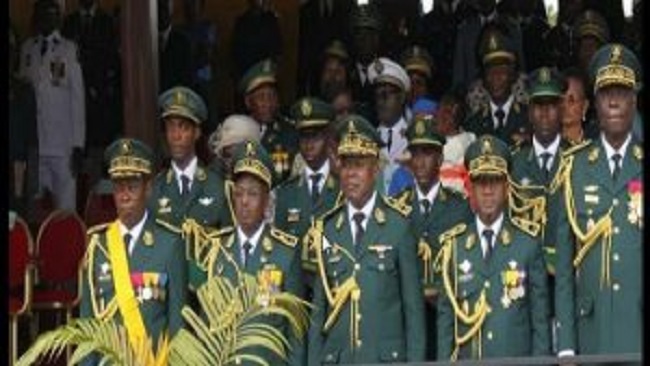 The Cameroonian army must put its conscience to the test
  Who really pushed for the return of the Vice President of the Republic?
  When politics fails a nation, football and the Church become the battleground
  Biya has had his era; Cameroon must now be allowed to enter its next one
  Biya’s hand: a source of glory and shame
Most Commented Posts
 4 Anglophone detainees killed in Yaounde
18 comments Chantal Biya says she will return to Cameroon if General Ivo Yenwo, Martin Belinga Eboutou and Ferdinand Ngoh Ngoh are sacked
13 comments The Anglophone Problem – When Facts don’t Lie
12 comments Anglophone Nationalism: Barrister Eyambe says “hidden plans are at work”
12 comments Largest wave of arrest by BIR in Bamenda
10 comments
Featured
-

Martinez Zogo Trial: questions over missing phone linked to Amougou Belinga
-

Revealed: Colonel Danwe admits ordering Martinez Zogo operation
-
Archbishop Nkea to battle decade of war with new peace Catechism
-

Southern Cameroons Crisis: 7 kidnapped by suspected Amba fighters in Bangourain
-
Southern Cameroons Crisis: 3 killed, 2 injured in bar shooting in Bamenda
-

US military nearing ‘breakdown’ amid sustained Iranian attacks
-
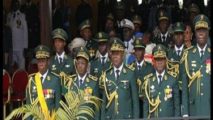
The Cameroonian army must put its conscience to the test
18, March 2026
Changes in the Senate and National Assembly: who becomes next head of state? 0
by soter • Cameroon, Editorial, Headline News, Politics
Cameroon as a nation now stands at a very quiet but consequential crossroads. The recent changes in the leadership of both the Upper and the Lower House have not merely reshuffled the Senate and the National Assembly hierarchies but they have subtly altered the geometry of succession in a Francophone dominated system where constitutional order and political reality do not always move in lockstep.
At the heart of the so called political changes in Yaoundé lies a 60 million dollar question: who becomes the next head of state?
Under Cameroon’s present constitution, the head of the Senate is first in line to assume interim leadership in the event of a vacancy. This provision was designed to guarantee President Biya’s continued stay in power and not to ensure continuity and institutional stability. With new figures now presiding over both the Senate and the National Assembly, the predictability of that succession has become even more complicated. Change is not only needed in both the Senate and the National Assembly but also in the Unity Palace and the Star Building.
Having a new leadership in the Senate is of course significant. In theory, the President of the Senate is a transitional political figure in a caretaker presidency with limited powers tasked with organizing elections. But in practice, Senator Aboubakary Abdoulaye occupying that seat becomes the face of the nation in a moment of potential uncertainty. Correspondingly, Senator Aboubakary Abdoulaye’s political alliances, administrative competence and perceived neutrality matters far more than the constitution suggest.
The National Assembly’s leadership shift from the 86 year old Cavaye Djibril to Theodore Datoua adds another layer to the puzzle. Though not directly in the line of succession, the National Assembly plays a vital role in shaping the political environment in which any transition unfolds. The Speaker of the National Assembly can influence parliamentary priorities, manage consensus and perhaps most importantly signal where the balance of power truly lies within the ruling CPDM institution.
What has emerged from these two changes in both the Upper and Lower House is not a clear successor, but a more fluid and possibly contested pathway to power. Political power in Cameroon revolves around a strong presidency, with the Senate and the National Assembly including the Central Committee of the ruling CPDM party often seen as supportive rather than autonomous. But as Cameroon approaches its moment of transition, these same establishments can become arenas of political negotiation or even rivalry.
The wahala here is not simply “who” will be the next head of state, but “how” that person will emerge. Will the constitution be followed allowing Senator Aboubakary Abdoulaye to step in smoothly and elections organized without friction? Or will political realities such as CPDM party dynamics, tribal and regional considerations and elite bargaining reshape the process behind the scenes?
Added to this very complicated scenario is also a generational undercurrent. Frankly speaking, recent changes in parliament may reflect a cautious attempt to recalibrate the Cameroon political system for the future. If so, the next president of the republic—whether interim or elected—could mark a departure from entrenched patterns.
For now, Cameroon remains in a state of watchful anticipation. The coming of Senator Aboubakary Abdoulaye and Hon. Theodore Datoua has not answered the succession question; they have instead sharpened it. And in doing so, they remind political commentators that in Cameroon, the formal rules are only part of the story. The rest unfolds in the quieter, less visible spaces where power is negotiated, alliances are forged and futures are decided.
The coming weeks and perhaps months will very much reveal whether these institutional adjustments were merely routine or the early signals of a more significant transition.
By Soter Tarh Agbaw-Ebai