

3, September 2018
Thousands join rival migrant protests in Germany’s Chemnitz 0
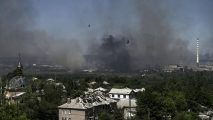
Thousands of opponents and supporters of Germany’s immigration policy marched Saturday through the eastern city of Chemnitz after a wave of racist violence that followed a knife killing.
Some protesters paraded with large portraits of victims of attacks perpetrated, they claimed, by asylum-seekers, while others brandished banners reading “Chemnitz is neither grey nor brown” and “The heart rather than hate”.
There was a heavy police presence with reinforcements from all over Germany after they were heavily outnumbered by thousands of neo-Nazis, football hooligans and other extremists earlier this week.
Sunday and Monday evenings saw outbreaks of street violence, triggered by the arrest of one Iraqi protester and one Syrian, suspected of stabbing a 35-year-old carpenter to death.
Following the arrests, mobs launched random street attacks against people they took to be foreigners, including an Afghan, a Syrian and a Bulgarian man.
Around 2,500 people marched in support of Chancellor Angela Merkel’s immigration policy which has seen more than one million migrants and refugees allowed into Germany since 2015, according to a police estimate.
The government lent its support to the pro-migrant rally through Foreign Minister Heiko Maas who tweeted: “The Second World War started 79 years ago. Germany caused unimaginable suffering in Europe. If once again people are parading today in the streets making Nazi salutes, our past history forces us to resolutely defend democracy.”
“We will not let right-wing extremists destroy our country and our democracy. Neither in Chemnitz, nor in Saxony nor anywhere in Germany. Our constitution must prevail. We must defend it. Now!” added one of the Greens’ leaders Cem Ozdemir in a tweet accompanied by a picture of him with demonstrators.
In a separate march later, an estimated 6,000 people marched at the call of various movements including the far-right anti-immigration alternative for Germany (AfD) party and the anti-Islam PEGIDA movement.
The violence and heated debate on immigration have brought back to the fore what has become the most challenging political issue for Merkel, especially in the former communist east of Germany where the AfD is the number one party in some towns and regions.
Following criticism of Merkel’s earlier open door policy, her government has increasingly tightened asylum laws as conservative and far-right disquiet has grown.
After an initially jubilant welcome, the migrant influx sparked a strong backlash that saw a spate of hate crimes and swept once-fringe party AfD into parliament.
(REUTERS)


















3, September 2018
Could the future of food in the world depend on what Africa does with agriculture? 0
Addressing a standing room only crowd of global agriculture experts at the FAO headquarters in Rome, 2017 World Food Prize Laureate and President of the African Development Bank (www.AfDB.org), Akinwumi Adesina, says the answer is a resounding yes!
He believes Africa does not need aid but disciplined investments. According to this grandson of a subsistence farmer, he says the time has come to view investment and development opportunities in Africa through a totally different lens.
With over 800 million people worldwide suffering from hunger and more than two billion affected by malnutrition, food insecurity remains a real threat to global development. Adesina, who is making a global pitch for renewed visionary leadership and strategic alliances, “the future of food in the world will depend on what Africa does with Agriculture.”
The African Development Bank, which he leads, envisions a food secure continent which uses advanced technologies, creatively adapts to climate change, and develops a whole new generation of what he describes as ‘agripreneurs’ – empowered youth and women who he expects to take agriculture to the next level.
By 2050, an additional 38 million African will be hungry. The paradox of lack in the midst of plenty, and Africa’s growing youth bulge are some of the reasons why Adesina’s sense of urgency is resonating with numerous government, private sector, and multilateral leaders during recent European and Asian trips. The banker and 2017 World Food Prize Laureate will be the first to admit that he considers himself the ‘evangelist-in-chief’ for a food secure Africa.
Africa continues to import what it should be producing, spending $35 billion on food imports each year, a figure that is expected to rise to $110 billion in 2025 if present trends continue.
A few days later, Adesina joined Rockefeller Foundation President Raj Shah, Unilever CEO Paul Polman, and 2018 World Food Prize nominees Lawrence Haddad and David Navarro, among other prominent global academic, development, and agriculture experts at Wageningen University and Research, in the Netherlands, to make the case for urgent collective action by State and non-State players to accelerate Africa’s agricultural growth and transformation.
Africa receives only 2 percent of the $100 billion annual revenues from chocolates globally. Adesina tells his audience that “adding value to what nations produce, is the secret to their wealth. Producing chocolate instead of simply exporting cocoa beans does not require rocket science.”
To expand opportunities for youth, women, and private sector players, Adesina is on a global mission to promote and seek support for the bank’s Affirmative Finance for Women in Africa (AFAWA) program which aims to mobilize $3 billion to support women entrepreneurs who historically lack access to finance, land, and land titles; a $300 million ENABLE Youth program to develop the next generation of agribusiness and commercial farmers for Africa; and a new global investment marketplace, the African Investment Forum, which will be held in Johannesburg November 7-9.
In separate meetings with Sigrid A.M. Kaag, Minister for Foreign Trade and Development Cooperation, in the Hague; Peter van Mierlo, CEO of the Dutch Entrepreneurial Development Bank (FMO), key private sector players, and members of the Dutch Foreign Affairs Advisory Council, Adesina said Africa and its partners must seize unprecedented opportunities for innovative partnerships and increased development impact.
Mierlo believes, “a huge benefit for Africa is that it can skip development cycles that often almost all developed countries had to go through, by deploying new technologies such as artificial intelligence and robotics in agriculture”.
In a continent where more than 640 million are without electricity, Adesina says the private sector is key to Africa’s development in Africa’s energy and agriculture sectors.
“If Africa is going to turn the tide of irregular migration, this is critical. There are three ways in which we can collaborate: either through the NEPAD Infrastructure Project Preparation Facility, Africa 50 – a private equity institution which has raised more than US$ 850 million from 22 countries, and the new Africa Investment Forum.”
Adesina, recognizes that the lack of electricity is Africa’s biggest development impediment. The Bank’s new and ambitious Desert-to-Power initiative which aims to generate 10,000MW of power across Africa’s Sahel region will be critical to reducing migration and climate change impacts. We will do this through a blended finance mechanism with guarantees”, Mr. Adesina said.
Speaking to a High-level Roundtable of Dutch Business Leaders at the Netherlands Enterprise Agency (RVO), informed key private sector leaders that “governance structures and business regulatory environments are changing in Africa. Indeed, several African countries have already made significant progress in improving their general business and investment environments. Africa is doing better than some of the Asian countries,” he reminded his audience. “In the energy sector, the African Development Bank is investing $12 billion over the next 5 years, with the goal of leveraging $40-50 billion; and an additional $US 24 billion, over ten years, in agriculture to implement its Feed Africa Strategy.”
Agriculture steadily taking center-stage
The strategy is already bearing fruit with the establishment of Staple Crop Processing Zones in several African countries, including Ethiopia, Togo, Democratic Republic of Congo, and Mozambique, with a plan to reach 15 countries in a few years.
Strategically located in and around rural farming communities Adesina says “these agriculture zones will form the nucleus of a new wave of agro-industries and greenfield ventures, attracting agripreneurs, biotechnology firms, intellectual and capital investments. They will also ensure that foods are processed and packaged right where they are produced, rather than in urban centers far removed from centers of production.”
Described as a visionary optimist by many colleagues, Adesina believes the bank’s policies and investments will help turn rural areas from zones of economic misery into zones of economic prosperity.
Distributed by APO Group on behalf of African Development Bank Group (AfDB)