
16, October 2022
African Union calls on Ethiopia rivals to ‘recommit’ to peace 0
The African Union on Sunday called on the warring parties in Ethiopia’s conflict to “recommit” to peace talks, as violence intensifies in the embattled Tigray region.
The city of Shire in northwest Tigray has been bombarded for several days in a joint offensive by Ethiopian and Eritrean troops, with civilian casualties reported in the push against rebels from the war-torn region.
The International Rescue Committee, an aid organisation delivering relief to stricken Tigray, announced on Saturday that one of its staff was among three civilians killed in an attack in Shire.
UN chief Antonio Guterres has joined the United States and other Western powers in expressing grave concern over the worsening violence and its impact on civilians, and called on both sides to negotiate peace.
Prime Minister Abiy Ahmed’s government, and the Tigrayan authorities, have accepted an AU invitation to talk, but negotiations scheduled to start last weekend in South Africa failed to take place.
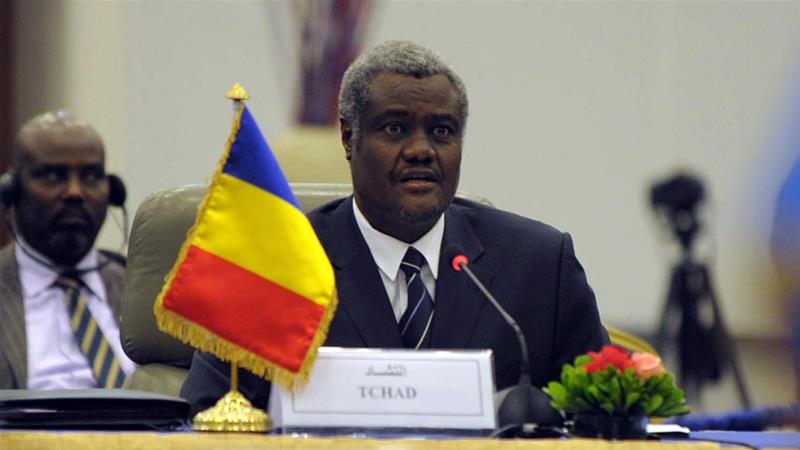
AU Commission chair Moussa Faki Mahamat said the escalating violence was of “grave concern”.
“The Chairperson urges the Parties to recommit to dialogue as per their agreement to direct talks to be convened in South Africa by a high-level team led by the AU High Representative for the Horn of Africa, and supported by the international community,” he said in a statement issued on Sunday, but dated Saturday.
Talks were to be mediated by the bloc’s Horn of Africa envoy Olusegun Obasanjo, South Africa’s former deputy president Phumzile Mlambo-Ngcuka and former Kenyan president Uhuru Kenyatta.
Diplomats suggested logistical issues were partly to blame for the much-anticipated meeting not going ahead.
The latest fighting came as US special envoy Mike Hammer arrived in Addis Ababa to push for an end to nearly two years of war between Ethiopia, its allies, and rebels led by the Tigray People’s Liberation Front (TPLF).
Fighting resumed in August after a five-month lull, dimming hopes of settling a conflict that has killed untold numbers of civilians, and been marked by atrocities by all sides.
The return to war also halted desperately-needed aid into Tigray, where the UN says millions of people have been forced from their homes, and hundreds of thousands are close to famine.
The conflict erupted in November 2020 when Abiy — a Nobel Peace Prize winner — sent troops to topple the TPLF, the ruling party in Tigray he accused of staging attacks on army camps.
The TPLF dominated Ethiopia’s ruling coalition for decades before Abiy came to power in 2018.
Source: AFP



















16, October 2022
Communist Party’s 20th Congress gets under way, offering clues to China’s future 0
The Chinese Communist Party (CCP) Congress kicked off in Beijing on Sunday, an event expected to confirm Xi Jinping as China’s first leader since Mao Zedong to serve three successive terms. Decisions unveiled at the congress – especially the fate of Prime Minister Li Keqiang – will indicate whether Xi plans to continue centralizing power and the direction of China’s economic policies.
The 20th Chinese Communist Party (CCP) Congress opening on October 16 was a celebration of the world’s largest political party, which boasts over 96 million members throughout China. However, all eyes are on one man: Chinese leader Xi Jinping.
Following the horrors of the Great Famine and the Cultural Revolution – and the death of Mao Zedong, who presided over both – the CCP under Deng Xiaoping set a two-term limit for its leaders in 1982. Xi abolished this rule in 2018, paving the way for him to rule indefinitely after his second term ends in 2023.
Drastic security measures
The leader of the world’s second-largest economy has done everything possible to ensure the congress runs smoothly. Beijing has been under special security measures since June. More than a million people have been arrested in the “public security crackdown” that has made the Chinese capital into a fortress. Employees of major companies based in Beijing are not allowed to leave the city for the duration of the congress. Visitors carrying bottles of water have to take a sip in front of police officers to show they are not carrying dangerous liquids.
And Chinese internet censors scrambled to remove any mention of a rare protest in Beijing on October 13 in which a banner displayed from a bridge called for “dictator and traitor Xi Jinping” to leave power.
Xi gathered all the Central Committee members on October 9 for a final rehearsal of the announcements to be made during the congress. The event will thus be a matter of rubber-stamping decisions already taken.
This comes after a rocky period for China. Over the past two years, “we’ve seen the coronavirus pandemic and China’s very costly zero-Covid policy; Sino-American tensions amid trade disputes; and a deepening of ties between Beijing and Moscow at a time when [President] Vladimir Putin has brought condemnation on Russia by invading Ukraine”, said Marc Lanteigne, a specialist in Chinese politics at the Arctic University of Norway.
Xi has concentrated so much power in his hands that it will be hard for him to avoid responsibility if the policies come under fire, Lanteigne said. So at the very most, the congress will strengthen Xi’s hold on the CCP – and at the very least, “it will show that, despite everything, Xi is still enormously powerful”.
But other than that, it is very hard to predict what will come out of the congress, because the CCP has become so “opaque” under Xi, noted Daniel Leese, a historian and China expert at the University of Freiburg.
Before previous CCP congresses, China specialists used to enjoy predicting who would be in and who would be out. Often, working papers would be leaked indicating someone was on the way up or on the way down as various party factions jostled for power.
This time, there are precious few signs to interpret, and those that remain are hard to decipher.
Leese said one recent trend has been a “decline in the number of pro-Xi propaganda articles” in the official press, adding: “This could mean that Xi has lost his shine – or it could mean he’s become so powerful that he doesn’t need propaganda anymore.”
Culled from France 24