
18, March 2022
Southern Cameroons conflict spills across Nigerian frontier 0
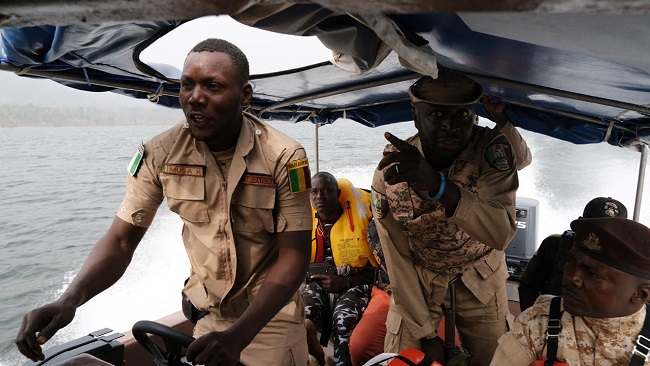
The peaceful Nigerian fishing village of Manga sits not far from Cameroon’s border, but its residents know all about the separatist war raging inside their West African neighbour.
Cameroon’s five-year conflict is spilling over into Nigeria, where the armed forces are struggling to secure the border as they battle jihadists, bandit gangs and separatists of their own elsewhere.
Cameroonian security forces and separatist gunmen care little for the territorial integrity of their neighbours where they have carried out cross-border raids, attacks on villages and made illegal arrests.
Manga lived though the bloody experience at the end of last year.
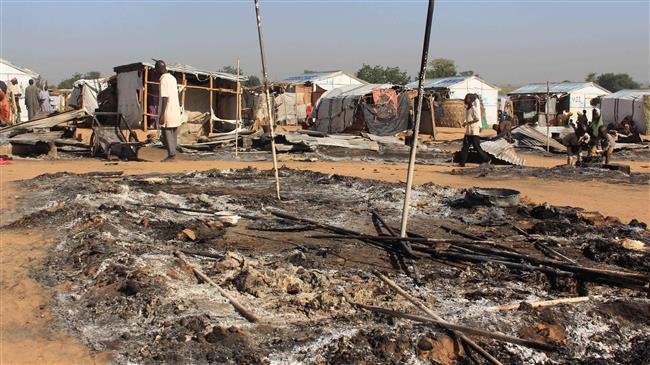
On November 17 around 50 armed separatists crossed over from Cameroon, attacking the village and killing five people including Manga’s 70-year-old chief, residents say.
Dozens of bullet holes still mark the earthen walls of the chief’s house and its upper part is charred by fire.
“I had never heard gunshots like that,” said Abubakar Manga, the chief’s brother, who managed to escape on a canoe from where he watched the attack.
“We still don’t understand,” he told AFP.
Two days before, about 30 Cameroonians had found refuge in Manga, after the attack on their village in Cameroon.
“In my village, the separatists confronted the army, but did not attack us,” said one of these refugees.
“But suddenly they changed and started destroying our houses,” said the man who spoke on condition of anonymity for his security.
Terrible revenge
Cameroon’s war has killed more than 6,000 people and forced one million Cameroonians to flee their homes as they are caught between the army and the rebels.
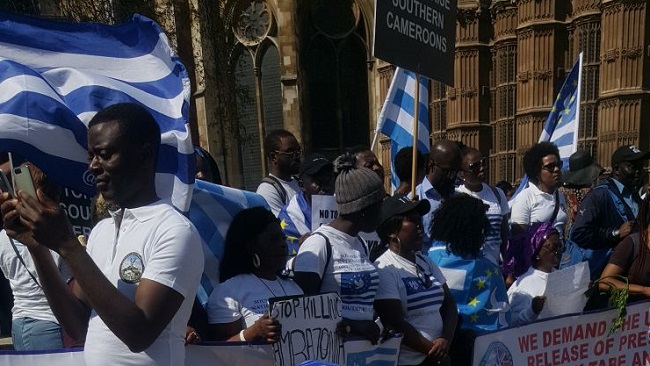
The war broke out in October 2017 when militants declared an independent state in the Northwest region and Southwest region, home to most of the anglophone minority in a country that is 80 percent French-speaking.
Since then, more than 250 villages have been destroyed, in terrible revenge by either the separatists or soldiers against populations accused of supporting the opposing camp.
“We fled to Manga to take shelter,” the refugee said, explaining how they believed they would be safe in Nigeria and not suffer violence for a second time.
But the separatist fighters are not the only ones who have expanded their fight to the other side of the Nigerian border.
In October, around 60 Cameroonian soldiers invaded the villages of Mairogo and Tosso, harassing and intimidating their inhabitants, according to the UN and local authorities.
“They were looking for armed separatists who had fled to Nigeria,” local elected official Joseph Ammamzalla told AFP.
Cameroonian authorities suspect that separatists are hiding among the 70,000 Cameroonian refugees in Nigeria.
For Cameroon officials, eastern Nigeria is also one of the sources of arms supply for the separatists.
In January and February 2022, Cameroonian soldiers again invaded Mairogo, according to the local official.
“They severely beat several residents, and arrested and took with them four young people, and we have had no further news,” he said.
To keep the refugees away from the border, the Taraba State authorities and the High Commissioner for Refugees (UNHCR) are in discussions to create a refugee camp.
In neighbouring states of Benue and Cross River, four camps have been established.
“Here I am no longer afraid,” said Zacharia Okana, 59, a Cameroonian refugee who lives in one of the Cross River camps.
An opponent of the regime of President Paul Biya, in power since 1982, Okana fled Cameroon in 2017 for fear of arrest. He said he was suspected of financially supporting the separatists, which he denies.
But in September 2020, he says he was illegally arrested in Ikom, a Nigerian town near the border, and taken back to Cameroon, where he spent three months in prison.
‘Abuja laissez-faire’
Since 2018, Nigerian media have reported the incursion of several villages in Cross River by Cameroonian soldiers.
Contacted by AFP, the Cameroonian defence ministry said it was “not aware of these incidents” while Nigeria’s armed forces had no comment.
One Nigerian military official, however, said, on condition of anonymity, that the army continued to work to “secure the border”.
But this is not “the priority” for Abuja, said Ikemesit Effiong, an analyst with the Nigerian risk consultancy SMB Intelligence.
The army is already engaged “on several other fronts”, he said, in the northeast, where it has been fighting a jihadist insurgency for twelve years and the northwest where criminal gangs are terrorising local populations.
Yaounde and Abuja “have no desire to publicise these incidents”, Effiong said.
There is a laissez-faire from Abuja, he said, as the government has no interest in seeing “a successful separatist rebellion in its neighbour” when it is also facing separatist agitation of its own.
The Nigerian army has been trying for years to crush the Indigenous People of Biafra (IPOB) separatist group, which is fighting to create a republic for the Igbo people in the southeast of the country.
“Because of their geographical proximity, the authorities are afraid to see the creation of a common front,” Effiong said.
That concern was reinforced in 2021 when IPOB and one of the separatist groups in Cameroon sought to enter into an alliance. But the accord did not materialise.
In 2018, Abuja did arrest several Cameroon separatist leaders seeking asylum in Nigeria and transferred them to Yaounde, where they were sentenced to life imprisonment.
The extradition was later deemed illegal by the Nigerian high court and denounced by the UN and civil society, but the men are still in prison in Cameroon.
Source: AFP














18, March 2022
War in Ukraine: Latest developments 0
Here are the latest developments in the war in Ukraine:
‘Hundreds’ trapped in bombed theatre
Ukraine’s President Volodymyr Zelensky says that 130 people have been saved after the bombing of a theatre in the port city of Mariupol, besieged by Russian forces, but that “hundreds” are still trapped in rubble.
He promises to continue rescue operations in Mariupol “despite shelling” in the southern port city that has suffered vast destruction.
Xi speaks out against war
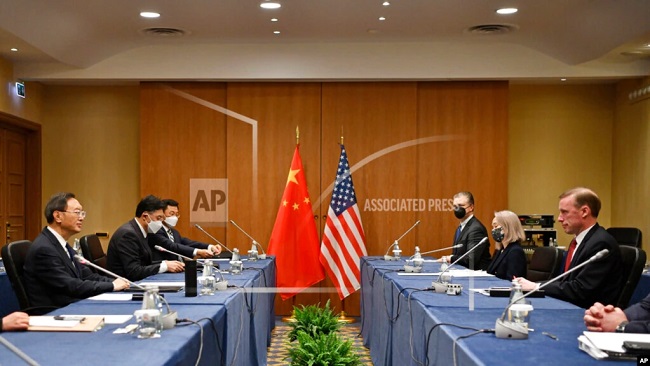
Chinese President Xi Jinping speaks out against conflict during his first call with his US counterpart Joe Biden since the Russian invasion of Ukraine, Chinese state TV reports.
He says during the nearly two-hour-long call Beijing and Washington should shoulder “our due international responsibilities” for peace and that war is “in no one’s interest”.
Strikes near Lviv airport
Russian forces destroy an aircraft repair plant near Lviv airport but no one was hurt, Mayor Andriy Sadovyi says on the messaging app Telegram.
The western city is just 70 kilometres (45 miles) from the border with NATO member Poland.
Kyiv tower blocks hit
Authorities in the capital Kyiv say one person was killed when a Russian rocket struck residential tower blocks in the northwestern suburbs. They said a school and playground were also hit.
Fighting in Mariupol, Lugansk
Russian troops and their separatist allies are fighting in the centre of Mariupol, the Russian defence ministry says.
Backed by Russian troops, separatists from the self-proclaimed Lugansk People’s Republic have also “liberated more than 90 percent of the republic’s territory”, the ministry adds.
One dead, one trapped in Kharkiv
In the eastern city of Kharkiv, Russian strikes demolish the six-storey building of a higher education institution, killing one person and leaving another trapped in the wreckage, officials say.
‘Dire’ situation in east
The UN warns that humanitarian needs are becoming ever more urgent across eastern Ukraine, with a potentially fatal lack of food, water and medicines in besieged cities such as Mariupol and Sumy.
Peace talks ‘stalled’
Russian President Vladimir Putin accuses Ukrainian authorities of stalling talks, but added that Moscow is ready to search for solutions as he speaks with German Chancellor Olaf Scholz.
US Secretary of State Antony Blinken warns that Russia has not produced “any meaningful efforts” to end the war.
G7 leaders convened
Scholz, as current G7 president, invites the leaders of the world’s top industrialised countries to a meeting on Ukraine as part of EU and NATO summits next week.
UK blocks Russia’s RT channel
Britain’s broadcasting regulator revokes the licence of Russia’s state-funded television channel RT, in the latest international repercussion for Moscow after its invasion of Ukraine.
– ‘Extensive’ economic fallout –
The International Monetary Fund, World Bank and other top world lenders warn of “extensive” economic fallout from the Ukraine war and express “horror” at the “devastating human catastrophe”.
IEA urges cut in global oil consumption
The International Energy Agency urges governments to urgently implement measures to cut global oil consumption within months following supply fears stemming from Russia’s invasion of Ukraine.
Russian diplomats expelled
The three Baltic countries of Estonia, Latvia and Lithuania announce the expulsion of 10 Russian diplomats over Moscow’s invasion of Ukraine.
3.25 million refugees
More than 3.25 million refugees have fled Ukraine since the Russian invasion, the United Nations says, with more than two million crossing the Polish border.
Source: AFP