
30, June 2022
Congo-Kinshasa set for final ceremony for Patrice Lumumba 0
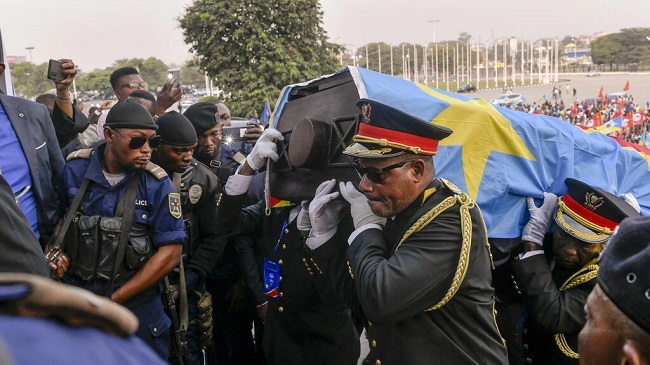
The scant remains of DR Congo’s fiery independence hero Patrice Lumumba were to be interred on Thursday after a pilgrimage that revived traumatic memories but also stirred national unity.
A single tooth is all that remains of the young nationalist who was murdered in January 1961 at the age of 35, just months after becoming Congo’s first post-colonial prime minister.
A coffin containing the remains was to be enshrined in a mausoleum in Kinshasa, in a ceremony hosted by President Felix Tshisekedi coinciding with the country’s 62nd anniversary.
Topped by a large statue of Lumumba, the mausoleum is located on a main avenue of the capital which also bears his name.
Lumumba was among the vanguard of pan-African leaders who led the charge to end colonialism in the late 1950s.
He rose to prominence in 1958 when he launched a political party, the Congolese National Movement (MNC), which called for independence and a secular Congolese state.
His party won national elections in May 1960, a month before independence from Belgium, leading him to be named first prime minister of the country when it became independent.
He stunned Belgium with a speech on independence day — attended by King Baudouin — that accused the exiting colonial masters of racism and “humiliating slavery” of the Congolese people.
Within three months, Lumumba was forced out by a coup fomented with the help of Belgium and the CIA, which also opposed the support he had requested from the Soviet Union.
In January 1961, Lumumba was handed over to the authorities in mineral-rich southeast Katanga province, which had seceded from the fledgling nation months earlier with Belgium’s support.
He was shot dead and his body was dissolved in acid, but a Belgian police officer involved in the killing kept one of his teeth as a trophy.
After years of campaigning by his family, Belgium returned the tooth on June 20, a move that followed a visit of reconciliation by Baudouin’s nephew and successor, King Philippe.
The remains were taken to Lumumba’s home area of Sankuru in the centre of the country, to his political stronghold of Kisangani in the northeast and finally to the place where he was murdered before being flown to Kinshasa.
Five former prime ministers joined a funeral vigil on Thursday alongside current government chief Jean-Michel Sama Lukonde.
“The figure of Patrice Lumumba is a prime symbol of national unity, transcending political differences,” said Evariste Mabi, a premier in the 1980s under Lumumba’s nemesis, dictator Mobutu Sese Seko.
“(He) embodies the people’s successful struggle for freedom.”
Source: AFP



















1, July 2022
US: Ketanji Brown Jackson sworn in, becoming first Black woman on Supreme Court 0
Ketanji Brown Jackson was sworn in on Thursday as a U.S. Supreme Court justice, making history as the first Black woman on the nation’s top judicial body while joining it at a time when its conservative majority has been flexing its muscles in major rulings.
Jackson, 51, joins the liberal bloc of a court with a 6-3 conservative majority. Her swearing in as President Joe Biden’s replacement for retiring liberal Justice Stephen Breyer came six days after the court overturned the 1973 Roe v. Wade landmark that legalized abortion nationwide. Breyer, at 83 the court’s oldest member, officially retired on Thursday.
“On behalf of all the members of the court, I am pleased to welcome Justice Jackson to the court and to our common calling,” Chief Justice John Roberts said at the ceremony.
A Reuters/Ipsos poll this week found that a majority of Americans – 57% – holds a negative view of the court following the abortion ruling, a significant shift from earlier in the month when a narrow majority held a positive view.
Jackson is the 116th justice, sixth woman and third Black person to serve on the Supreme Court since its 1789 founding.
Biden appointed Jackson last year to the U.S. Court of Appeals for the District of Columbia Circuit after she spent eight years as a federal district judge. Like the three conservative justices appointed by the Democratic president’s Republican predecessor Donald Trump, Jackson is young enough to serve for decades in the lifetime job.
The Senate confirmed Jackson on a 53-47 vote on April 7, with three Republicans joining the Democrats in support of her.
Jackson’s appointment does not shift the court’s ideological balance.
“It has taken 232 years and 115 prior appointments for a Black woman to be selected to serve on the Supreme Court of the United States,” Jackson said at an April 8 event celebrating her confirmation. “But we’ve made it – we’ve made it – all of us, all of us.”
Biden has aimed to bring more women and minorities and a wider range of backgrounds to the federal judiciary. Jackson’s appointment fulfilled a pledge Biden made during the 2020 presidential campaign to name a Black woman to the Supreme Court. With Jackson’s addition, the Supreme Court for the first time has four women on the bench.
Breyer in January announced his plans to retire, having served since being appointed by Democratic President Bill Clinton in 1994. Jackson served as a clerk for Breyer early in her legal career.
The court issued its final two rulings of its current term on Thursday. Jackson joins a liberal bloc that has found itself outvoted in major rulings this term, not only on abortion rights but on gun rights, expanding religious liberties and other matters.
Jackson will participate in arguments in cases for the first time when the court’s next term opens in October. One major case for the coming term gives the conservative justices an opportunity to end affirmative action policies used by colleges and universities in their admissions processes to increase their enrollment of Black and Hispanic students to achieve campus diversity.
Source: REUTERS