
7, December 2021
2021 AFRICA CUP OF NATIONS: New doubts on Cameroon’s ability to host 0
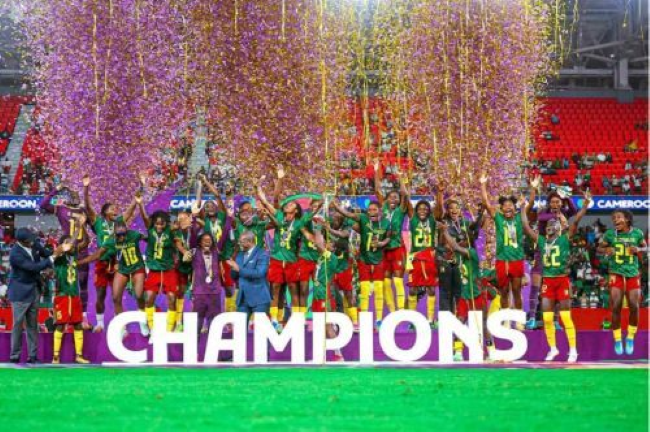
A former Technical Director of the Confederation of African Football, Abdel Moneim Shatta has cast doubt over the hosting of the 2021 Africa Cup of Nations in Cameroon.
The Afcon is scheduled to be hosted by Cameroon and is expected to take place from January 9 to February 6, 2022.
The tournament was originally scheduled to be played in June and July 2021 but Caf announced on January 15, 2020, that due to unfavourable climatic conditions during this period, the tournament would take place from January 9 to February 6, 2021.
However, on June 30, 2020, Caf moved the tournament for the second time, then to January 2022 following the effects of the Covid-19 pandemic across the continent, whilst retaining the name 2021 Africa Cup of Nations for sponsorship purposes.
However, according to Shatta, the tournament is now facing uncertainty and could be cancelled because the host country is facing problems with finishing the preparations.
“The committees that went to Cameroon saw that the time was not enough to finish the preparations for the African Nations Cup, but Fifa is taking over this issue and opened an office there to run things,” Shatta told Al Hayah TV.
“Cameroon when it requested to host the Nations Cup, the number of participants in the tournament was 16 teams, not 24, and the opening stadium in Cameroon so far there is a great deal of confusion around it.
“If the tournament is not held on time, no country is able to host the tournament even if it is postponed for 3 or 4 months, and if it is not held on time, it will be cancelled.
“Things in the African Union are not acceptable to me, and no one gives us consideration here in the continent of Africa, and it was easy for the President of the International Football Association to find solutions to the conflict between the date of the Cup of Nations and the Club World Cup, there’s huge disrespect to the tournament and Africa playing the two tournaments at the same time’.”
Shatta also revealed the possibility of the tournament being moved to Qatar if Cameroon fails to beat the deadline.
“Caf is led by Fifa now since the appearance of Fatma Samoura on the scene, everything is possible, and it’s up to Fifa to approve that the Afcon be held outside the continent.”
With the Afcon expanded from 16 to 24 teams, at least six venues are expected to be used across five Cameroonian cities.
The six stadiums selected to host matches are the Olembe Stadium and Stade Ahmadou Ahidjo in the capital Yaounde, the Japoma Stadium in Douala, the Limbe Stadium in Limbe, the Kouekong Stadium in Bafoussam and the Roumde Adjia Stadium in Garoua.
The opening match of the tournament between Cameroon and Burkina Faso and the final are set to take place at the newly built 60,000 seater Olembe Stadium in Yaounde.
Source: Goal.com















8, December 2021
Bishops condemn attacks on Southern Cameroons schools as more details emerge on the Ekondo Titi incident 0
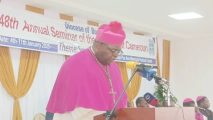
Cameroon’s English-speaking bishops have condemned attacks on schools in the country’s conflict-ridden North West and South West Regions.
Their latest statement comes after four students and a teacher were killed on Nov. 24 at Government Bilingual High School Ekondo-Titi in the South West region.
Schools have become a battleground as Anglophone separatists fight the majority French-speaking government in the African country. For many years, the separatists imposed a schools’ boycott, which they enforced with violence.
“Our hearts have been pierced again!” said Archbishop Andrew Nkea Fuanya of Bamemda, in a statement he signed on behalf of all the bishops of his ecclesiastical province, which overs the Anglophone regions of Cameroon.
“In recent times, we have painfully witnessed an agonizing drama involving, among other evils, the targeting and killing of pupils, students and teachers … We have hardly recovered from the cruel killing of Enondiale Tchuengia Carolaisse, killed in Molyko-Buea on Thursday, October 14, 2021, and the brutal killing of another pupil, Brandy Tataw, on Friday, November 1, 2021, in Nkwen-Bamenda, then we are confronted again with the killing of four more innocent Cameroonians within the protected area of a school,” said the archbishop.
“These innocent victims are not the cause of the socio-political crisis, and their deaths cannot be the solution. Their murder is totally senseless and unacceptable,” Nkea said.
A local government administrator confirmed the attack, telling Crux that “separatist fighters laid ambush in the school before students arrived. They were dressed like soldiers to give students the feeling that they were actual soldiers guarding the school.”
Timothee Aboloa identified the students as Emmanuel Orume 12, Joyceline Iken 16, and Kum Emmanuel, 17. The teacher, Celestine Song was 58 years old and a mother of four.
“It was quite a frightening scene,” said Henry Agbor, a local resident.
“I heard a loud explosive. I was standing around the Okada beach park ready to take a bike to the beach before the mayhem broke out. Besides the teacher and students who have died, many students are also wounded,” he told Crux.
“We never expected this,” said Father Gaetan Ndongo.
“The attacks are creating fear around the place and the education of our children has been systematically sacrificed,” he told Crux.
The recent attacks are a grim reminder of the price education has had to pay in the separatist war in Cameroon’s English-speaking regions, now in its 5th year.
The darkest date was probably Oct. 24, 2020, when six children were killed by suspected separatists at the Mother Francisca International Bilingual Academy in Kumba.
Several other schools were attacked the following month, leading to the deaths of at least three other students.
Earlier this year, on Oct. 14, a soldier killed Enondiale Carolise, a student on her way to school in Buea. Another girl, Tataw Brandy, was killed by a soldier in Bamenda on Nov. 10.
The United Nations says more than 700,000 children have been forced out of school during the conflict, with 2 out of 3 schools being shut.
Yasmine Sherif, the director of Education Cannot Wait, said the Cameroon crisis is among “the most complex humanitarian crises in the world today.”
“Children and youth are having to flee their homes and schools, are threatened with violence and kidnapping, and being forced into early childhood marriage and recruited into armed groups,” said Sherif.
“We call for urgent support from donors to respond to this forgotten crisis. We call for the respect of human rights and adherence to the principles of international humanitarian law and the Safe Schools Declaration, and for partners to redouble efforts so all children and adolescents can get back to the safety, protection and hope that quality learning environments provide,” she said.
The bishops have condemned violence as a means of problem solving, insisting that life must be protected.
“We, the Bishops of the Ecclesiastical Province of Bamenda, condemn these barbaric acts, which violate all International Laws and Conventions safeguarding the inviolability of schools and the protection of learners (pupils and students), and teachers, offend against the fundamental right to education, and breaks the Fifth Commandment of God,” the statement reads.
“We have been persistent in our call for the respect and defence of human rights, especially the right to life, openness to dialogue, an option for the truth and recourse to peaceful means as the best way to a durable solution,” it continues.
While calling on the government to ensure the security of schools, we make a special appeal, once more, to all perpetrators of violence to allow the genuinely human feelings of love, pardon and benevolence to flow into their hearts so that the safety and security of all may be guaranteed, alongside the right of all young people to life and to an education and a future,” the statement added.
Source: Crux