
10, April 2026
Popemobile arrives as Cameroon gears up for the Holy Father visit 0
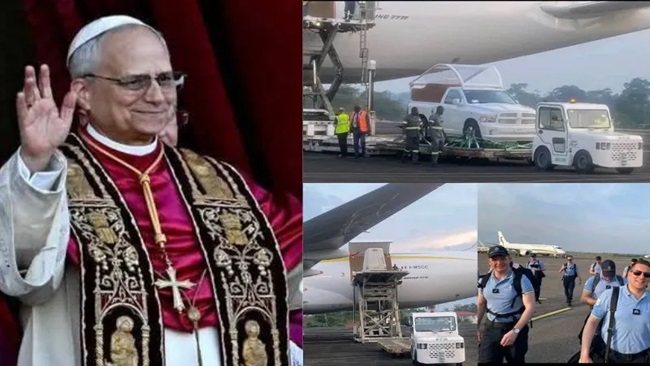
The official vehicle of Pope Leo XIV has arrived in Cameroon, marking a key milestone in preparations for the Holy Father’s planned Apostolic visit scheduled for April 15–18.
The vehicle, widely known as the “Popemobile” and bearing the registration SCV 1, landed on Wednesday, April 8, in the afternoon via a special cargo flight at Yaoundé Nsimalen International Airport.
A Boeing 777F operated by MSC Air Cargo transported the vehicle from abroad.
The Popemobile,short for Status Civitatis Vaticanae (State of Vatican City), will be used by the Holy Father during the various stages of his visit, including stops in Yaoundé, Bamenda, and Douala.
Selected Archbishops from these cities may have the privilege of accompanying the Pope in the vehicle.
The vehicle was officially received at the airport by the Apostolic Nuncio to Cameroon and Equatorial Guinea, Archbishop José Avelino Bettencourt, alongside the Local Ordinary of Yaoundé, Archbishop Jean Mbarga.
This marks the fourth time the Popemobile has been brought to Yaoundé, following previous papal visits in 1985, 1995, and 2009.
While the Popemobile used during this visit appears to be an American-made model—possibly a Chevrolet, GMC, or Cadillac—it differs from the Pope’s primary vehicle at the Vatican, a fully electric Mercedes-Benz G-Class Electric (G580). That model, originally offered to Pope Francis in 2024, reflects the Vatican’s commitment to environmental sustainability and has been used in several recent public appearances, including a visit to Monaco.
Although the exact cost of a modern Popemobile is not publicly disclosed, base models like the electric G-Class are estimated to exceed 115 million FCFA (US$204,871.24). These customized vehicles are typically donated and built on high-end SUV platforms.
Pope Leo XIV is expected to arrive in Cameroon on April 15 on the second stage of his four-nation African trip. After a welcome ceremony at the Yaoundé Nsimalen International Airport, he is to meet the country’s President and address authorities, civil society leaders, and diplomats.
The Holy Father is also to visit the Ngul Zamba Orphanage and meet privately with members of the National Episcopal Conference of Cameroon (NECC).
During his time in Cameroon, the Holy Father is expected to place particular emphasis on reconciliation and social healing. On Thursday, April 16, he is to travel to Bamenda, where he is scheduled to hold a “Meeting for Peace” with the local community at Saint Joseph’s Cathedral and celebrate Mass at Bamenda International Airport.
The Papal visit to Bamenda carries symbolic significance given the region’s experience of political and social tensions in recent years.
On Friday, April 17, the Pontiff is to visit Douala, where he is scheduled to preside over a large Eucharistic celebration at Japoma Stadium. The program also includes a private visit to Saint Paul Catholic Hospital and a dialogue with university students and professors at the Catholic University of Central Africa (UCAC).
He is expected to leave Cameroon on April 18 for the third leg of his trip, which is to take him to Angola.
Source: aciAfrica












10, April 2026
CPDM Crime Syndicate: PhD selection list sparks protests and claims of unfairness 0
The publication of a list of 600 selected PhD candidates for admission into Cameroon’s 11 state universities has triggered mixed reactions, with celebrations among successful applicants but protests and allegations of unfairness from those left out.
The list, published by the ministry of higher education recently following validation by the scientific councils of the universities, comes two months after applications were submitted via an official notice.
While those selected view their admission as a long-awaited opportunity to join the country’s academic community, critics argue that the limited intake risks deepening inequalities in access to doctoral education.
The responses to the list also come against the backdrop of the suspension of PhD programmes in July 2024 at all Cameroonian institutions after the ministry expressed concern over the financial implication and academic readiness of institutions to provide PhD education. Many candidates have had to put their applications on hold while waiting for the resumption of PhD programmes.
Celebration and opportunity
Abdoulaye Nfor of the University of Bamenda, who was selected for a PhD in chemical pathology, described his inclusion on the list as a personal milestone.
“It’s finally a dream come true. I have been looking forward to carrying out my research on the assessment of lead and cadmium exposure and associated metabolic dysfunction in mining communities in Cameroon,” he told University World News.
Selected students will start their PhD training from this month (April 2026). A notice from the vice-chancellor of the University of Buea instructed admitted candidates to report for classes on 6 April, according to a public notice.
Limited access and criticism
However, students and academics say the selection of only 600 candidates from more than 5,000 applicants nationwide leaves many qualified candidates without opportunities.
“The selection of just 600 out of over 5,000 applicants nationally is a complete denial of access to this prestigious level of academic qualification,” said Professor Mathias Eric Owona Nguini of the University of Yaoundé I.
“A PhD is the pinnacle of academic achievement, symbolising a profound commitment to research and scholarship that any brilliant student dreams of. Denial is an injustice,” he told University World News.
Some unsuccessful applicants have criticised what they describe as a lack of transparency in the selection process.
“While other countries are improving their research ecosystems by increasing the number of young researchers, our higher education policy is, instead, limiting. This is a big setback,” said Oumarou Dika, a PhD applicant at the University of Ngaoundéré.
Philip Ebontane, who applied to the University of Buea, also questioned the outcome.
“The selection process to me is doubtful. After obtaining my BSc and masters degrees in mass communication and corporate communication respectively from the University of Buea with excellent grades some five years ago, I see no reason why my application for a PhD programme was not accepted,” he said.
Allegations and official response
According to media reports, unsuccessful applicants from the University of Yaoundé I have lodged a collective complaint with Jacques Fame Ndongo, the Minister of Higher Education, alleging favouritism and lack of merit in the selection process. In a letter cited in the report, students warned of possible protests if no explanation is provided.
“By denying us the fundamental right to education, we are being pushed towards revolt and despair,” the students wrote.
The allegations follow an earlier statement by the rector of the University of Ngaoundéré in February 2026 warning against rumours of corruption involving members of the scientific council responsible for the selection.
However, Ndongo rejected claims of irregularities, stating that the selection process was based on merit.
“The selection operation was done on the basis of merit and the quality of research projects presented in line with the country’s SND30 development vision,” the minister said in a press release.
University authorities have encouraged unsuccessful candidates to reapply in future selection rounds.
“We could not select students above the quota of 60 set by the ministry of higher education. Contrary to claims by some non-selected students, the scientific council did its best in the selection procedure based strictly on merit,” said Professor Remy Magloire Etoua, rector of the University of Yaoundé I, speaking on state radio on 27 March 2026.
Calls for broader reform
Experts say the controversy highlights deeper structural challenges in Cameroon’s higher education system, including limited capacity for doctoral training and insufficient investment in research.
A report by Africa Online & Publications notes that Cameroon’s universities lag in global rankings due to political interference, underfunding and outdated curricula.
“Integrating doctoral reforms with investments in teacher training, digitalisation and research grants would create a more holistic system,” the report states.
It adds that, while the expansion of doctoral programmes is a positive step, long-term success will depend on sustained investment and structural reform.
“Stakeholders, including government, universities and international partners, must prioritise sustainable funding, infrastructure and inclusive policies to transform challenges into opportunities,” the report recommends.
Culled from University World News