

25, September 2019
Ambazonia Restoration Forces Intensify Attacks To Protest Dialogue 0
New violence has flared in Cameroon as preparations intensify for a national dialogue called by President Paul Biya to end the conflict that has killed at least 2,000 people in the country’s English-speaking regions. Scores of people have been killed in recent days and electricity has been cut, mostly in English-speaking towns, when attackers set fire to power distribution equipment. The military has been deployed to replace teachers who are, once again, escaped to safer places.
Forty-five-year-old Godfred Metuge heeded the call of the Cameroon government to return and teach in the English-speaking southwestern town of Mamfe when the school year in the central African nation began September 2. Metuge has again fled for his life to Cameroon’s capital, Yaounde.
“It is because of the insecurity there. I was traumatized,” he said. “My children were traumatized and there are many people who had from the trauma, they went to serious depressions and from serious depressions, some even passed on.”

Metuge said violent attacks by separatist fighters intensified when Cameroon’s president, Paul Biya, on September 10 announced that he was convening a national dialogue to solve the crisis in the English-speaking regions, but did not release separatist leader Ayuk Tabe and his 10 collaborators who have life prison sentences by a military tribunal in Yaounde.
47-year-old trader Etienne Mbaku, who has also fled from the English-speaking northwestern town of Ndop, says he thinks that the violence seen since September 10 when Biya called for the national dialogue will stop if the president frees separatist leaders.
“What I think should be added before the dialogue is, he should personally grant a general amnesty to the detainees to calm down people who are angry so that they should participate in the dialogue,” he said.

The military reports gun battles have intensified in the English-speaking northwestern towns of Kumbo, Ndop, Bamenda, Bafut, Kom, Mbengwi, Bambui and the south western towns of Buea, Kumba, Mamfe, Eyumujock and Mutengene. The new violence has left about 25 dead in the past two weeks.
The electricity supply has been interrupted in many northwestern towns after separatist fighters pulled down and burned high tension cables and electricity equipment. They also destroyed nine schools and blocked several roads into the English-speaking regions and blew up tankers transporting fuel to English-speaking towns.
The military said it had deployed troops to protect civilians and their property.
Colonel Sone Joseph Ajang, director of administrative and regulatory affairs in Cameroon’s ministry of defense says they have deployed teachers who are also military personnel to schools hardest hit by the violence.
“Their role is to teach and to ensure that security in the school vicinity is guaranteed,” he said. “We want to make a shift by giving firm instructions to the head teachers to ensure that they bring the attention of the hierarchy to absentee teachers who are military personnel because teaching staff who are absent compromise the future of our children whom they have under their duty to ensure that education is dispatched to them.”

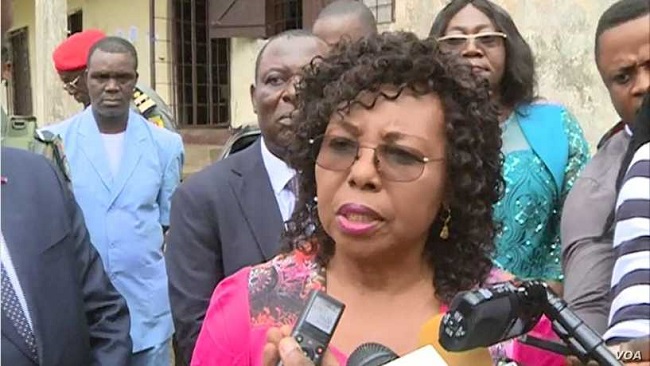
Bernard Okalia Bilai, governor of Cameroons English-speaking southwest region says fighters should drop their guns and have confidence that the dialogue will address issues they have been raising.
“I am appealing [to the fighters] to drop all their arms,” he said. “Our children are not going to school for three years. Please, can those who are preventing children stop. Can those who are destroying the economy because they wanted the dialogue stop so that we go to dialogue now and come back with peace.”
As the violence continues, Cameroon’s prime minister, Dion Ngute, has been consulting with political party leaders, civil society activists, opinion leaders, traditional rulers, lawmakers and clergy to gather their proposals, which will be submitted for examination during the national dialogue announced from September 30 to October 4 in Yaounde with the aim of achieving a definitive return to peace.
Civil society groups and opposition political parties are calling for the unconditional release of Anglophone separatist leaders and other political prisoners before discussions begin.
Separatist groups have, on social media, called the dialogue a non-event. They say they became a sovereign state called Ambazonia on October 1, 2017 when Ayuk Tabe, their leader declared their independence. They want the international community to intervene and press the government in Yaounde to order its troops out of Ambazonia.
The conflict in Cameroon’s English-speaking regions has killed more than 2,000 people, internally displaced more than 500,000 and caused more than 50,000 Cameroonians to seek refuge in Nigeria, according to the United Nations.
Source: VOA













25, September 2019
EU Brags Of Funding Guterres Genocide Office Amid Inaction on Southern Cameroons 0
The European Union is bragging about giving money to United Nations Secretary General Guterres supposed office to prevent genocide, under Adama Dieng who Inner City Press asked him about Southern Cameroons urged the territorial integrity of Biya’s terror state.
The European Commission’s Service for Foreign Policy Instruments (FPI) has granted more than $ 550,000 to the United Nations Office on Genocide Prevention and the Responsibility to Protect. This contribution supports the implementation of a project that aims to advance the prevention of genocide, war crimes, ethnic cleansing and crimes against humanity (atrocity crimes) globally.
With this grant, the European Commission supports multilateralism and stands firmly with the United Nations to prevent conflict and sustain peace. Mrs. Hilde Hardeman, Head of the Service for Foreign Policy Instruments of the European Commission and Under-Secretary-General Adama Dieng, Special Adviser on the Prevention of Genocide, signed an agreement in New York on this financial contribution.
The goal of this 18-month project is to develop and disseminate guidelines for practitioners on the prevention of atrocity crimes. This will entail the organization of an expert-level workshop and two high-level events, in Brussels and in New York to contribute to a broader atrocity prevention program.
During the signing of the agreement, Adama Dieng expressed the gratitude of his office to the European Union for “its strong support for the United Nations and multilateralism, which strengthens partnership and cooperation in early warning. He added that “this financial contribution from the EU to the UN Office on Genocide Prevention and the Responsibility to Protect will help prevent atrocity crimes and support the UN Secretary-General’s vision on prevention.”
This literally blood money. It would have been cheaper to just get France (and the UK) to stop supporting Biya’s killings, and to get Guterres to stop that and stop censoring the Press.
Culled from Inner City Press