17, March 2026
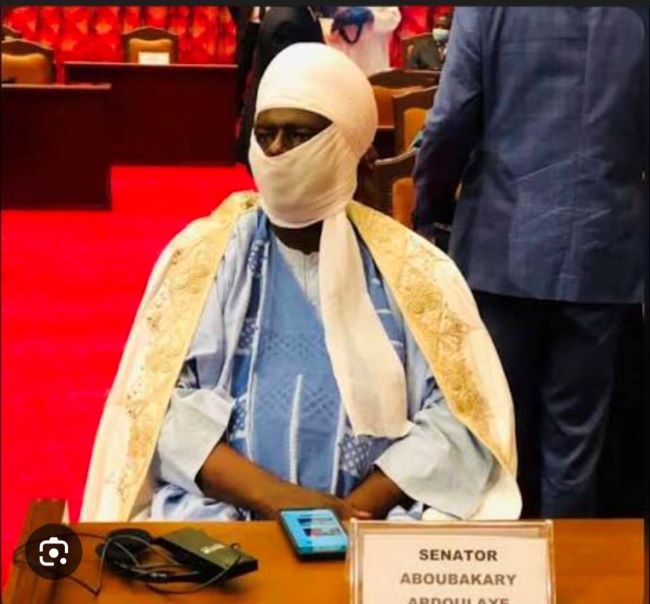
The Lamido of Rey Bouba is new Senate President 0
Senator Aboubakary Abdoulaye who also moonlights as the Lamido of Rey Bouba has been elected President of the Cameroonian Senate signaling the end of Niat Njifengi. Today’s electoral victory of Senator Abdoulaye marks a moment of both continuity and cautious anticipation in Cameroon’s political story. At a time when all administrative and political establishments in Cameroon are being tested by shifting public expectations, generational change, and demands for accountability, this change of leadership in the Cameroonian Senate carries significance well beyond ceremonial protocol in Yaoundé.
Senator Aboubakary Abdoulaye is stepping into the role with the weight of institutional responsibility on his shoulders. The Senate, often perceived as the nation’s House of Lords within Cameroon’s legislative framework, plays an important role in safeguarding constitutional order, reviewing legislation, and ensuring regional representation. This traditional leader from the Far North region will be judged not only by how effectively the Senate performs these duties, but also by how it responds to the broader concerns of Cameroonian citizens, Francophone and Anglophone.
Seas of political commentators have opined today that Senator Aboubakary Abdoulaye is a reflection of the enduring influence of established political structures in Cameroon. But his electoral victory also raises an important question: can continuity coexist with renewal? For many in Yaoundé, the hope is that Senator Abdoulaye’s tenure will not simply reinforce the status quo, but rather inject a measure of responsiveness into governance—particularly in addressing economic pressures, social cohesion, and the ongoing challenges in various regions of the country including the war in Southern Cameroons.
There is also political weight in leadership transitions such as this. They offer an opportunity to reaffirm public trust in institutions that, for some, may feel distant from everyday realities. The Senate president, though not always at the forefront of executive decision-making, occupies a position that can either reinforce institutional credibility or deepen public skepticism. Abdoulaye’s approach to transparency, dialogue, and legislative independence will therefore be closely scrutinized.
Cameroon stands at a delicate juncture. Its political future will depend not only on leadership at the highest executive levels but also on the strength and integrity of its legislative bodies. In this regard, the Senate presidency is more than a title—it is a test of stewardship.
As Senator Aboubakary Abdoulaye assumes office, the expectations are clear. Stability must be matched with vision. Tradition must be balanced with reform. And above all, leadership must remain attuned to the voices of the people it is meant to serve.
Whether this moment becomes a footnote in a long continuum of continuity or a subtle turning point toward renewal will depend on the choices made in the days ahead.
By Queen Besumbu Agbaw in UK with files from Rita Akana in Yaoundé
















19, March 2026
No tickets will be sold for Pope Leo XIV’s masses in Cameroon 0
A poster circulating widely on WhatsApp claims that access fees will be charged for masses to be celebrated by Pope Leo XIV during his apostolic visit to Cameroon. The poster, shared for several hours on the messaging platform, lists fees ranging from 10,000 to 100,000 CFA francs to attend celebrations in Yaoundé, Bamenda and Douala. The claim is false: the Apostolic Nunciature in Cameroon has formally denied that any tickets are being sold.
An image widely shared on WhatsApp claims to be an official poster for the apostolic visit of Pope Leo XIV to Cameroon, scheduled for April 15-18, 2026. The image lists several categories of access to papal masses: “ticket” (10,000 CFA francs), “comfort” (30,000 CFA francs), “premium” (50,000 CFA francs) and “ultra VIP” (100,000 CFA francs), and includes a WhatsApp number for reservations.
Several elements suggest the poster is not authentic. It does not display the official logo of the Catholic Church in Cameroon, refers to a ticketing system that is unusual for papal masses, and uses a graphic style more typical of commercial promotional posters.
Official framework of the visit
On February 25, 2026, the Civil Cabinet of the Presidency of Cameroon announced that Pope Leo XIV would undertake an apostolic visit to the country from April 15 to 18 at the invitation of President Paul Biya. The program includes stops in Yaoundé, Bamenda and Douala.
Local church authorities have also begun announcing the celebrations planned during the visit. The Archdiocese of Bamenda, for example, confirmed in a communiqué dated March 8 and published on March 13 that a mass will be celebrated at Bamenda Airport on April 16. The document does not mention any payment required to attend.
Official denial
Following the circulation of the poster, the Apostolic Nunciature in Cameroon issued a clarification stating that no tickets are being sold for the papal visit.
In its statement, the Nunciature confirmed that access to all liturgical celebrations presided over by Pope Leo XIV in Yaoundé, Bamenda and Douala will be entirely free. It added that no ticket sales or paid reservations have been authorized.
The Nunciature also warned against any private initiative seeking to charge for access to papal masses and called on the faithful to focus on the spiritual preparation for the visit.
The Archdioceses of Yaoundé and Douala also dismissed the poster on social media, stating that access to papal celebrations is free and that the message circulating online is a scam.
The poster claiming that access to Pope Leo XIV’s masses in Cameroon requires payment is misinformation. Church authorities confirm that attendance at the celebrations during the apostolic visit will be free.
Source: Sbbc