
21, July 2026
Cameroon Gold Scandal: UAE trade data exposes hidden exports amounting $524 million 0
Cameroon is set to launch a nationwide operation on August 1 to recover an estimated 305 billion CFA francs ($524 million) in unpaid taxes from undeclared gold exports after trade data from the United Arab Emirates (UAE) exposed major discrepancies in the country’s official export records.
The operation will target 51 mining companies and 33 previously unidentified mining sites suspected of evading taxes and customs duties between 2023 and 2025, according to the Ministry of Mines, Industry and Technological Development.
The crackdown follows findings in the 2023 Extractive Industries Transparency Initiative (EITI) report, which revealed that Cameroon officially declared exporting just 22.3 kilograms of gold in 2023.
In contrast, customs data from the UAE—one of the world’s largest gold trading hubs—recorded imports of more than 15 tonnes of gold originating from Cameroon during the same period.
According to the Gold Demand Trends report published by the World Gold Council, gold sales in the United Arab Emirates reached approximately 37.8 tonnes during the first nine months of 2023, making the UAE one of the world’s largest and most active gold trading and retail markets.
The discrepancy has fueled concerns over widespread underreporting, smuggling, and weak oversight in Cameroon’s mining sector, resulting in significant losses in tax and royalty revenues.
Cameroon moves to tighten oversight
The recovery campaign will be led jointly by the National Mining Corporation (SONAMINES), the Directorate General of Taxes, and the Directorate General of Customs.
Authorities will audit mining firms suspected of under-declaring production while investigating mining sites that allegedly operated outside official records. The government aims to recover unpaid royalties, mining taxes, and export duties tied to undeclared gold production over the past three years.
The initiative comes as African governments increasingly seek to boost domestic revenues amid rising debt pressures and tighter global financing conditions.
For Cameroon, the effort represents one of the country’s most ambitious attempts to formalize its gold industry and curb illicit mineral exports.
The case also highlights how international trade data is becoming an important tool in exposing illicit financial flows.
By comparing export declarations with customs records from importing countries such as the UAE, authorities can identify inconsistencies that point to underreported production or informal exports.
Cameroon is not alone in facing the challenge. Gold-producing countries including Ghana, Sudan, Mali, and the Democratic Republic of Congo have stepped up efforts in recent years to combat smuggling, strengthen mineral traceability, and improve revenue collection from the mining sector.
If successful, Cameroon’s tax recovery drive could serve as a model for how African governments use cross-border trade data to recover lost revenues and tighten oversight of one of the continent’s most valuable export industries.
Source: Business Insider Africa




















21, July 2026
Biya regime gives ship owner 15 days to clear wreck from Douala Port Channel 0
Cameroon has given the owner of the Black Rhino 15 days to remove the container ship from the access channel of the Port of Douala-Bonabéri after it ran aground following a collision earlier this month, as authorities seek to prevent further disruption at the country’s main maritime gateway.
The vessel, which is carrying about 150 containers, has remained stranded in the channel since the accident on the night of July 11-12. Within eight days, the shipowner must submit a final report prepared by its appointed experts, outlining the technical solution selected and a detailed recovery plan.
Specialists from marine salvage firms Wave Group and SMIT have already arrived in Douala. The MSM Dolores, a vessel that could assist in the operation, is also reportedly ready to depart from Bata in Equatorial Guinea.
The recovery plan must detail each stage of the operation, including stabilizing the vessel, removing containers, lifting and towing procedures, refloating operations, safety measures, pollution prevention, and the expected timeline.
If the shipowner fails to submit the plan within the deadline, the government will issue a formal eight-day notice. Should the company still fail to act, the authorities may carry out the operation themselves at the owner’s expense, in accordance with Cameroonian law.
Collision Blocks Part of the Access Channel
The measures were announced after a crisis meeting chaired on July 20 in Douala by Transport Minister Jean Ernest Massena Ngalle Bibehe.
The collision occurred during the night of July 11-12 in the port’s navigation channel. It involved the Sea Honor, a Tuvalu-flagged cargo ship leaving the port, and the Cyprus-flagged Black Rhino, which was entering the harbor.
The Black Rhino sustained damage near its bridge and was at risk of sinking. The Port Authority of Douala immediately activated its emergency response team.
The Sea Honor was freed and later towed to an anchorage area for repairs. To prevent it from sinking, the Black Rhino was intentionally grounded alongside the channel’s red buoy line, allowing maritime traffic to continue as much as possible. All 15 crew members were evacuated safely, and no fatalities were reported.
Navigation Restrictions Remain in Place
Although shipping resumed a few hours after the collision, the stranded vessel and its cargo continue to restrict navigation through the channel.
According to preliminary findings from the Port Authority of Douala, a steering failure aboard the Black Rhino may have caused the accident. However, that theory remains subject to the ongoing technical investigation.
The inquiry will determine the exact circumstances of the collision and assess the responsibilities of both vessels, their crews, and any other parties involved in the port maneuvers. Keeping the ship in the channel continues to pose operational risks by reducing maneuvering space, limiting access for some vessels, slowing traffic, increasing waiting times, and raising costs for shipping companies.
Authorities are also monitoring environmental risks, including potential hull damage, fuel leaks, and the possibility of containers falling into the water.
Strategic Trade Route at Stake
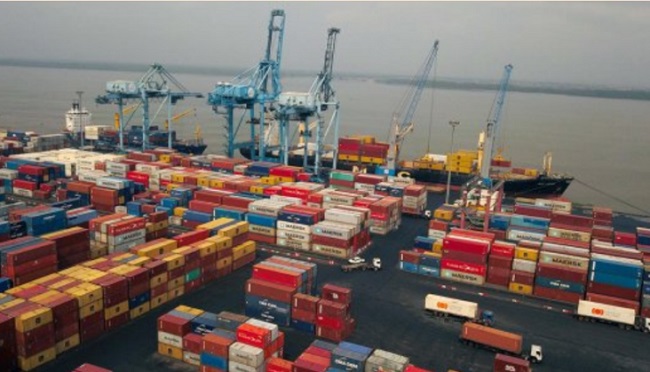
The Port of Douala handles most of Cameroon’s maritime trade and serves as the main gateway for cargo bound for Chad and the Central African Republic.
Any prolonged disruption to the navigation channel could therefore affect imports, exports, and supply chains in all three countries. The government’s ultimatum reflects its determination to speed up the recovery while ensuring that the shipowner bears the cost of the operation.
Beyond the immediate response, the accident has also highlighted the operational constraints of the Port of Douala’s busy and physically limited navigation channel, where incidents can quickly disrupt maritime traffic.
For the government, the priority is to remove the vessel as quickly as possible, maintain uninterrupted port operations, and preserve confidence among shipping companies.
Source: Business in Cameroon