30, November 2019
Call for support for Ambazonian prisoners of conscience on Prisoners for Peace Day 0
War Resisters’ International has recently been joined by new affiliates. One of the new affiliates of our expanding network is the Ambazonian Prisoners of Conscience Support Network (APOCS Net). On this Prisoners for Peace Day, we feature APOCS Net’s work and encourage our followers to write to Ambazonian prisoners of conscience, alongside other prisoners for peace and conscience.
Below is a call for support from APOCS Net explaining their work and encouraging everyone to stand in solidarity with, and write to, Ambazonian prisoners of conscience.
The Ambazonian Prisoners of Conscience Support Network
The Ambazonian Prisoners of Conscience Support Network (APOCS Net) was started in January 2018 by Ambazonian diaspora organizers and allies in South Africa, the United Kingdom and the United States who wanted to help Ambazonians who had been rounded up and imprisoned in secret detention centers of the French Neocolonial regime in Cameroon.
The current generation of Ambazonian Prisoners of Conscience refers to people imprisoned for the expression of their conscientiously held belief that the fundamental human rights of the people of Ambazonia, formerly the United Nations Trust Territory of Southern Cameroons under United Kingdom administration, needs to be respected by all — including the French neo-colonial regime in Cameroon and its allies. The conflict between Ambazonia and Cameroon, which is the basis for the imprisonment of close to 3,000 Ambazonian political prisoners, has it roots in the military occupation of Ambazonia by Cameroon following an ill-fated UN plebiscite on a confederation between the two countries in 1961.
Six decades of disciplined protest have been based on the principles of nonviolence and the slogan “the force of argument, not the argument of force.” The recorded history of repression against indigenous Ambazonians, however, goes as far back as 1891 during the period of German colonization. Legendary leader Mountain King Kuva Likenye was deported from Buea to Wonya Mokumba because of his anti-colonial stance, where he fell ill and died soon after.
The number of Ambazonian political prisoners has skyrocketed since fall 2016, following nationwide protests to defend the Ambazonian common law–based judicial system from the Cameroonian regime’s attempt to replace it with what amounts to a colonial court system.
Leaders from all corners of Ambazonian civil society have been rounded up in the dragnet that followed this nonviolent uprising — teachers and teachers union leaders (including Vice Principal Penn Terrence and Mr. Wilfred Tassang, organizer with the Ambazonian Teachers’ Union, CAPTAC), lawyers and legal workers union leaders (including Barrister Shufai Berinyuy and Barrister Eyambe Elias, both organizers with the Ambazonia Legal Workers Union), journalists and press union leaders (including Mancho Bibixy, Tsi Conrad, Awah Paul and Felix Ngalim), student union leaders, doctors, and members of the traditional rulers association.
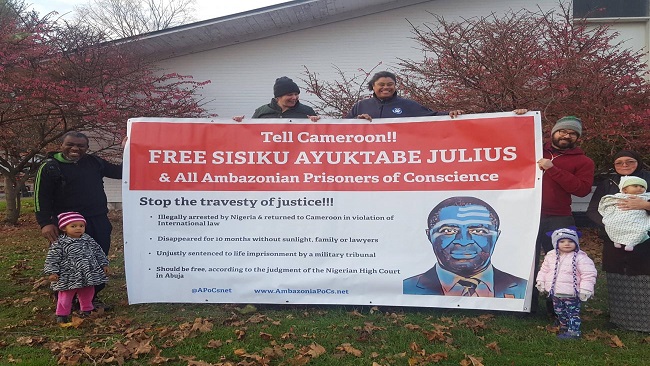
The most high-profile prisoner is Sisiku AyukTabe Julius, an open source tech developer known for his nonviolent leadership and philanthropic work, who in January 2018 was arrested along with his aides while meeting at the Nera Hotel in Nigeria, and forcibly returned to Cameroon in violation of the international legal principle of nonrefoulement.
In March 2019, the Federal High Court of Nigeria ruled that the abduction and deportation of these “Nera 10” and other prisoners by Nigerian authorities was illegal within Nigeria, and a violation of international law, and that they should be immediately released and returned to Nigeria. Yet they are still being imprisoned by the Cameroon regime.
These prisoners of conscience continue to provide leadership from behind bars, and APOCS Net works to support their physical and emotional well-being, to gather and disseminate information that is relevant to their struggle, and to organize solidarity actions in consultation with their needs and campaigns. We also work to support imprisoned human rights defenders in Cameroon, such as the Kamto 203 and l’Association pour la Défense des Droits des Etudiants au Cameroun (ADDEC), as well as other political prisoners in the rest of the Francafrique controlled territories. APOCS Net actively seeks to contribute to the building of a global network in solidarity with imprisoned human rights defenders all over the world.
Below is information on how you can write to the Ambazonian prisoners of conscience named in this article. Follow the links to read more.
The Nera 10:
- Mr. Julius AyukTabe — American University of Nigeria in Yola, North Eastern Nigeria
- Mr. Wilfred Tassang — organizer with the Ambazonia teachers Union, CAPTAC
- Professor Augustine Awasum — Ahmadu Bello University, Zaria, Northern Nigeria
- Dr. Cornelius Njikimpi Kwanga — Umaru Musa Yar’adua University in Katsina, Nigeria
- Dr. Henry Kimeng — Ahmadu Bello University, Nigeria
- Dr. Fidelis Ndeh-Che — American University of Nigeria in Yola, North Eastern Nigeria
- Dr. Egbe Ogork — Associate Professor, Bayero University in Kano
- Barrister Shufai Berinyuy — Organizer with the Ambazonia Legal workers Union
- Barrister Eyambe Elias — Organizer with the Ambazonia Legal workers Union
- Dr. Nfor Ngalla Nfor — Ambazonia Civil Society leader
Write to the Nera 10 prisoners at the following address:
Prison Principal Kondengui Yaoundé
B. P 100, YAOUNDÉ
Cameroon
NOTE: write to each prisoner individually, using their individual names; do not use the term Nera 10!
- Penn Terrence: https://ambazoniapocs.net/node/11
- Mancho Bibixy, Tsi Conrad and others: https://ambazoniapocs.net/node/8
Write to Penn, Mancho and Tsi at:
Prison Centrale de Yaoundé
B. P 100, YAOUNDÉ
Cameroon
















2, December 2019
Southern Cameroons Crisis: Commonwealth, AU, OIF Call for Peace and Unity 0
Three international organizations have ended an official visit to Cameroon with a call for efforts to restore security, justice and the conditions for the resumption of normal life in English-speaking northwest and southwest regions of the country hit by the separatist crisis that has killed over 3,000 people. The Commonwealth, African Union, and International Organization of La Francophonie delegation says it is convinced dialogue remains the preferred path for peace to return, but that the government should start implementing the recommendations of the last major national dialogue it organized. Some, however, have been critical of government efforts.
Moussa Faki Mahamat, chairperson of the African Union Commission, says after exchanging views with Cameroonian President Paul Biya, Prime Minister Joseph Dion Ngute, representatives of the main political parties, religious leaders, youth representatives and a cross-section of Cameroonians, the organizations are convinced that there is a yearning for peace to return to the restive English-speaking regions.
He says they noted that a majority of Cameroonians welcomed the convening of the Grand National Dialogue from September 30 to October 4, in which Cameroon’s government consulted with political party leaders, activists, opinion leaders, traditional rulers, lawmakers and clergy, and are anxiously waiting for the government to implement its recommendations. Those recommendations include establishing some sort of special status for the minority English-speaking regions, to be considered by the country’s parliament. It also backed enforcement of the constitutional language giving English and French equal status and saying they must be used in all public offices and documents. It also backed continuing the process of decentralization by giving more powers and resources to local councils.
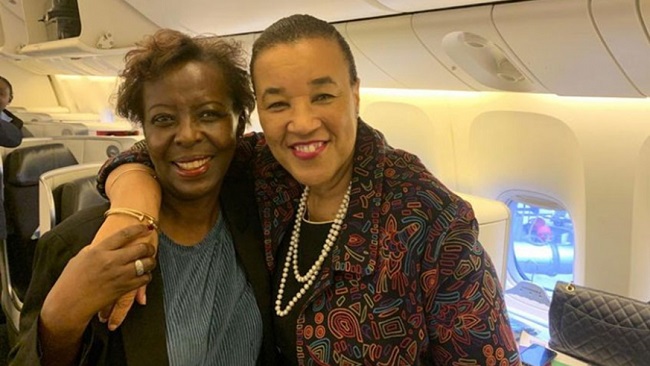
Mahamat participated in the tripartite mission with International Organization of La Francophonie Secretary General Louise Mushikiwabo and Commonwealth Secretary General Patricia Scotland to encourage national peace efforts.
Mahamat said after their meetings in Yaounde, they observed that a large majority of Cameroonians supported the convening of the major national dialogue and believe it aided their quest for peace. He said they were convinced that dialogue remains the only path to peace, and asked the government to implement the recommendations of the national dialogue.
After the national dialogue, hundreds of prisoners were freed when Biya ordered a halt to court proceedings against them, saying he was implementing the recommendations of the dialogue.
However, Albert Mvomo, an official of the opposition Cameroon United Party, says Biya’s government has not been doing enough to solve the crisis. He says the AU, OIF and Commonwealth delegation should have proposed sanctions to force Biya to solve the crisis.
He says the three organizations, like any international organization, should force the government in Yaounde to solve the crisis in the English-speaking regions through economic and diplomatic sanctions. He says Cameroon’s government shows no serious sign of wanting to stop the crisis.
Mvomo said the growing number of displaced people in towns and villages in the French-speaking regions showed the government has not been doing much to stop the separatist conflicts.
Simon Munzo, an Anglophone leader who took part at the national dialogue, says while some recommendations would require legislation, Cameroon should have started showing serious signs that it wants peace to return by restoring public infrastructure and villages and towns destroyed by the fighting for the population to return.
“We expect the government to maintain the momentum through the implementation of the recommendations of the dialogue,” said Munzo. “Some of them require legislation. Others do not, for example rebuilding schools and bridges and all of that. You do not need legislation for that except in terms of budgeting. Now, there are other aspects that will require modifying the constitution.”
Separatists have insisted on social media that they do not recognize the outcome of the national dialogue and will be ready to negotiate with the Yaounde government only on the terms of the separation of the English-speaking and French-speaking parts of Cameroon.
Source: VOA