
6, October 2019
Southern Camerons Crisis: Will the National Dialogue make any difference? 0
Life in Cameroon’s two English-speaking provinces has been brought to a standstill by three years of conflict, which has cost about 3,000 lives and forced 500,000 from their homes.
The dispute had been simmering for decades, but boiled over in 2016, when teachers and lawyers started to protest against the use of French in schools and courts.
The government in the majority French-speaking country responded with lethal force, provoking rebels to declare independence for the region they call “Ambazonia”, which in turn led to an even stronger military crackdown.
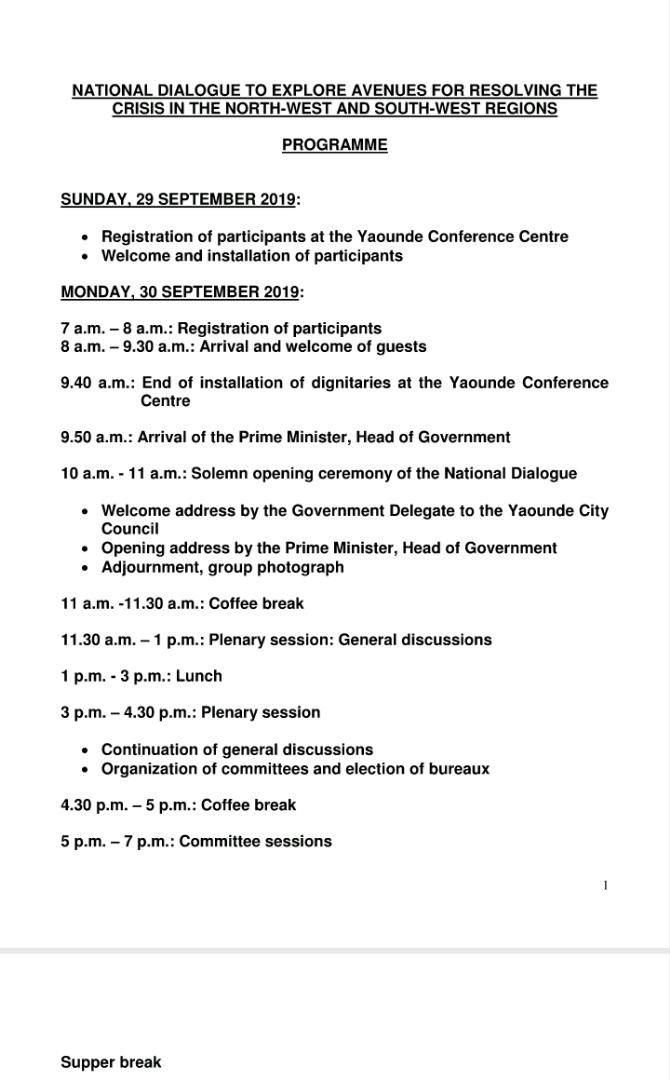
In an attempt to end the crisis, President Paul Biya called for talks, dubbed the National Dialogue, this week.
Some were encouraged by this, but others dismissed it as a sham. So what has it achieved?
The National Dialogue made a series of proposals:
- the adoption of a special status for the two Anglophone regions
- the restoration of the House of Traditional Chiefs
- the election of local governors
- the immediate relaunch of certain airport and seaport projects in the two regions
- the rapid integration of ex-combatants into society
- the name of the country be returned to former name, the United Republic of Cameroon
- implement the law that government officials declare their assets, in order to tackle corruption
Why do these proposals matter?
A return to the name United Republic of Cameroon is significant as it would go some way towards recognising the different histories of the different parts of the country.
At independence, the Southern Cameroons (colonised by Britain) voted in a UN-organised plebiscite to be united with the Republic of Cameroon (formerly colonised by France).
The new country the two entities created was called the Federal Republic of Cameroon. But the federation was scrapped in 1972 in a controversial referendum, giving rise to the United Republic of Cameroon.
“It is the abolition of this federal structure that lies at the core of the Anglophone problem,” opposition leader John Fru Ndi told the BBC.
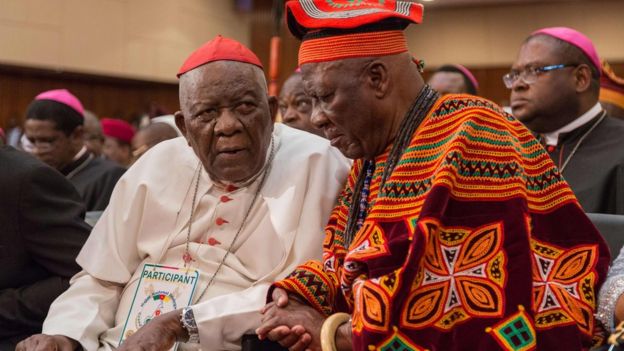
In 1984, President Paul Biya worsened the situation by scrapping the word “united” from the name of the country, and it became known simply as the Republic of Cameroon, which was the same name given at independence to the part of Cameroon colonised by France.
“What that meant was that the Anglophone entity had been annexed,” Mr Fru Ndi said.
What difference would they make?
A return to the United Republic of Cameroon has been welcomed, although Mr Fru Ndi would have preferred a return to a federal system of government.
The prospect of electing local governors has also been welcomed by many. Jean Emmanuel Pondi, a professor of political science, told the BBC that “for Anglophones, it is a return to normalcy”.
He said that locally elected officials would mean decisions being taken closer to the people.
“It used to be an administration of proximity where things are done by the people, for the people, and in the right moment,” Prof Pondi said.
“The problem with the centralisation of power is precisely that things are done miles and miles away, by people who have no idea of the consequences of the decisions they are taking.”
He said giving more autonomy to the regions would also “accelerate their dimension of good governance, because you have to be accountable immediately, or else, you are not elected”.
The proposals will be forwarded to President Biya, with the expectation that he will order them to be implemented.
Cameroon – still divided along colonial lines:
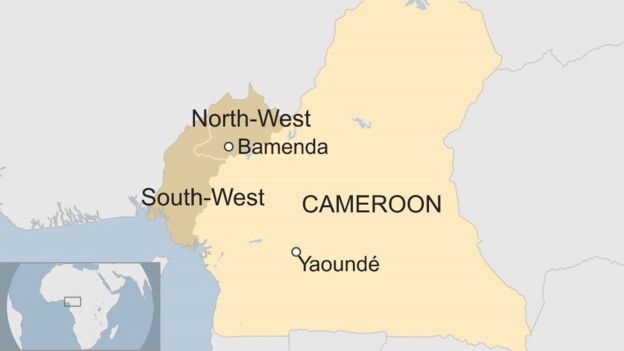
- Colonised by Germany in 1884
- British and French troops force Germans to leave in 1916
- Cameroon is split three years later – 80% goes to the French and 20% to the British
- French-run Cameroon becomes independent in 1960
- Following a referendum, the (British) Southern Cameroons join Cameroon, while Northern Cameroons join English-speaking Nigeria
What has the reaction been?
Opinion has been sharply divided.
Backers like Elvis Ngolle Ngolle, a senior figure with the ruling party, thinks that it is a “decisive step in the right direction”.
“It will enhance participatory development across the country,” he told the BBC.
“We believe that these proposals will calm down minds and restore peace.”
But Akere Muna, a political leader and former Cameroon representative of Transparency International, walked out of the talks in protest over what he said were attempts to stifle debate.
“Speakers were pre-arranged. You couldn’t even ask a question. It was stage-managed. So they were actually looking for spectators, not participants,” Mr Muna told the BBC.
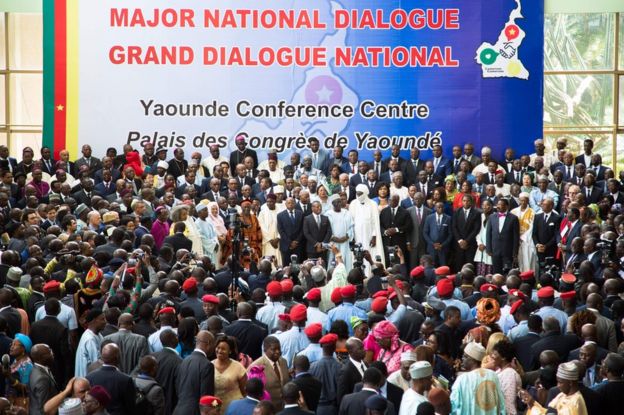
Noting that the debate in the two English-speaking regions was about “secession and separation,” he questioned why there was no commission to examine those alternatives.
“So, I thought that the prescription had nothing to do with the illness,” he said.
On Thursday, in what appeared to be a goodwill gesture President Biya ordered all charges dropped against more than 300 people detained in connection with the Anglophone crisis.
But the decision failed to appease critics who say thousands more are locked up on trumped-up charges.
What do the separatists say?
They have pledged to keep fighting until “Ambazonia is freed”.
Ivo Tapang, a spokesman for 13 armed groups called the Contender Forces of Ambazonia, has made it clear that the concessions made so far are not enough to deter them from their fight for freedom.
“We will not accept an olive branch from someone whose troops are still in our territory,” he said. “We will intensify our struggle with guns and bullets.”
Source: BBC














7, October 2019
Biya declares National dialogue ‘success’, Ambazonians doubtful 0
Cameroon’s president Paul Biya on Friday praised this week’s national dialogue, saying a series of recommendations had been published, including the equality of English and French speakers, giving greater autonomy to the provinces and offering amnesty to fighters who down arms.
The dialogue “afforded you the opportunity to reaffirm once more your attachment to peace and concord in your country,” Biya said in a tweet addressing the people. “I would like to congratulate and thank you very sincerely for that.”
The government hoped that the talks, which closed on Friday, would open the door to a historic peace agreement, ending a fight between the army and English-speaking militias seeking to form a breakaway state called Ambazonia.
The conflict has cost nearly 2,000 lives, forced half a million people to flee and presented President Paul Biya with his biggest threat in nearly 40 years of rule.
What did the government offer?
Biya, who is 86 years old, said on Tuesday that he would drop charges against 333 prisoners held in relation to the crisis, but the move failed to appease separatists and moderates alike who say that thousands more remain imprisoned on trumped-up charges.
On Thursday, delegates at the Grand Dialogue recommended the adoption of a “special status” for the two regions where most of the country’s English-speaking minority (16%) live.
The special status, if approved by the central government, would grant them greater financial autonomy, the possibility of electing their local governors previously appointed by the executive, and the restoration of a house of traditional chiefs in these two regions.
The prime minister, Joseph Dion Ngut, who chaired the dialogue, described it as “a success (…) because it found interesting and permanent solutions to the problems most Cameroonians” were raising.
Several moderate Anglophones, in favour of a return to federalism and not in favour of the secession demanded by the radical ones, cautiously effectively welcomed the recommendation.
“This special status is just a first step towards finding a permanent solution to this crisis”, the famous Anglophone human rights lawyer Felix Agbor Nkongho told the AFP.
Its application, which requires a constitutional amendment, “could have a strong symbolic value in the minds and attitudes of those who wanted a return to federalism,” says Cameroonian researcher Edouard Epiphane Yogo of the Bureau des Etudes Stratégiques in Yaoundé.
“It would be a victory for those who absolutely wanted federalism, and a victory for those who wanted decentralization,” he says.
Critics say it is ‘not enough’
However, “the war is not over,” says English-speaking activist Ayah Ayah Ayah Abine, who believes that “only negotiation between the two sides can put an end to the war.
“After the thousands of lives wasted by the radicalization of both sides, something really special would be needed to end this conflict,” he added, arguing that Yaoundé‘s proposed status for the English-speaking regions is “only a combination of words that does not cover anything specific.
The dialogue was boycotted by key leaders of the separatist movement.
“The inhabitants of Ambazonia do not need a special status. We are not part of Cameroon,” Ebenezer Akwanga, leader of one of the separatist armed groups told AFP.
“Ambazonia is marching towards freedom and nothing can stop us,” he added.
For Chris Anu, the independence leader, this proposed special status is almost an insult:
“Do they suggest that we are a handicap?”, he asks, before asserting: “Nothing less than total independence for the people of the Southern Cameroons (another name for the English-speaking state wanted by the independentists), and there is no way to discuss it”.
Critics say the talks this week were not inclusive and did not involve any discussion about a return to federalism that many say is the solution to the conflict.
“Cameroon is a joke,” said Cho Ayaba, a leading member of the Ambazonian Governing Council. “Let me be absolutely clear: no Ambazonian is and will be part of Cameroon’s charade.”
Former opposition presidential candidate Akere Muna was told at the talks that the people allowed to speak at one session had already been identified and that he would not be able to participate.
“I said to myself, but that’s not a dialogue,” Muna told Reuters. “It’s a show and I’m a spectator. I left.”
Roots of the conflict
The roots of their grievances go back a century to the League of Nations’ decision to split the former German colony of Kamerun between the allied French and British victors at the end of World War One.
For 10 years after the French- and English-speaking regions joined together in 1961, the country was a federation in which the Anglophone regions largely governed themselves. Biya’s centralisation push after he came to power in 1982 quickly eroded any remaining Anglophone autonomy.
The insurgency emerged after a heavy-handed government crackdown on peaceful protests late in 2016 in the Anglophone Northwest and Southwest regions by lawyers and teachers who complained of being marginalised by the French-speaking majority.
Within months of the initial 2016 protests, newly-formed armed groups were attacking army posts in the Anglophone regions. The army responded by burning down villages and shooting civilians.
Once vibrant cities, including the technology hub of Buea, have turned into ghost towns. Most schools have closed; villages have emptied out as people flee into Nigeria.
Separatists entrenched in the mountainous west say they will only come to the table if the government releases all political prisoners, including 10 leaders who were sentenced in August to life in prison on terrorism charges, and withdraws the military from the two English-speaking regions.
“When we want to bring peace, it is generally the symbols that count, the symbol is not the number” of detainees released “but rather the quality” of those who are released,” warns Yogo.
Source: Agencies