20, September 2021
Southern Cameroons Crisis: Yaoundé is in a cul-de-sac 0
Four years ago, nobody thought the whole notion of Southern Cameroons independence could ever be taken seriously.
For many in government, those who called for the separation of Cameroon, a country touted as an oasis of peace in a desert of chaos, were adventurers who were playing with fire.
The Yaoundé government which is known for its penchant for repression declared the angry Southern Cameroonians terrorists and immediately proceeded to implement its strategy of repression in the pious hope that future adventurers would think twice before calling for any independence.
This wrong assessment of the situation pushed bureaucrats in Yaoundé onto the airwaves to pontificate on things they had very little knowledge of, confidently telling the French-speaking majority that the military’s mission in the two restive regions of the country would be swift and short.
In less than two weeks after the country’s president, Paul Biya, declared war on two English-speaking regions of the country, the government dispatched hundreds of its outdated tanks to many remote parts of Southern Cameroons not knowing that the outcome could be the reverse of what many in the country’s bureaucracy were sure about.
Little did the government and its poorly trained soldiers know that they were treading on dangerous terrain. The government was confident that it was going to roll back the “adventurers” right back to where they came from, but it did not know that behind the ragtag military, there was massive financial and moral support which will help the fighters to give the government’s military, a run for its money.
For years after, the ragtag military has morphed into a very dangerous force that is wreaking havoc on the military and its expensive equipment.
The last couple of months have been particularly tough for the military. The various factions seem to be ganging up against the military and the northwest region in particular has become a graveyard for many soldiers and their military equipment.
Last week was indeed one of the bloodiest with Ndop fighters demonstrating that they can hit the military anywhere, anytime and where it hurts the most.
Southern Cameroonian fighters are no longer interested in exchanging fire with the fear-filled soldiers. They are now employing a more sophisticated and effective method to hit the military in its soft underbelly.
Soldiers are now being blown up like dilapidated buildings with many bursting like rotten tomatoes. The use of IEDs by Southern Cameroonian fighters is one game changer that has left the Yaoundé regime in the grip of mobid fear and in a cul-de-sac.
The government seems to be frozen in its position. The country’s president, Paul Biya, had vowed that there would never be talks on the form of the state, but things are changing on the ground and if care is not taken, Southern Cameroons’ independence might come sooner rather than later.
The fighters on the ground are determined and the massive flow of cash from many parts of the world is giving the fighters a morale boost.
The government is confused. The Southern Cameroonian crisis has become a hot potato in the government’s mouth. The government must decide. It must change its position. Time is of the essence in this situation. Cameroon is falling apart.
The government must come back on its decision. It will never win this war. Its soldiers are deserting and this is rendering the military more vulnerable.
Despite numerous recruitment drives for more gendarme officers and soldiers in the country, the Yaoundé government is still concerned as its hope of winning this dirty war is diminishing by the day.
Most of the soldiers being killed are young men from the South and Center regions and the numerous body bags heading to those regions are gradually convincing the president’s supporters that he had engaged in a journey that might not be ending anytime soon.
The Cameroon Concord News Group has been talking to some soldiers in Yaoundé and many say they are permanently in fear. Many have lost their mental health and the mere thought of being sent to the warfront has transformed the stomachs of these soldiers into butterfly tanks.
More than three thousand soldiers have been killed and a similar number has been maimed. Most of those who get deployed to Southern Cameroons usually visit their doctors and they feign illnesses just to obtain either exemptions or 6- monthly sick-notes.
Young recruits are quitting the military daily. Many in the military are now handing themselves in to be imprisoned for 6 months (customary prison term for disobeying war orders) instead of going to Southern Cameroons.
The much-touted Cameroon military is gradually falling apart, especially as thousands are deserting and heading to neighboring countries.
To encourage the country’s military, the government recently issued a memo to the army and gendarmerie to the effect that should a soldier die in combat, his or her family would receive a paltry sum of CFAF 5 million.
Unfortunately, this financial incentive is not helping and many young soldiers are plotting to quit the beleaguered and poorly-paid military.
Soldiers of the rank and file know they cannot win the war, but their bosses are insisting that they must fight to a finish, especially as the war has created a booming war economy that is transforming the military generals into instant millionaires.
Paul Biya seems to have handed the treasury to the military but Southern Cameroonian fighters are clearly demonstrating that this war is not a war of money but a war of courage and strategy.
They have proven that even if the Yaoundé government is given the Federal Reserve (the American Central Bank), it will never win this war.
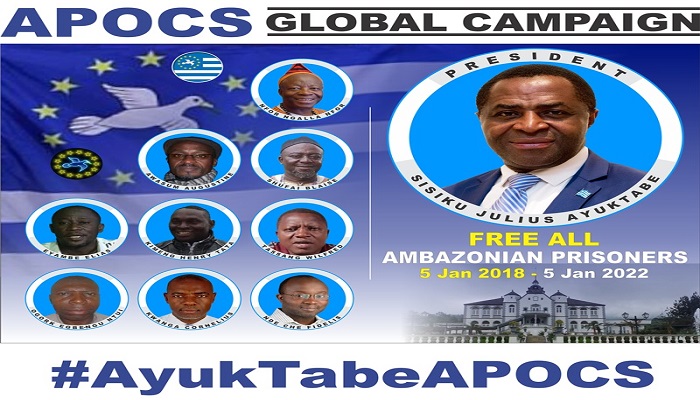
The dynamics are changing on a daily basis and the power dynamics clearly favor Southern Cameroonians and their fighters who are looking forward to the day the government will swallow its pride and call for real negotiations which will lead to an independent and strong Southern Cameroons with Sisiku Julius Ayuk Tabe and his colleagues taking the reins of power in their fatherland.
By Soter Tarh Agbaw-Ebai


23, September 2021
The War in Southern Cameroons: A Report From Ground Zero 0
A Cameroon Catholic priest kidnapped on Aug. 29 by separatists was freed two days later in a rare piece of good news in a country suffering from increasing internal conflict that is tearing this nation apart.
Msgr. Julius Agbortoko Abbor, the vicar general of the Diocese of Mamfe, was released after being abducted from the residence of the bishop emeritus of the diocese by a group of young separatists who entered the major seminary compound and kidnapped him, according to ACI Africa.
Just days before the kidnapping, Catholic bishops in Cameroon’s Bamenda Ecclesiastical Province renewed an appeal to end the protracted five-year conflict in the country’s two Anglophone regions in the nation’s northwest and southwest.
“A lot of violence, insecurity, kidnappings, torture, and senseless killings, sometimes of innocent people and children” is continuing in Cameroon, the bishops said, and they appealed to all warring parties to stop the ongoing violence “with immediate effect.”
Cameroon’s internal conflict, which began in 2016 and has worsened since 2018, revolves around marginalization of the Anglophone minority in the country (20% of the population) and its grievances against the majority Francophone population and administration.
Anglophone lawyers had complained in the mid-2010s that the English legal system was being undermined and overwhelmed by the civil law system, dominated by Francophone jurists, lawyers and magistrates. Meanwhile, teachers in the Anglophone part of the country grew resentful that non-English-speaking educators were being sent to teach students in English.
These and other resentments, coupled with inadequate leadership from President Paul Biya, 88, led to a brutal military crackdown by the government in 2017 of peaceful demonstrations. Violence was also perpetrated against lawyers, there were incidents of torture and rape, including of students at the nation’s Anglophone university, along with the arbitrary arrests and detention of peaceful protesters, many of whom remain in prisons around the country.
These injustices led to the growth of of more than 30 Ambazonian militia groups, known locally as “The Boys,” in the historically English-speaking regions. Formed in 2016, they are pushing for a new autonomous region called Ambazonia, covering territory that had been the former British colony of Southern Cameroons, but which became part of unified Cameroon in 1961.
The Ambazonian separatists have since embarked on destroying everything that belongs to the Francophone government — houses, markets and goods, and have killed some of those who fail to respect them and their objectives.
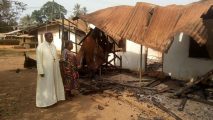
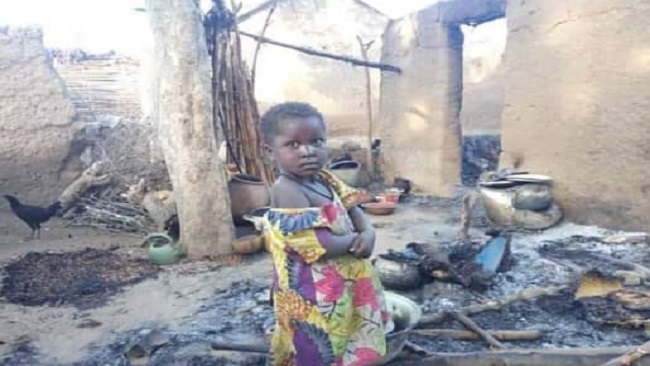
Particularly damaging has been the closure of schools in the two regions since the beginning of the crisis. Only a few of the schools manage to operate, and they are vulnerable to attack at any time, with teachers and principals at risk of death and school buildings set on fire. One was gutted last week just before the start of the new academic year by unidentified persons.
An Ambazonian fighter told the Register he joined the separatist cause, “because of the torment Anglophone citizens have been suffering from La Republic [Francophone] government.”
“I therefore decided to join the fight for independence,” he said. “I have been fighting for over four years now.”
Others told the Register they joined because the army had destroyed their houses, killed family members and committed acts of torture, and so they joined to retaliate.
Humanitarian Crisis
More than 3,500 people have been killed since the current conflict began in 2016 with killings taking place on daily basis, according to humanitarian organizations.
Over 67,000 people have fled across the border and are now living in Nigeria or remain as refugees there. According to a U.N. report, 4.4 million people are threatened by the war, while 2.2 million are directly affected. Thousands have been internally displaced, living in unbearable conditions in other French-speaking regions.
Emmanuel Lampaert, operations coordinator for Doctors without Borders (MSF) in Central Africa, said that many of those in hospital are suffering from malnutrition.
“We cannot stay any longer in a region where we are not allowed to provide care to people here,’’ Lampaert said in reference to the government suspending MSF activities in the region last December after accusing it of supporting the armed groups.
“The suspension significantly reduces access to medical services in an area where communities are badly affected by armed violence,” he said. “Those who have fled the violence often take refuge in the bush, far from any health facilities, vulnerable to malaria, infections or snakebites, in locations often inaccessible for emergency vehicles such as ambulances, or even motorcycles.”
“When two elephants are fighting, the grass suffers” goes the old African saying and it is particularly apropos to this five-year old conflict that has brought great suffering to the local population, caught as it is between the military and secessionist fighters. It also shows no sign of ending, as the government continues to be reluctant to build a general consensus and truthful, inclusive national dialogue with all the protagonists to find a lasting solution.
The Catholic Church has been deeply concerned about the crisis. Christians represent the majority in the region and have been badly affected. The bishops of the Bamenda Ecclesiastical Province wrote a memorandum in 2016 outlining the cause of the conflict and proposing solutions but it received no response from the Biya administration.
The late Cameroonian Cardinal Christian Tumi, who died in April aged 90, tried to convene an all-Anglophone conference but it required government and international support which were not forthcoming. Church leaders, meanwhile, have used their pulpits and give interviews to local TV channels to make their voices heard.
In an interview with a local TV channel on Feb. 24, 2020, Archbishop emeritus Cornelius Fontem Esua of Bamenda — who was once taken hostage by secessionists — said, “The position of the Church is that we are neutral, neither for the government nor the Amba boys. We tell them: no violence, no killings, that God’s law is ‘Thou shall not kill’ whether it’s the military or the Amba boys.” To resolve the conflict, he said there should be a total amnesty: “Let the military go back to their barracks and the Amba boys should put down their arms.”
Without mincing his words, Cardinal Tumi said in 2019 that most of the killings in the regions are by the military because they are the ones with sophisticated weapons. The separatists do kill, but their targets are the military and those whom they suspect are enemies of the Ambazonia, be they Anglophone or Francophone. For example, five police officers were given a state burial last month after being killed by a mine laid by separatists on Aug. 10 in Bafut, in the northwest region.
Last week, 15 soldiers were killed in an ambush by the separatists fighters led by a commander of the Bambalang Marine Forces who calls himself “General No Pity.” Separatists have also recently burned down a market, the office of a local mayor, and the residence of a senior law enforcement officer in Balikumbat, northwestern Cameroon. These acts of violence have even led to some Francophones calling on the army to step up their fight instead of calling for peace.
Many civilians continue to perish regularly. On Aug. 20, a 7-year-old girl, a pupil of St Therese Primary School in Kumbo, was shot and killed in crossfire. Two weeks earlier, seven civilians were killed by the military in Meluf, including local citizen Jude Thaddeus, a nephew of this correspondent.
In July 2018, Mill Hill Missionary Father Alexander Sob Nougi was accidentally killed by a stray bullet on Church premises. In May 2018, many people mistaken as separatists were fatally shot by the military in Pinyin, while what has become known as the Ngarbuh incident, which took place on Feb. 14, 2021, 21 civilians, including 13 children, were killed in their sleep by Cameroon soldiers and Fulani militia, a predominantly Muslim group better known in Cameroon as “Mbororos,” who claim to be victims of separatist groups.
According to a report from Human Rights Watch, 350 people have been kidnapped since October 2018, including 300 students and released after a ransom was paid in most cases. Cardinal Tumi was also kidnapped in 2020, as priests and religious seem to be targets. The report also condemned regular use of torture and secret detention from Cameroon authorities.
Cameroonian Voices
Father Gaston Yuven, a curate of St. Paul’s Parish, Kikaikom Kumbo Diocese, a stronghold of the armed secessionist group, told the Register, “It’s disastrous but this doesn’t stop people going about their daily activities. One just needs to enquire before taking any step. Then you’re safe.”
“There is an increase in faith; more people come to Church,” he added. “Those who want to come always make it but when it is not safe, the liturgies go ahead while the others keep themselves safe. More people turn to put God at the center, but a few seek protection elsewhere.”
“The present situation is getting worse because more casualties are being registered,” Deacon Doh Lawrence of the Diocese of Kumbo said. “Many innocent civilians are killed, and gun battles have intensified. Nearly everything is at a standstill because many roads are blocked, and battles continue. Poverty has increased, people are dying in houses because of no medical attention. Churches are empty because people have been displaced. Many schools remain closed because of threats from separatists, economic activities are experiencing a heavy downturn. Kumbo market is nearly empty since many people can’t sell their goods.”
A separatist fighter told the Register that “right now the situation here is not calm. We have been losing lives here about a week now. A child of 7 years was shot in Kumbo by the military and they’ve also been raping our women, burning down people’s houses, stealing from people’s houses, keeping military bases in villages. The situation is getting worse and worse.”
A military source who spoke on condition of anonymity said a lot of uniformed men have been lost since last month in the two regions, with daily reports of them being killed either during confrontations or setting off mines laid by the separatist. Some reports even mention 3,000 military deaths since the beginning of the crisis, and the number could be higher.
To make matters worse, the blockage of roads is forcing civilians to cover miles on foot to either get to the hospital, markets, etc., since no vehicle is allowed. Bishop George Nkuo of the Kumbo Diocese once had to trek many miles with his Mass kit for his pastoral mission to a neighboring village.
But despite all these difficulties, faith in the region remains robust: thousands of Christians hold firm to the belief that God is the one to bring an end to this war. Thus their unflinching trust in God persists through all the difficulties they are going through.
The unwavering faith of Christians is something to behold — they constantly pray for a return to peace. The pain is great, the damage irreparable. Enough blood has been shed, and human life has lost its value in the troubled regions. There is fear, insecurity looms all over the conflict-torn regions. The end of the war is not a matter of today nor tomorrow. The government vehemently refuses to adhere to numerous proposals, instead offering solutions that are far from bringing an end to the conflict.
A so-called “grand national dialogue” between the warring parties took place Sept. 30 -Oct. 4, 2019, but it seems to have been a place to squander billions rather than to discuss a path to peace, the result being that after the talks, atrocities increased, with the number of killings more than ever, and schools still closed in most areas.
As Archbishop Esua of Bamenda said during his interview, some topics like the form of the state were considered taboo during the national dialogue, which is the major concern of the Anglophones. This has led people to question the seriousness of the government in finding a lasting solution to this problem. The creation of a national disarmament, demobilization and reintegration committee (DDR), the special status of the two English regions, and a special fund for the reconstruction of the two destroyed regions are merely dormant measures that have yielded little fruit because the situation on the ground remains chaotic.
Epilogue: A Correspondent’s Analysis
Speaking as a Cameroonian who has witnessed this conflict first-hand, I can say that never in the history of this nation has it been on such a divided course. People are divided more than united, opinions are opposed, clergy are against clergy, politicians against politicians, Francophones against Anglophones, Anglophones against Anglophones.
Some who are radical want total independence while the majority want a complete federal system of government, separate from the current centralized system of government. But even with decentralization, it still doesn’t answer the wish of the Anglophones.
As division continues while more blood is shed, the majority of government workers — teachers and other public workers — have fled the regions but continue to earn their monthly salary. Some have not taught for the past four years. They are targeted by separatists. The region has gone backwards by 20 years — economically, socially and spiritually. Those areas that have been the most resilient, such as Kumbo, which is one of the biggest and more active parts of the region, has become a shadow of itself.
As long as both sides are unwilling to discuss the issues fairly, a compromise will remain elusive. People are afraid to talk, even some bishops have forbidden their priests from speaking publicly on the issue. Because the truth is hidden by lies, the military and separatists are unable to accept responsibility for the atrocities they commit.
The international community needs to act so these atrocities will stop. Mere words of condemnation are not enough; they need to act. Young people are frustrated, some becoming armed robbers or prostitutes in other towns. Hundreds have joined the separatists because their future has been destroyed by the brutal government. Their homes, businesses, means of transport have been confiscated.
Only God knows the end and how long this will go on. One particularly regrettable fact is that since the beginning, this crisis has never even been considered an important issue in both houses of the parliament, serving to only increase the anger of the oppressed. But another thing is certain: If the damage that has been caused and is still being caused is never redressed, the conflict will only increase hatred between the oppressed and the oppressor.
Source: National Catholic Register