
18, March 2020
Maurice Kamto says “Cameroon can achieve peace. But first, it needs a ceasefire” 0
On March 18 last year, the United States assistant secretary of state for African affairs, Tibor Nagy, met Cameroonian President Paul Biya in Yaoundé, the country’s capital. The meeting took place after nearly three years of mounting concerns about the violent descent into chaos in Cameroon’s northwest and southwest regions. The central government and separatists from our English-speaking minority have been engaged in a brutal conflict deriving from the latter’s valid grievances about marginalisation and the ongoing, deliberate efforts to dilute their English cultural heritage in the predominantly French culture of Cameroon.
Several months earlier, in December 2018, before a congressional committee hearing in the US House of Representatives, Nagy raised the issue of Cameroon as among the world’s most dire conflicts, stating: “I fear that [the crisis] could get much, much worse.” He was, indeed, correct. And Nagy’s grim prediction paralleled that of countless Cameroonian activists, journalists and pro-democracy leaders, including my own colleagues, who have consistently raised the alarms — often putting their lives and livelihoods at risk for doing so, and incurring the wrath of Cameroonian authorities.
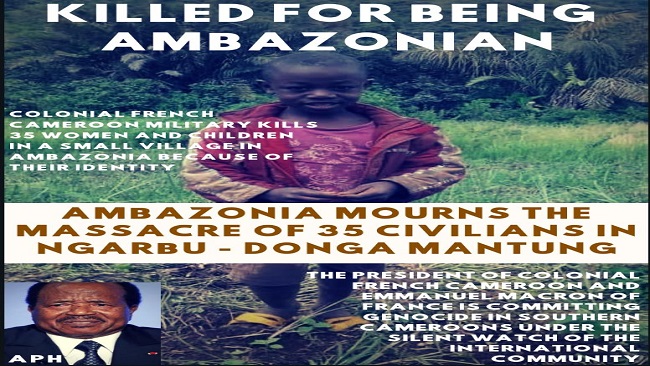
The United Nations conservatively estimates that the ongoing conflict has killed more than 3 000 people and displaced nearly 700 000 more in the Anglophone regions, a staggering number that comprises about 20% of our country’s population. Most recently, on February 14, about two dozen villagers, including 14 children and a pregnant woman, were massacred in the village of Ngarbuh in the northwest region by suspected members of the Cameroonian army. This state of affairs has led to massive instability inside Cameroon, as well as the surrounding region, including in our neighbour Nigeria, where tens of thousands of civilians — mainly women and young children — have sought fleeting security.
One year after the meeting between Nagy and Biya, nothing has changed for the better. In fact, it has merely metastasised, largely due to government incompetence, ongoing acts of state violence and unthinkable brutality, and a hardened resolve among Cameroon’s Anglophone separatists, who now view violent retaliation as the last and seemingly only option to achieve their demands.
A feasible plan to resolve Cameroon’s worsening conflict (which represents only one of the many symptoms of the long-ruling, long-abusive Biya dictatorship) is long overdue. Last month, I visited Washington DC to raise my concerns and to present an alternative vision to secure a democratic and stable Cameroon. For my efforts, I was greeted with death threats and intimidation, which prompted US legislators to demand my safe return. These hazards, of course, are not surprising in light of my nine-month prison ordeal in 2019, as well as what appears to be an attempt on my life this past weekend while touring Garoua, a town in the north. I will not be deterred, and I will not be silent.
Here is my plan to move Cameroon forward, from ongoing violence to a just peace. First and foremost, as an act of good faith, the Cameroonian government must immediately release all political prisoners who have been incarcerated, ostensibly because of the Anglophone conflict, as well as the post-electoral crisis triggered by the sham presidential election of October 2018, which extended Biya’s almost four-decade rule. The prisoners released must include, for example, Ayuk Tabe, a well-known voice from the Anglophone separatist community, and Mamadou Yakuba, the first vice-president of my political party, the Cameroon Renaissance Movement.
Second, the violence on both sides must end today. To accomplish this feat, the Cameroonian government, and Biya specifically, must agree to at least a temporary ceasefire with separatist forces in the Anglophone regions, including the removal of all major military installations. Our people have suffered enough calamity, and further violence will only entrench the now nearly insurmountable animosities on both sides of the divide.
Third, the separatists and the central government must agree to a basic framework for inclusive dialogue. A key element of this roadmap will be to have honest discussions about the form and make-up of a new Cameroonian state. For me, federalism holds the key for a more sustainable and peaceful future. The proposed dialogue, presided over by an impartial international mediator, will work towards the definitive settlement of the now full-blown civil war that is tearing apart the Anglophone regions. Further delays toward this end are wholly irresponsible.
Fourth, the government must assist Anglophone citizens to return to their homes and communities by pledging to rebuild infrastructure destroyed during the war, including countless private residences, hospitals and schools. Indeed, most schools in the two Anglophone regions have already been empty for three years, effectively robbing our country of its future and a generation of knowledge and needed skills.
Lastly, Biya’s government — in co-ordination with civil society and the pro-democracy opposition — must undertake long-overdue political reforms; in other words, we must address the root causes of Cameroon’s cascading crises. There must be a consensual reform of the electoral system, certainly before the planning of any new elections, to avoid the post-election conflicts that have festered for the past 17 months. Relatedly, there must be a consensual drafting of a uniquely Cameroonian charter that guarantees the respect of basic freedoms and human rights, which have been trampled on for too long.
These interrelated initiatives will build the mutual respect that is required, and thus far lacking, to forge a viable path forward for Cameroon. If undertaken in good faith, by both sides of the conflict, we, as patriotic Cameroonians can earnestly begin to stitch together our frayed social fabric. It is not beyond repair, but the time to act is now. Only then can we, as concerned citizens, begin to trust in our leaders, heal divisions, and to put faith in our future as a nation.
Maurice Kamto is the president of the opposition Cameroon Renaissance Movement and a former political prisoner in Cameroon

![Glory Tiku says she is struggling to fend for herself and her baby [Linus Unah/Al Jazeera]](https://www.aljazeera.com/mritems/Images/2020/2/27/8c182e776cf241fcb975f50a519d6d14_18.jpg)
![Adagom-3 settlement for Cameroonian refugees was established in late 2019 and it hosts more than 500 refugees [Linus Unah/Al Jazeera]](https://www.aljazeera.com/mritems/Images/2020/2/27/d1427017115a4a48955a3f1ddb0a39f3_18.jpg)
















19, March 2020
Coronavirus: where do we stand in the race for a vaccine? 0
As the world races to find a vaccine or a cure for the coronavirus, antimalarial drugs, HIV medications, flu vaccines and arthritis treatments are all being tested. FRANCE 24 takes a look at the latest medical efforts to combat the pandemic.
Teams of scientists across the world are working around the clock to either develop a new drug or repurpose an existing medication to halt the spread of the virus.
Viruses are tiny parasitic bits of genetic material that replicate inside another organism. Vaccines for viruses such as measles are typically made from a weakened form of the virus. But this process can take years.
Scientists are now fast-tracking results and sidestepping normal scientific steps, such as animal testing, to find drugs that will treat and kill the virus that causes COVID-19.
How close are we to a vaccine?
China:
The first country to experience the virus and also the first to start searching for vaccines and cures, China is understandably leading the field in the hunt for a vaccine. On December 31 last year, China alerted the World Health Organization (WHO) to several cases of unusual pneumonia in Wuhan, a port city of 11 million people in Hubei province. The virus was at that point unknown.
To create an original vaccine, the Chinese company Beijing Advaccine Biotechnology is working with a US biotech company called Inovio Pharmaceuticals. They are in the process of developing a “DNA vaccine” called INO-4800.
This vaccine is already in preclinical trial. It involves directly injecting genetic material into a person to trigger a stronger immune response, so they are better equipped to stop an infection.
Japan:
On January 16, Japan became the first country to confirm a coronavirus case outside China.
Fujifilm may be best known for its photographic products, but the Japanese company also makes a drug called Favipiravir (capitalized). This was initially intended to treat new strains of the flu. However, it appears to be proving effective in treating coronavirus patients, particularly those with lighter symptoms.
Europe:
Germany’s BioNTech has been one of the major players in European vaccine developments. It announced on Monday that it is developing an experimental vaccine, working with Fosun Pharma in China. On Tuesday, it confirmed a collaboration with America’s largest pharmaceutical company, Pfizer, to develop the drug outside of China. They hope to be in a position to start testing the new vaccine early next month.
Reuters reported on Sunday that the German government was trying to stop the US administration from persuading CureVac, another German drugmaker working on an experimental vaccine for the coronavirus, to move its research to the United States. This prompted German politicians to insist that no country should have a monopoly on any future vaccine.
Earlier, the Welt am Sonntag German newspaper reported that US President Donald Trump had offered funds to lure CureVac to the United States, and the German government was making counter-offers to tempt it to stay.
Responding to the report, the U.S. ambassador to Germany, Richard Grenell, wrote on Twitter: “The Welt story was wrong.”
US:
The first human trials of a potential vaccine called mRNA-1273 have already begun in the United States. Their vaccine has been made by biotechnology company Moderna Therapeutics.
Four patients received injections of the vaccine at the Kaiser Permanente research facility in Seattle, Washington, the Associated Press news agency reported.
The early-stage study of mRNA-1273 is being carried out by the US National Institutes of Health.
Instead of creating the mRNA-1273 vaccine from the coronavirus, scientists have copied a short segment of genetic code from the virus.
To test this new drug as fast as possible, they have sidestepped normal procedures such as initially testing on animals. The initial trial is expected to involve 45 healthy adult volunteers between the ages of 18 and 55 years over approximately six weeks. It could take 12 months before any concrete results are produced.
How close are we to a cure?
China:
By the end of January, China was already exploring how existing drugs might be repurposed to kill the virus.
One of the first drugs China explored with some success was an antimalarial drug called chloroquine phosphate. Speaking at a press conference on February 18, Sun Yanrong, deputy head of the China National Centre for Biotechnology Development at the ministry of science and technology, said this drug has already been under clinical trial in more than 10 hospitals in Beijing as well as in Guangdong Province and in Hunan Province.
According to Sun, patients treated with chloroquine saw a greater drop in fever, an improvement in their lung scans and required a shorter time to recover compared to parallel groups.
Among other drugs currently being tested in China is a Swiss-made anti-inflammation drug called Tocilizumab that suppresses overreactions by the immune system.
Another interesting advance has been made with a US antiviral drug called remdesivir, which has had impressive results in tests with more than 200 extremely ill patients.
Remdesivir was developed by Gilead Sciences to treat Ebola patients. It had good results in laboratories and with animals but was less successful with tests out in the field. Nevertheless, global health authorities deem it the most promising of possible treatments for people with severe cases of the virus.
Europe:
French pharmaceutical company Sanofi has announced it is ready to offer millions of doses of an antimalarial drug to French authorities after “promising” initial trials.
Sanofi said it could potentially treat 300,000 COVID-19 patients with the antimalarial drug Plaquenil, a spokesperson for the laboratory told AFP, adding that the group was ready to work with French health authorities “to confirm these results”.
Sanofi and its partner Regeneron Pharmaceuticals Inc have also started a clinical trial of their rheumatoid arthritis drug Kevzara as a treatment for the virus, the companies said on Monday.
Testing for patients with mid-to-severe stages of the virus will begin immediately, and the companies anticipate the trial will test up to 400 patients.
United States:
The United States may have had a slow start, but it has now sprinted ahead in the race for a vaccine.
A key development in the battle against the virus has emerged from the Quantitative Biosciences Institute Coronavirus Research Group, based out of the University of California. This team of hundreds of scientists has identified more than 50 drugs already in circulation that may effectively treat people infected with the virus.
The group has taken a different approach from many of their peers. Rather than find drugs that attack the virus itself, they are exploring drugs that will protect the proteins in our own cells that the coronavirus depends on to thrive and reproduce. With this type of treatment, our own systems will fight the virus.
Such a project would typically take a minimum of two years to achieve the results that this working group, which includes 22 laboratories across the US, has managed in a few weeks.
Another major development is the use of the HIV combination treatment lopinavir-ritonavari. This is currently being used in trials in America and other countries across the world, including India.
However, amid all the scientific developments, there are also unfounded rumours. In a statement published on Monday, Johnson & Johnson said there is “no evidence” that its HIV drug Prezista had any effect against the coronavirus in response to unsubstantiated reports that the drug might be a cure.
The company said it was aware that some HIV treatments are being considered as options to treat patients diagnosed with COVID-19.
Johnson & Johnson did say, however, that it was “partnering with multiple organizations to support the development of research programs and fast-track solutions for COVID-19”.
Culled from France 24