8, October 2017
Why La Republique du Cameroun lost a war of choice it should never have declared 0

8, October 2017

7, October 2017
Church leaders in Cameroon’s Anglophone region have spoken on the current crisis which has led to deaths, injuries and arrests after security forces clashed with protesters. The Bamenda Provincial Episcopal Conference (BAPEC) in a statement issued on Wednesday October 4, said the clashes created a ‘warlike atmosphere’ during the period spanning September 29 to October 2.
“The sighs of those who have lost property through looting or arson, the pain of anxiety inflicted on families and friends of those abducted or missing, the trauma caused on the young and the old by the fright from the warlike atmosphere of last weekend in particular have left another heap of painful memories in our minds and hearts.
“We want, in the first place, to express our profound grief and sympathies to those families who in the recent crisis have lost their dear ones. We pray for the repose of the souls of those who have died,” they said in the 26-point statement.
The release signed by six Bishops gave a detailed account of what happened in the region as they saw it and reiterated past efforts they had undertaken to avert the crisis. They also declared October 14 a day of mourning for those killed in the clashes.
Significant portions focused on the highhanded nature of the security response to what they said were very peaceful processions. Point 8 read as follows: “On Sunday, 1st October 2017, some Priests and some members of Christ’s Lay Faithful were prevented by the heavy military presence on their streets from going to church and so they failed to exercise their constitutional right of freedom of worship. In some areas, we noted with disgust that some Christians were teargassed as they came out of Mass!
“This move, by whosoever instructed, created a lot of confusion and chaos, especially as the faithful believed that the Archbishop’s letter, calling for prayers for peace and tranquillity and which had been endorsed by the Governor of the North West Region, was sufficient authorization for Sunday worship to go on as normal, despite the political tension.
“We, the Bishops of the Bamenda Provincial Episcopal Conference, are sad and disturbed, having learned that some of our Christians were pursued into their houses – some arrested, some maimed and some (including defenceless teenagers and elderly persons) were simply shot to death, some from helicopters.
“Elsewhere in the world, the Forces of Law and Order protect demonstrating citizens. In our country, peaceful demonstrations, except perhaps those organized by the ruling party, seem to be an opportune moment for our Armed Forces to demonstrate their shooting prowess both from the ground and from the air on unarmed and helpless civilians.”
Condemnation of the deadly clashes have been coming in thick and fast. President Paul Biya, the United States, the United Kingdom, the United Nations chief among others have all called for restraint and dialogue to resolve the tensions.
Cameroon’s English – speaking regions that have long protested marginalization from French Cameroon are now fighting for independence under the Ambazonia republic name. Yaounde, however, insists that the unity of the Central African country is non-negotiable.
Source: Africa News
6, October 2017
According to a poll conducted by the Nkafu Policy Institute, a think-tank based in Yaounde, majority of Cameroonians prefer federalism instead of the current unitary system of government. The findings revealed that of the 60.2% interviewed at the national level, federalism is advocated in the following proportions:
47.7% in the Central, South / East regions;
42.9% for the Grand North (Adamaoua / North / Far-North).
68.3% for Littoral and West;
And, 96.1% for the Southern Cameroons regions.
In the same vein, 44% of respondents claiming to be the militants of ruling CPDM crime syndicate prefer a federal system. Finally, the majority of Cameroonians (93.5%) are advocates of regional budgetary autonomy.
52% are recommending a full autonomy while 41% suggest that the budget be placed under the supervision of the central government in Yaoundé.
The majority of respondents, (91.8%) are against the appointment of regional governors. These Cameroonians prefer that they be elected. 75.2% of people claiming to be members of the ruling party also share the idea of elected governors.
669 Cameroonians aged 20 or more were interviewed during the research taken into account the 2013 population estimates by age, sex, region of origin and socio-economic status.
By Chi Prucence Asong, CCN
6, October 2017
The Vatican’s Finance Chief Cardinal George Pell, who is a top adviser to Pope Francis, has made a second appearance at an Australian court on sexual abuse charges.
The frail-looking Pell, who is the most senior Catholic Church official facing such charges, attended the Melbourne Magistrates Court on Friday.
He intended to challenge what has been described as historical charges, meaning that the alleged offenses took place a long while ago.
He appeared at the largely administrative court flanked by police officers and did not react to a group of loud protesters carrying signs that condemned the extensive involvement of Catholic clerics in the sexual abuse of minors and aspiring priests.
Pell is accused of committing multiple sexual offenses, which he strongly denies.

The allegations against the high-ranking Vatican official coincide with the final stages of Australia’s Royal Commission into Institutional Responses to Child Sex Abuse, established in 2012 following a decade of pressure to probe widespread allegations of institutional pedophilia. The commission has reportedly interviewed thousands of survivors and heard claims of child abuse at churches, orphanages, sporting clubs, youth groups, and schools.
According to local news reports, the court’s Magistrate Belinda Wallington said all witnesses would be allowed except five, meaning that as many as 50 of them could be called.
The exact details and nature of the allegations have not been revealed. It has been said that there are “multiple complainants.”
The 76-year-old former archbishop of Sydney and Melbourne traveled from Rome to Australia in July to attend the first hearing in the case while maintaining his innocence. Though Pell has not yet had to enter a plea, he instructed his lawyer at his last court appearance to make clear he intended to plead not guilty.
Pell’s attorney Robert Richter has said one of the witnesses had given police a “vague” statement. Wallington, the magistrate, said the male witness in question was 11 years old at the time and that “we’re dealing with historical events. Memory’s not static.”
After years of widely-reported cover-ups and silence from the Catholic Church over pedophilia scandals, abuse survivors and their advocates have hailed the prosecution of Pell as a major shift in the way society is responding to the crisis. Meanwhile, Pell has been granted a leave of absence by the Pope.
Culled from Presstv
6, October 2017
Russian President Vladimir Putin and Saudi King Salman have held talks behind closed doors in the Russian capital of Moscow, reportedly discussing bilateral and regional issues.
The talks were held on Thursday with the participation of other Russian and Saudi officials. “We have held detailed talks behind closed doors to talk about bilateral relations and the situation in the region,” Putin said after the meeting. “That was a very meaningful, substantive and confidential conversation.”
The Russian president also said he was confident the visit by Salman would give a fresh impetus to the development of bilateral ties with Riyadh. Putin also accepted an invitation by the Saudi king to Saudi Arabia.
Salman and his delegation arrived in the Russian capital for a four-day visit on Wednesday. The Saudis have reportedly signed more than 15 cooperation agreements — with multi-billion-dollar energy and military contracts — with the Russian side. Moscow has also agreed to sell its advanced S-400 missile defense system to Riyadh.

Putin and Salman also discussed the conflict in Syria, where they support opposing sides. The Saudis have been backing the wide range of militants fighting the elected Syrian government, while Russia backs the legitimate Damascus government.
Saudi Arabia has officially been calling for an ouster of Assad, while Russia says the future of Syria and the political future of Assad should only be determined by the Syrian people.
Nevertheless, Salman claimed that Riyadh favors a political solution to the conflict in Syria, according to a report by TASS.
“A political solution must be achieved that would guarantee security, stability, unity and territorial integrity of Syria,” he was quoted as saying. The two leaders also discussed the oil market and how to stabilize prices.
Culled from Presstv
6, October 2017
Over the course of the past year, Cameroon has been experiencing internal turmoil and instability related to grievances pitting an Anglophone minority against a majority Francophone establishment. The Anglophone grievances, initially driven primarily by professionals – lawyers, school teachers, bureaucrats – have increasingly taken hold in a population that’s experienced a three-month Internet shut-down, several general strikes, school boycotts, escalating violence and the imprisonment of journalists and activists over the last 12 months.
During national holiday celebrations this past weekend, protesters were shot dead on the streets of several towns in Anglophone regions by Cameroonian security forces, and excessive violence has been widely reported. Amnesty International estimates that at least 17 protesters were killed. (Death toll now stands at a hundred) Cameroon has been led by the same long-standing president for over 30 years, Paul Biya, who has called for calm and “peaceful dialogue“, but hasn’t yet yielded an inch on the demand for reforms. Meanwhile, some Anglophone Cameroonians have a leader, a flag and a national anthem – and are demanding to secede from Cameroon, to form their own country of Ambazonia.
On October 1, Cameroonians celebrate Unification Day to mark not only the anniversary of when British Cameroon became independent from the British in 1961, but also their unification with French Cameroon to form a two-state federation, the Federal Republic of Cameroon. Over the years, the two-state solution gave way to a single state, the United Republic of Cameroon, in which the balance of power was centered around the Francophone majority. Over the years, the marginalization of Anglophone Cameroonians has become increasingly entrenched. Whether it be the lack of recognition for English education, services or applicable legal system, over the years the corrosive effects of this marginalization have been slowly eating away at the status quo. The central government operates only in French, and, in the last 35 years of Paul Biya’s rule, there has been no movement signaling interest in protecting, upholding – let alone promoting – minority interests in his country.
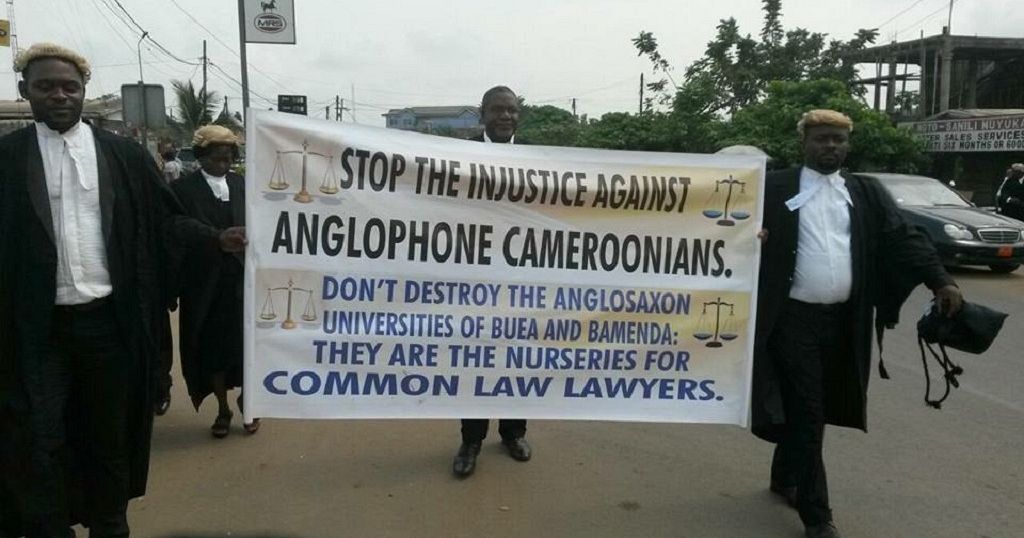
Lawyers protest in Cameroon – via Africanews
Last year, protesters started taking to the streets to demand greater autonomy and recognition of the English language in institutions, systems and services. The central government responded by cracking down on activists and shutting down the Internet. While gradual progress has been made, with new government initiatives to be more inclusive of Anglophones, the International Crisis Group notes that this progress is seen as “too little too late.” As the crisis continues to fester, a secessionist trend within the broader reform movement has been gaining strength. Their vocal demands have prompted an even stronger crack down – further arrests, military deployment in the region – from the central government, leading up to last weekend’s deadly violence. In this violent political climate, secessionists have been emboldened and gaining in popularity, though the exact extent of popular support for full independence from the rest of Cameroon, under the banner of Ambazonia, is difficult to gauge. A rally for Ambazonia even took place in front of the UN during the General Assembly in September, with similar events in Cameroon where tensions escalated between protesters and security forces.
Local blogger Reuben Abati summarizes the current situation:
“On Sunday, October 1, 2017, Sisiku AyukTabe, Chairman of the Southern Cameroons Governing Council, formally declared the independence of Southern Cameroons or the Federal Republic of Ambazonia: “We, the people of Southern Cameroons are slaves to no one”, he said, “Not now, not ever again! Today we reaffirm autonomy over our heritage and over our territory…It is time to tell Yaounde that enough is enough!” The response from Yaounde has been characteristic. Weeks before the protests and the declaration of independence in Southern Cameroons, soldiers were sent to the region to shoot in the air, prevent rallies, and intimidate the people.”
While Anglophone Cameroon has legitimate grievances that need to be addressed by the government, a resolution that would include secession or independence for Ambazonia is highly unlikely. Few nations in modern history have accessed fully independent status as a nation, and this only after hard-fought battles that were dearly paid for. The international community long ago established – in law and in practice – that it is preferable for borders to remain stable (The African Union’s own constitution spells out the defense of members’ territorial integrity.) The youngest nation in the world, South Sudan, and its sister nation, Sudan, have never really stopped fighting since South Sudan became independent in 2011. The United Nations – or other regional organizations such as the AU or ECOWAS – are therefore likely to continue to encourage dialogue between the government and representatives from Anglophone Cameroon, without “siding” with secessionist demands.
So far, the international community and media have shown little interest in the situation in Cameroon, though one clear option available would be to begin brokering a dialogue. The table has yet to be even set for any discussions to occur, and the international community has an opportunity to make a difference by creating the conditions for negotiations to begin in earnest. With this approach, the central government can avoid the worst – a full blow rebellion – and Anglophone Cameroonians have an opportunity to have their grievances addressed. A political, negotiated solution is still within reach – for now.
Culled from UN Dispatch
5, October 2017
Saudi Arabia has signed preliminary agreements to buy S-400 air defense systems and receive “cutting-edge technologies” from Russia as King Salman bin Abdulaziz Al Saud is on an official trip to Moscow as the first Saudi monarch to visit the European country.
Under agreements signed with Russian state-owned arms exporter Rosoboronexport, Saudi Arabia is set to procure the anti-aircraft weapon system, the Kornet-EM anti-tank guided missile system, 220mm 24-barrel TOS-1A multiple rocket launcher as well as AGS-30 Atlant automatic grenade launcher, the state-owned Saudi Arabian Military Industries (SAMI) said in a statement on Thursday.
SAMI, however, did not provide any information about the number of the systems or the value of the deal.
These contracts are “expected to play a pivotal role in the growth and development of the military and military systems industry in Saudi Arabia,” the statement read.
The Saudi Arabian Military Industries further noted that the memoranda of understanding also “include the transfer of technology for the local production” of the aforementioned military systems.
“In addition, the parties will cooperate in setting a plan to localize the manufacturing and sustainment of parts of the S-400 air defense system,” SAMI said.

Saudi and Russian military officials also agreed on the production of AK-103 automatic assault rifles and its ammunition in Saudi Arabia besides educational and training programs for Saudi nationals.
“These agreements are expected to have tangible economic contributions and create hundreds of direct jobs. They will also transfer cutting-edge technologies that will act as a catalyst for localizing 50 percent of the Kingdom’s military spending,” SAMI said.
A number of other deals have been signed during King Salman’s four-day visit to Russia, which started on Wednesday.
There are reports that Saudi Arabian national petroleum and natural gas company, Saudi Aramco, is discussing several investment opportunities with Russian producers of liquefied natural gas (LNG).

“LNG is one of the areas where we are looking for partners in Russia,” Amin H. Nasser, president and chief executive officer of Saudi Aramco, told reporters in Moscow on Thursday.
Nasser noted that there are no current plans to take a stake in the Novatek LNG project, known as Arctic LNG-2. Novatek is Russia’s largest independent natural gas producer.
“We are not discussing this at this stage. We are looking at opportunities for working together with the different companies. But what you mention in particular – nothing from Saudi Aramco,” he said.
Source: Presstv
5, October 2017
Thousands of protesters have turned out in the West African state of Togo for the second day running, in a campaign aimed at forcing out President Faure Gnassingbe.
On Thursday,demonstrators converged from three points in the capital Lome for what was billed as a “march of anger” against a family which has ruled Togo for 50 years, culminating in a rally on the seafront.
“Demonstrators have used rocks to block the road from Gakpoto to St. Joseph’s school, and others are preventing cars from going through,” Amnesty International’s director for Togo, Aime Adi, said.
In Atikoume district, angry youths refused to follow the march itinerary set down by the 14-party opposition coalition, and said they would block streets, an AFP journalist saw.
However, in some neighborhoods on the march route, tension that was noticeable on Wednesday seemed to have eased somewhat.
Marchers said they would maintain pressure on the Gnassingbe government.
“I am not tired and I will never be tired so long as the struggle is not over. Even if we have to march every day, I will be there,” said a protester.

In the north of the country — a region previously seen as reliably pro-government — several other rallies, also drawing thousands of people, took place in the northern cities of Sokode, Bafilo and Dapaong, local residents told AFP.
However, there were no protests in the far northern town of Mango, where a young man was killed in a demonstration on September 20, which was followed by a crackdown by the authorities.
The protests are the seventh in a wave of agitation that began in August. At least four people have been killed and dozens injured.
The government is proposing an overhaul of the constitution under which presidential terms would be limited to two five-year spells in office.
Gnassingbe, in power since the death of his father in 2005, was re-elected in 2010 and again in 2015, in votes that the opposition denounced as unfair.
If the two-term limit applies from the next elections, scheduled in 2020, he could theoretically remain in office until 2030.
As a result, the opposition wants the two-term restriction to be applied retroactively by restoring the 1992 constitution, in order to force Gnassingbe from office.
The president’s father, General Gnassingbe Eyadema, ruled the country with an iron fist from 1967 until his death in 2005.
According to a source close to the presidency, the proposed change to the constitution will be put to a referendum “by the end of the year.”
(Source: AFP)
5, October 2017
In a statement issued on October 4, 2017, The British Minister of African Affairs Rory Stewart has stressed that the UK is “deeply concerned” about the various reports of deaths and violence recorded in Southern Cameroons. He appealed to the Biya government and the leadership of the Southern Cameroons Ambazonia Governing Council to restrained.
“We invite both parties to create an atmosphere of trust, avoid provocative acts, to the forces of order to respect human rights and to act in order to ensure the protection of men and their property “Says Rory Steward.
The British Government called on the Governing Council and the Government of Cameroon to reject acts of violence, to dialogue and to take urgent action to find solutions to the demands raised by Southern Cameroonians.
The reaction of the British Government comes after that of the Trump administration. Washington said on Wednesday that “the use of force by the Cameroonian government to restrict freedom of expression and the peaceful assembly and the violence of the demonstrators are unacceptable “. The White House urged the Government of Cameroon to respect human rights and freedom of expression, including access to the Internet.
Chi Prudence Asong, CCN
Owona Nguini’s attacks on Samuel Eto’o are becoming increasingly unconvincing
Dr Joachim Arrey speaks of drugs and teenage girls lured into forced sex in Manyu
Cameroon to expire in December
Iran deal: the cards are now in Tehran’s favour
Exam leaks in CPDM Cameroon: A symptom of a deeper corruption crisis
4 Anglophone detainees killed in Yaounde
Chantal Biya says she will return to Cameroon if General Ivo Yenwo, Martin Belinga Eboutou and Ferdinand Ngoh Ngoh are sacked
The Anglophone Problem – When Facts don’t Lie
Anglophone Nationalism: Barrister Eyambe says “hidden plans are at work”
Largest wave of arrest by BIR in Bamenda
8, October 2017
Abuja to try 2,300 Boko Haram militants 0
Nigeria is going to try more than 2,300 suspected members of the Takfiri Boko Haram militant group in unprecedented mass trials behind closed doors.
The defendants, whose trials are to begin on Monday, have all been picked up and held in detention since the start of Boko Haram militancy eight years ago.
To date, just 13 people have been put on trial and only nine convicted for their links to the Takfiri group, according to official figures.
The most high-profile current case is that of Khalid Al-Barnawi, a leader of Boko Haram offshoot Ansaru, who is charged with the abduction and murder of 10 foreign nationals.
Nigeria’s Justice Ministry announced the start of the trials at the end of last month, saying four judges had been assigned and that defendants would have legal representation.
Some 1,670 detainees at a military base in Kainji, in the central state of Niger, will be tried first and will be followed by 651 others held at the Giwa barracks in the capital of the northeastern state of Borno State, Maiduguri.
The trials are seen as a positive step, as many of the detainees had been held in custody for years, without access to a lawyer or ever having appeared before a judge. Amnesty International said in a June 2015 report that more than 20,000 people had been arbitrarily arrested as part of the fight against Boko Haram.
President Muhammadu Buhari, who was elected in 2015, has promised to look into repeated accusations of human rights violations, including by high-ranking officers.
At least two commissions of inquiry have been established but the army announced in June this year that no action would be taken against top brass accused by Amnesty.
Amnesty believes the mass trials of Boko Haram suspects were the result of international pressure on the Nigerian government.
Source: Presstv