25, December 2024
Francis urges ‘all people of all nations’ to silence sound of arms this Christmas 0
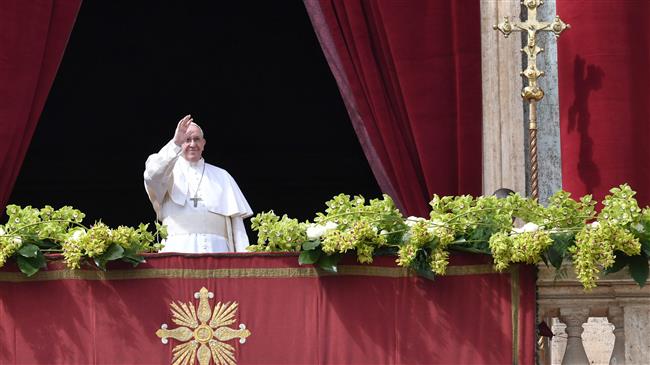
Pope Francis in his traditional Christmas message on Wednesday urged “all people of all nations” to find courage during this Holy Year “to silence the sounds of arms and overcome divisions” plaguing the world, from the Middle East to Ukraine, Africa to Asia.
The pontiff’s “Urbi et Orbi” – “To the City and the World” – address serves as a summary of the woes facing the world this year. As Christmas coincided with the start of the 2025 Holy Year celebration that he dedicated to hope, Francis called for broad reconciliation, “even (with) our enemies.”
“I invite every individual, and all people of all nations … to become pilgrims of hope, to silence the sounds of arms and overcome divisions,” the pope said from the loggia of St. Peter’s Basilica to throngs of people below.
The pope invoked the Holy Door of St. Peter’s Basilica, which he opened on Christmas Eve to launch the 2025 Jubilee, as representing God’s mercy, which “unties every knot; it tears down every wall of division; it dispels hatred and the spirit of revenge.”
He called for arms to be silenced in war-torn Ukraine and in the Middle East, singling out Christian communities in Israel and the Palestinian territories, “particularly in Gaza where the humanitarian situation is extremely grave,” as well as Lebanon and Syria “at this most delicate time.”
He cited a deadly outbreak of measles in the Democratic Republic of Congo, and the suffering of the people of Myanmar, forced to flee their homes by “the ongoing clash of arms.” The pope likewise remembered children suffering from war and hunger, the elderly living in solitude, those fleeing their homelands, who have lost their jobs, and are persecuted for their faith.
Pilgrims were lined up on Christmas Day to walk through the great Holy Door at the entrance of St. Peter’s Basilica, as the Jubilee is expected to bring some 32 million Catholic faithful to Rome.
Traversing the Holy Door is one way that the faithful can obtain indulgences, or forgiveness for sins during a Jubilee, a once-every-quarter-century tradition that dates from 1300.
Pilgrims submitted to security controls before entering the Holy Door, amid new security fears following a deadly Christmas market attack in Germany. Many paused to touch the door as they passed and made the sign of the cross upon entering the basilica dedicated to St. Peter, the founder of the Roman Catholic Church.
“You feel so humble when you go through the door that once you go through is almost like a release, a release of emotions,” said Blanca Martin, a pilgrim from San Diego. “… It’s almost like a release of emotions, you feel like now you are able to let go and put everything in the hands of God. See I am getting emotional. It’s just a beautiful experience.”
Source: AP















29, December 2024
President Putin apologises to Azerbaijani president for ‘tragic’ plane crash 0
Russian President Vladimir Putin on Saturday apologized to his Azerbaijani counterpart for what he called a “tragic incident” following the crash of an Azerbaijani airliner in Kazakhstan that killed 38 people, but stopped short of acknowledging that Moscow was responsible.
Putin’s apology came as allegations mounted that the plane had been shot down by Russian air defenses attempting to deflect a Ukrainian drone strike near Grozny, the regional capital of the Russian republic of Chechnya.
An official Kremlin statement issued Saturday said that air defense systems were firing near Grozny airport as the airliner “repeatedly” attempted to land there on Wednesday. It did not explicitly say one of these hit the plane.
The statement said Putin apologized to Azerbaijani President Ilham Aliyev “for the fact that the tragic incident occurred in Russian airspace.”
The readout said Russia has launched a criminal probe into the incident, and Azerbaijani state prosecutors have arrived in Grozny to participate. The Kremlin also said that “relevant services” from Russia, Azerbaijan and Kazakhstan are jointly investigating the crash site near the city of Aktau in Kazakhstan.
The plane was flying from Azerbaijan’s capital, Baku, to Grozny when it turned toward Kazakhstan, hundreds of kilometers (miles) across the Caspian Sea from its intended destination, and crashed while making an attempt to land. There were 29 survivors.
According to a readout of the call provided by Aliyev’s press office, the Azerbaijani president told Putin that the plane was subject to “external physical and technical interference,” although he also stopped short of blaming Russian air defenses.
Aliyev noted that the plane had multiple holes in its fuselage and that the occupants had sustained injuries “due to foreign particles penetrating the cabin mid-flight.”
He said that a team of international experts had begun probing the incident at Azerbaijan’s initiative, but provided no details. Earlier this week, the Azerbaijani Prosecutor General’s office confirmed that investigators from Azerbaijan are working in Grozny.
On Friday, a U.S. official and an Azerbaijani minister made separate statements blaming the crash on an external weapon, echoing those made by aviation experts who blamed the crash on Russian air defense systems responding to a Ukrainian attack.
Passengers and crew who survived the crash told Azerbaijani media that they heard loud noises on the aircraft as it was circling over Grozny.
Dmitry Yadrov, head of Russia’s civil aviation authority Rosaviatsia, said Friday that as the plane was preparing to land in Grozny in deep fog, Ukrainian drones were targeting the city, prompting authorities to close the area to air traffic.
Yadrov said that after the captain made two unsuccessful attempts to land, he was offered other airports but decided to fly to Aktau.
Earlier in the week, Rosaviatsia had cited unspecified early evidence as showing that a bird strike led to an emergency on board.
In the days following the crash, Azerbaijan Airlines blamed “physical and technical interference” and announced the suspension of flights to several Russian airports. It didn’t say where the interference came from or provide any further details.
If proven that the plane crashed after being hit by Russian fire, it would be the second deadly civil aviation accident linked to fighting in Ukraine. Malaysia Airlines Flight 17 was downed with a Russian surface-to-air missile, killing all 298 people aboard, as it flew over the area in eastern Ukraine controlled by Moscow-backed separatists in 2014.
Russia has denied responsibility, but a Dutch court in 2022 convicted two Russians and a pro-Russia Ukrainian man for their role in downing the plane with an air defense system brought into Ukraine from a Russian military base.
Following Wednesday’s suspension of flights from Baku to Grozny and nearby Makhachkala, Azerbaijan Airlines announced Friday that it would also halt service to eight more Russian cities.
Several other airlines have made similar announcements since the crash. Kazakhstan’s Qazaq Air on Friday said it would stop flying from Astana to the Russian city of Yekaterinburg in the Ural Mountains for a month.
Turkmenistan Airlines, the Central Asian country’s flagship carrier, on Saturday halted flights to Moscow for at least a month, citing safety concerns. Earlier this week, Israel’s El Al carrier suspended service from Tel Aviv to the Russian capital, citing “developments in Russia’s airspace.”
Source: AP