10, May 2022
UK: Past, present and future on display as Charles steps up 0
The pomp and pageantry of the State Opening of Parliament at the Palace of Westminster in London traditionally takes longer than the speech itself.
But for nine short minutes on Tuesday, Britons were given a glimpse of their future without Queen Elizabeth II as head of state.
Ill health and old age forced the 96-year-old monarch to withdraw from outlining her government’s legislative agenda for only the third time since her reign began in 1952.
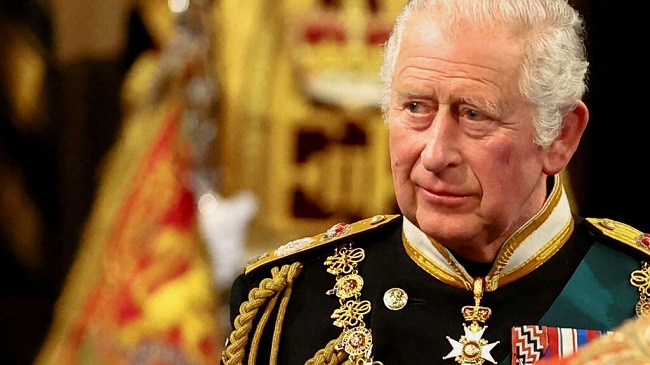
Instead it fell to her eldest son Prince Charles, 73, to deputise, in the most important state engagement yet in his record-breaking time as her heir.
When his mother dies, he will be king and opening parliament for a new session will be one of his most important constitutional duties as head of state.
Other than the last-minute change of personnel, there was little to distinguish the ceremony from previous ones in the putative “mother of all parliaments”.
Two mounted divisions of the Household Cavalry regiment formed a “secure passage” for the limousine carrying Charles and his wife Camilla from Buckingham Palace.
The red-coated Queen’s Body Guard of the Yeoman of the Guard — the “Beefeaters” — kept watch. Liveried parliamentary and government officials processed.
A ceremonial search of the cellars of parliament was conducted — a throwback to when a gunpowder plot was foiled before the opening of 1605.
The door of the House of Commons was slammed shut in the path of Black Rod, an official from the unelected upper House of Lords, to symbolise the independence of the elected lower chamber from the monarchy.
One member of parliament was held “hostage” at Buckingham Palace to ensure the safe return of the monarch, another throwback to more troubled times.
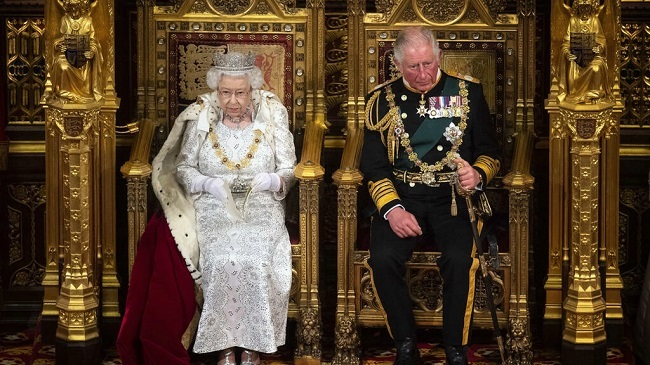
Elected members of parliament from the House of Commons are invited to the unelected upper chamber House of Lords to listen to the Queen’s Speech
Elected members of parliament from the House of Commons are invited to the unelected upper chamber House of Lords to listen to the Queen’s Speech Aaron Chown POOL/AFP
Then MPs filed into the Lords, their daywear in contrast to the peers in red and white ermine robes, to listen to the speech.
‘God save the Queen’
Charles, dressed in the ceremonial uniform of admiral of the fleet, complete with a sheathed sword, arrived to a trumpet fanfare.
The Prince of Wales has had a lifetime to prepare, showing no sign of nerves, smiling and occasionally stopping to chat as he made his way to the chamber and the platform bearing the consort’s throne.
Camilla sat to his left and his eldest son, Prince William, 39, to his right, getting his first taste of an occasion he will also have to perform one day.
The raised golden throne of the monarch, who was said to be watching on television from home, was removed. In its place was the crown on a velvet cushion.
At 11:34 am (1034 GMT), Charles began reading his mother’s words, written for her by the government.
“My Government’s priority is to grow and strengthen the economy and help ease the cost of living for families,” he read.
“My Government will level up opportunity in all parts of the country and support more people into work.
“My Ministers will continue to support the police to make the streets safer, and fund the National Health Service to reduce the COVID backlogs.
Queen Elizabeth II, who has been head of state since 1952, was said to have watched the ceremony on television from home.
“In these challenging times, my Government will play a leading role in defending democracy and freedom across the world, including continuing to support the people of Ukraine.”
At 11:43 am it was over. As he left, a military band played the national anthem, “God Save the Queen”.
Source: AFP




















10, May 2022
How can Cameroonian youths find jobs in a world of cut-throat competition and job scarcity? 0
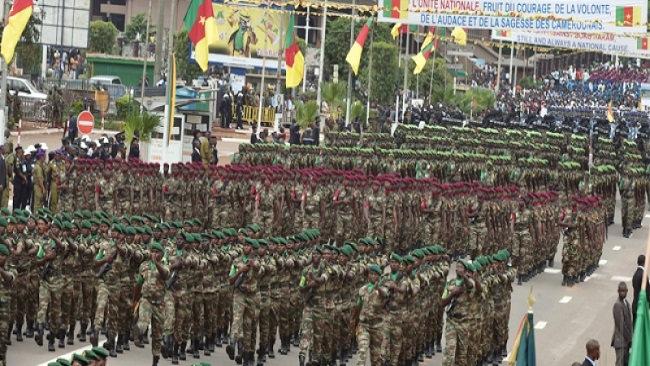
Cameroonian youths are really going through tough times. This remains a fact as thousands have been caught in the toxic spiral of unemployment, frustration and bitterness.
Many have been to the university and many of them are unable to find jobs that can keep them busy and out of crime and out of psychological torture.
This situation is very disheartening, especially as the whole notion of education has been designed to enable young people become useful to themselves, their families and their country.
Many young people are slowly dying and many are very intellectual. Knowledge is being wasted in Cameroon. Their education has not offered them the type of job many of them thought they could get.
Some people blame youth unemployment in Cameroon on government employment policy failure, lack of appropriate skills on the part of the graduates, shrinking global economic growth, poor business environment, etc.
Despite these challenges, the million dollar question remains. How can Cameroonian youths be made employable so that they can compete favorably at home and with their colleagues in other countries in the global job market.
While some factors responsible for youth unemployment are clearly within the government’s purview and can only be addressed by the government, others could be addressed by other social actors, the private sector and the graduates themselves.
One of such ways is to help the students get the skills that might enhance their chances in the job market.
Skills development is an idea whose time has come and both the graduates and government must embrace this idea.
The government should help graduates with certain degrees to complete certification programs which will help the graduates to be job-ready.
Graduates of economics, for example, should be made to undergo short-term post-graduate training which will enable them specialize in areas in which they want to work.
A graduate diploma in risk management, project management, environmental economics and other areas of specialization will help some of our graduates to achieve their goals in life.
Those who have studied accounting and finance in our universities could be granted scholarships for them to carry out accounting and finance certification programs which are very costly.
With education also being provided online, these students could be made to study from the comfort of their homes, especially as Internet connection in Cameroon is improving.
Many of our graduates come from poor backgrounds and if left unaided, they might never be part of the labor market and this will only increase their frustration and anger with a country they consider to be theirs.
Many young Cameroonians go to university without the orientation they need to make good educational choices. Education is an investment and it could be stressful if these young Cameroonians leave school without the prospect of having a job.
Many of them are future lifelines for their aging and ailing parents, and without much needed support, they may not be of any help to their families, communities and the country.
Many young Cameroonians have read law, but a law degree alone will not be able to open doors for many of them. To qualify as a lawyer in Cameroon, especially in the English-speaking part of the country, Cameroonians are expected to be graduates of recognized law schools.
Unfortunately, Cameroon does not have a law school and this is really frustrating for many young aspiring Cameroonian lawyers. There is a school of magistracy in Yaounde, but admission into this school is complicated.
It is rumored that admission into this school is for the highest bidder. How can young people from poor backgrounds get admitted into this school? Is excellence something Cameroonians can still count on?
The government can really help those who want to become lawyers by setting up a law school within the University of Buea or Bamenda to make things easier for future lawyers.
Other countries are simplifying things for their citizens and it is time for the Cameroon government to take a look at the possibility of creating a law school in Cameroon.
Many young Cameroonians are brillant, but they seem to be excluded from efforts at making the country a better place.
Reducing youth unemployment will not only be an issue of presidential degrees, it must be a demonstration of long term commitment by the government to eradicate this problem that has robbed many young Cameroonians of their happiness.
Universities in Cameroon should start working with private sector experts to understand the needs of the labor market so that new training programs could be made available in those universities.
In many countries in the world, the private sector has a say in educational curricula and short courses sometimes get taught by industry experts who help to orientate future graduates.
A graduate of journalism will be pointed in the right direction by industry experts. These experts can help young graduates gain much-needed experience through paid internships or volunteering programs.
Lack of experience can hold a brillant graduate down for years. Skills development programs, apprenticeship programs and experience-based training may help many young people to gain a better understanding of the job market.
Government policies in this regard will go a long way in helping young Cameroonians find jobs both within and out of the country. If left unaided and if their unemployment periods are long, many of these brilliant young men might put their knowledge to other things and in many cases to the wrong things like scamming, stealing and other illegal practices.
The Cameroonian private sector has a stake in this issue. It must work with the government in this regard to get the right manpower which will result in greater productivity and output.
Helping the young Cameroonian find work should be a partnership between many stakeholders. It is time to establish such a partnership which will inspire hope in young people.
By Dr Joachim Arrey