10, July 2025
President Trump praises Liberian leader on English 0
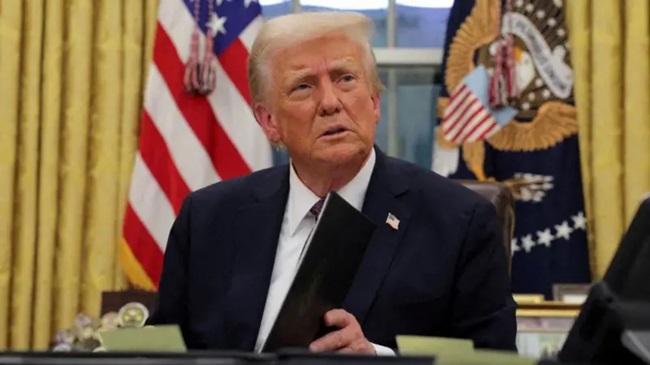
US President Donald Trump complimented the president of Liberia Wednesday on his English-speaking skills — despite English being the official language of the West African nation.

Trump was hosting a White House lunch with African leaders Wednesday, and — after brief remarks from President Joseph Boakai — asked the business graduate where he had picked up his linguistic know-how.
“Thank you, and such good English… Where did you learn to speak so beautifully? Where were you educated?” Trump said.
Boakai — who, like most Liberians, speaks English as a first language — indicated he had been educated in his native country.
He was facing away from the media, making his countenance hard to gauge — but his laconic, mumbled response hinted at awkwardness.
Trump, who was surrounded by French-speaking presidents from other West African nations, kept digging.
“It’s beautiful English. I have people at this table can’t speak nearly as well,” he said.

US engagement in Liberia began in the 1820s when the Congress- and slaveholder-funded American Colonization Society began sending freed slaves to its shores.
Thousands of “Americo-Liberian” settlers followed, declaring themselves independent in 1847 and setting up a government to rule over a native African majority.
The country has a diverse array of indigenous languages and a number of creolized dialects, while Kpelle-speakers are the largest single linguistic group.
Boakai himself can read and write in Mendi and Kissi but converses in Liberia’s official tongue and lingua franca — English.
Source: AFP













10, July 2025
Southern Cameroons Crisis: Over 150,000 children missing 0
More than 150,000 children have gone missing in Cameroon’s Anglophone regions amid the ongoing armed conflict, now in its eighth year. The figures were revealed during the 7th session of the Presidential Plan for the Reconstruction and Development (PPRD) of the North-West and South-West regions, held on July 4 in Bamenda, under the chairmanship of Prime Minister Joseph Dion Ngute.
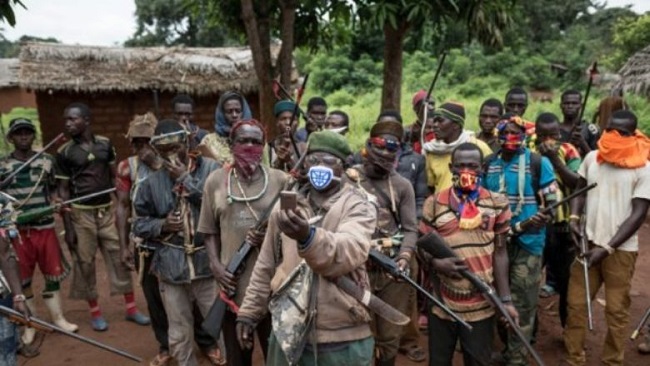
According to Paul Tassong, president of the PPRD steering committee, NGO reports indicate that separatist groups abducted many of these children without issuing any ransom or public demands.
This worsening security crisis has also driven over 200,000 children out of classrooms across the two regions.
In its June 2025 report on the Situation of Children in Cameroon, the United Nations Children’s Fund (UNICEF) confirms that school enrollment in these areas remains alarmingly low, with some children having missed school for more than five years.
The report also states that, in 2024, 334,000 people were displaced from the North-West and South-West, including 174,000 who crossed into Nigeria. The conflict has crippled the education system: 41% of schools are closed, leaving 223,749 children out of school and increasing their vulnerability to recruitment by non-state armed groups.
To address this humanitarian crisis, the government launched the PPRD, aimed at rebuilding and stabilizing the affected areas. Over the first five years, the state and partners mobilized over CFA600 billion—a dramatic rise from the plan’s initial budget of 89 billion, later reassessed to CFA2,500 billion due to escalating needs.
With this funding, the government has rebuilt nearly 120 schools—71 in the North-West and 49 in the South-West—as part of broader efforts to restore basic services and community infrastructure.
Since late 2016, the two Anglophone regions have faced a violent separatist insurgency, initially triggered by grievances over perceived marginalization. Armed groups have enforced school boycotts, and attacks on students, teachers, and school buildings have become widespread.
Source: Business in Cameroon