10, March 2020
Tokyo tourist sites ‘nearly empty’ as coronavirus bites 0
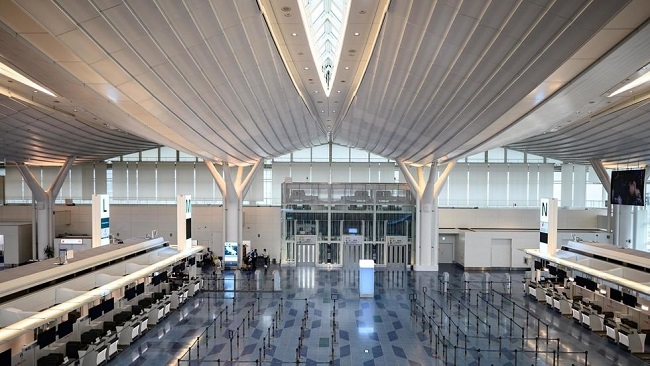
In Tokyo’s Tsukiji fish market, restaurants normally thronged with tourists hoping to sample some of its renowned sushi stand empty, victim of the coronavirus that is battering Japan’s tourism sector.
Cook Hiroshi Ota, 61, said nearly three-quarters of his customers in normal times are Chinese tourists, but they are kept away by new Japanese measures requesting everyone from China and South Korea self-quarantine for two weeks.
“It was normal until around December but after that, people stopped coming from China during the Lunar New Year. The streets and shops here are nearly empty,” he told AFP.
The tuna shop next to his restaurant has closed down temporarily as customers have dried up and operating costs remain high, he said. All around, shops normally packed for lunchtime service have lowered their corrugated iron shutters.
Noriko Suzuki, a 63-year-old selling sea urchins and oysters at the market, said: “I haven’t seen a single person on the street this morning,” complaining of a “sharp drop” in customers, especially from China, since the outbreak of the virus.
Prime Minister Shinzo Abe has set a target of 40 million tourists to visit Japan in 2020, as the country gears up to host the Olympic and Paralympic Games.
But the coronavirus that has infected more than 110,000 people worldwide, including more than 500 in Japan, has dampened tourism around the world and even cast a question mark over the Games themselves.
According to the Japan National Tourism Organization, visitors from South Korea and China made up about half of all inbound tourists in 2018, the latest available figures.
Tourism had already dropped significantly from South Korea — down 64 percent in November 2019 compared to the same period the year before — as Tokyo and Seoul became embroiled in a spat over trade and Japan’s war-time history.
– ‘Huge impact’ –
Chinese and Korean tourists “have disappeared” from the street, said one woman selling food at Senso-ji, a temple in Tokyo that is one of the capital’s biggest tourism draws.
The usually packed streets are much quieter than usual with “less than half” the usual number of tourists, said a vendor at a travel bag shop on the street leading up to the temple.
“We have to live with this for the time being but the media should not get too excited about the virus. It generates a negative feeling and also affects businesses that are doing fine,” said the woman, who declined to give her name.
On the northern island of Hokkaido, tourism has “dropped significantly” because of the coronavirus outbreak, said Masahi Isobe, from the local tourism office.
“Chinese tourists account for more than one quarter of foreign travellers to Hokkaido. With the government measures, there will be no Chinese or Korean visitors here and this will make a huge impact,” she told AFP.
Source: AFP



![Glory Tiku says she is struggling to fend for herself and her baby [Linus Unah/Al Jazeera]](https://www.aljazeera.com/mritems/Images/2020/2/27/8c182e776cf241fcb975f50a519d6d14_18.jpg)
![Adagom-3 settlement for Cameroonian refugees was established in late 2019 and it hosts more than 500 refugees [Linus Unah/Al Jazeera]](https://www.aljazeera.com/mritems/Images/2020/2/27/d1427017115a4a48955a3f1ddb0a39f3_18.jpg)



















10, March 2020
Cameroon’s Pathetic and Chaotic Response to the Coronavirus 0
A day after the IMF/World Bank announced a $50 billion aid package to help poor countries contain the coronavirus outbreak; Cameroon confirmed its first two cases of the deadly virus; a 58-year-old French national and a Cameroonian who came in contact with him, after he arrived Yaoundé on Feb 24. The public health minister said in separate communiqués that both patients were isolated at the Yaoundé Central hospital where they are receiving “symptomatic treatment” (whatever that means). The Health minister also ask those who had contact with the index case to call a toll-free number to “receive appropriate care” while assuring public opinion that “everything is being done to contain this outbreak without undue delay, in conformity with the high instructions from the President of the Republic, HE Mr. Paul Biya.”The feudal deference to Mr. President aside, the health minister’s belated effort to calm frayed nerves cannot be taken to signify successful containment; rather, it is an expression of a luxurious desire which signposts the absence of an emergency healthcare plan that should have been activated to contain the virus. This unpreparedness is most pathetic and tragic and Cameroonians deserve better.
It is indeed embarrassing to note that this epidemic has taken Cameroon unawares. How can the government’s containment strategy be anchored on self-reporting using a toll-free number? What happens if someone calls and reports that he/she is witnessing symptoms of the coronavirus? Is there a team of trained health personnel with the appropriate test-kits, including an ambulance ready to take such a patient and all those who have been exposed to him to a quarantine facility, assuming such a facility even exists? Alternatively, will such a patient be ordered to self-quarantine at home; and how will the patient be monitored? Amid global warnings about the coronavirus that has claimed over 3,000 plus lives and infected no fewer than 100,000 people, the health minister’s verbal pugilism advertises in spectacular fashion, a certain poverty of ideas on the part of those who govern Cameroon even in matters that are supposedly routine; and is indicative of a failure of leadership in the country. This is a public shame to a nation that should have outgrown primary healthcare challenges.
As official rhetoric and public grandstanding drives fear into the complex matrix over the unfolding coronavirus crisis, the gravity of the epidemic demands an urgent, robust and holistic national response, beyond laconic press statements designed to aggrandize the president. Even more disheartening, there is still no concerted effort by competent health workers to screen passengers arriving at Cameroon airports to determine whether they are sick or exhibited any symptoms of the coronavirus. It is shocking that a country like Cameroon does not even have one facility that such patients can be isolated. The WHO representative in Cameroon told CRTV that the test of the infected French national was done at Centre Pasteur in Yaoundé. This begs the question: what is the capacity of Centre Pasteur to handle an epidemic in which thousands of people get infected through community transmission?
With a shambolic healthcare system, decrepit health infrastructure, acerbic poverty and political volatility, most hospitals lack isolation or quarantine units, personal protection equipment (PPE) and trained personnel to carry out the necessary care against the coronavirus. Does the Health Minister need any reminder that laboratory confirmation of coronavirus diagnosis requires equipment, test kits and trained personnel that most Cameroon hospitals don’t have? It is utterly ridiculous for the government to ask people who have had contact with the index case to self-report or self-isolate or self-quarantine. There is no beneficial value in government’s misplaced self-vindication, amid reports that the government was struggling to contact the passengers who were exposed to the Frenchman who brought the coronavirus to Cameroon. As an urgent public safety imperative, the government should publish the flight manifest to enable the public identify passengers on that plane who were exposed and might have been infected by the Frenchman.
The implications of the other passengers still roaming at large and interacting with the public is the potential infection of hundreds, if not thousands of other people, aggravating the risk of widespread infection given that every infected person is said to infect at least two other people. Because for each day a coronavirus patient stays at home, family and all contacts are endangered, it is, therefore, better left to the imagination, the terrible consequences, specifically on public health and on public psyche of what evidently is a disaster waiting to happen! Against the backdrop of this doomsday scenario coupled with the dire indicators on the state of official unpreparedness to handle the coronavirus crisis, the question must be asked: what is this nation ever prepared for? The world is on red alert over the deadly coronavirus, yet Cameroonians are left to the vagaries of life while their leaders do nothing. Not even an emergency budgetary allocation has been earmarked to contain the virus. This is unacceptable!
The coronavirus is sufficiently serious a disease as to warrant the declaration of a national emergency by the government, wherein all hospitals (public and private), and health personnel across the country are put on red alert. Unfortunately, corrupt Cameroonian government officials with their remarkable genius for travesty seem more interested in transforming the coronavirus epidemic into another cash cow to line their pockets; as some have done with the ongoing armed insurgency in the Anglophone regions. The rumor mill has also spun beyond reason, misinforming the public with all manner of unfounded cures and remedies with no scientific basis. It was claimed in some quarters that drinking beer and eating bitter kola was a potent remedy and Cameroonians promptly descended on beer and bitter kola, until the rumor was debunked; saving them from the tragedy of their ignorance. Some Cameroonians view the timing of the confirmed cases as inauspicious, believing it is just a ploy by the regime to attract a share of the promised $50 billion IMF/World Bank largesse to help poor countries contain the coronavirus outbreak. Be that as it may.
The coronavirus is a national crisis of monumental proportion as the World Health Organization (WHO) has all but declared it a global pandemic. The deadly virus can wipe out scores of people in a matter of days if unchecked. The disease is contracted by direct contact with an infected person and the virus can remain within an infected person for as long as three weeks after exposure before manifesting. The symptoms progress from fever to nausea, headache, sore throat, tiredness, muscle pain, vomiting, diarrhea, coughing and neck-stiffness. So far, there is no vaccine or known cure as scientists are still working on a number of trial drugs that are expected to be ready not earlier than 18 months. Therefore, the government must continue to take coronavirus seriously and sustain public enlightenment through traditional as well as the now very popular social media, on measures to prevent or contain it. Scrupulous personal hygiene, avoidance of contact with suspected victims, and immediate report of suspected cases to health authorities, are just some of the steps the public should take.
The outbreak of the coronavirus in Cameroon, once again, presents a challenge to the authorities to address basic social amenities that make for improved living conditions for the average Cameroonian. While the world struggles to develop a potent cure, the best way out now is good hygiene. Keeping the living environment clean is essential. All must be careful, people should as much as possible avoid crowded areas, while churches, mosques and other religious houses should control meetings that bring too many people into contact with one another. The same goes for CPDM rallies. Commercial cyclists (Bendskin) could also be at risk of spreading the virus through body contacts. The times call for a rapid holistic response, targeting short-term measures and long-term improvement in human development indices, not slogans and empty bureaucratic noises and public grandstanding because one thing is clear – the coronavirus puts everybody at risk.
By Ekinneh Agbaw-Ebai