3, March 2022
CPDM Crime Syndicate: Students stranded as teachers strike, demand unpaid salaries 0
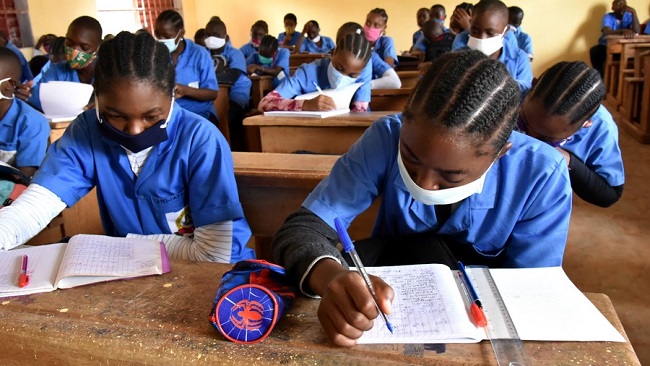
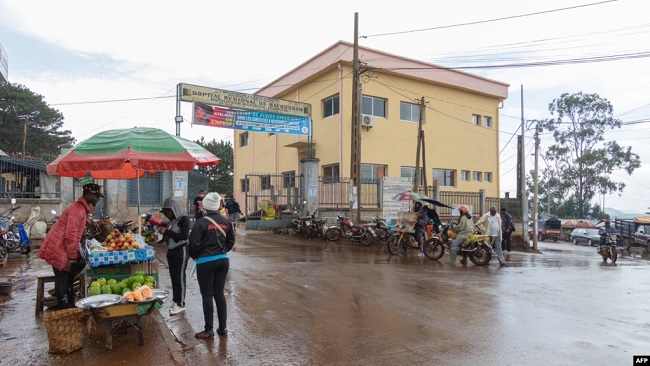
Teachers in Cameroon are refusing to work, citing unpaid salaries, some dating back years. Government-led negotiations Tuesday failed to reach an agreement, putting the education of hundreds of thousands of children on hold.
Students at Government Bilingual High School Deido in the city of Douala sing that the government should pay their teachers so children have access to education.
In the song, the children say their dreams of becoming government ministers, doctors, journalists and entrepreneurs will be shattered if the government fails to listen to teachers.
Architect David Muluh has three children in the school. He says he visited the school on Wednesday to find out why teachers come to school but refuse to teach and “because of COVID, children have not been regular in school. If they continue losing [education] because their teachers are on strike, the children’s future is jeopardized. So, my plea is that the government should look into their problems.”
Muluh said school attendance in Cameroon has not been regular since the central African state reported its first cases of COVID-19 in March 2020.
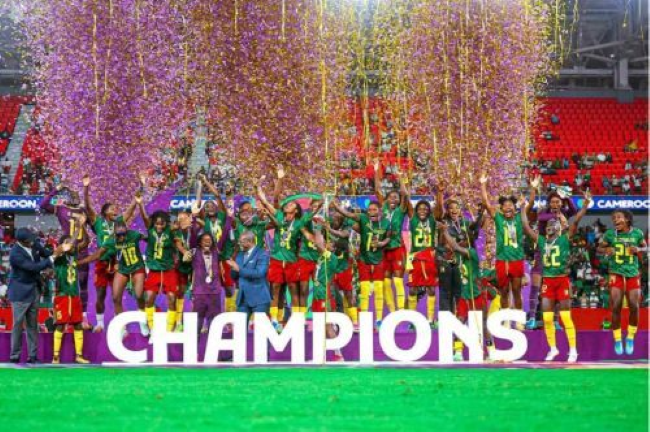
He said during the Africa Football Cup of Nations, which Cameroon hosted last month, the government interrupted classes so students could fill empty football stadiums. He said children have no time to waste if they are to prepare for this year’s final examinations, expected in May.
Ten Cameroon teachers’ associations and unions last week announced a strike against what they call the disrespect of teachers by the government.
The teachers say the monthly salaries of primary school teachers should be increased from about $150 to at least $400. They are also asking the salaries of secondary school teachers to be increased from about $400 to at least $800.
Valentine Tameh, president of the Teachers’ Association of Cameroon, says his colleagues are particularly angry because the government has recruited more teachers than it can pay and now owes several years of unpaid salaries.
“You have teachers who have gone for 9 years, 10 years, without salaries and the government has kept promising and kept promising and promising and what is most irksome is that those who have money, go and give bribes and they have their arrears, they have their salaries.”
The sides negotiated Tuesday, and the government promised to look into the teachers’ grievances and pay the outstanding salaries of at least 17,000 teachers, though it did not say when.
A statement from Fouda Seraphin Magloire, secretary general of the prime minister’s office, said the teachers agreed to suspend the strike.
Geography instructor Appolinnaire Ze, a spokesman for the disgruntled teachers, says the teachers agreed to no such thing.
Ze says all teachers should go to school, but should not teach. He says school children should be calm and understand that teachers are going through a very difficult time. Ze says teachers should be humble but courageous to ask intimidating police and government officials if the police and government officials can also work for so many years without being paid.
The government denies that its officials and the police are trying to intimidate the teachers.
Source: VOA


















3, March 2022
Manu Dibango: Today, Tomorrow And Forever 0
Emmanuel N’Djoké Dibango – Manu Dibango – will live forever thanks to his Afropolitan sounds, and to the fact that many artists in Africa and beyond are deeply indebted to him.
He was a man of legendary generosity of spirit and talent, with an accommodating heart that sought to bridge the local and the global with creativity and innovation in song and music. His album Soul Makossa was of such artistic genius that even a global superstar like Michael Jackson couldn’t resist sampling from it to enrich his own album, Thriller.
In his 1994 biography, Dibango describes himself as “Négropolitain”. It’s a term that would later be adopted and popularised as “Afropolitanism” by others enthralled by his idea of grounded cosmopolitanism.
African and European at one and the same time.
He saw himself – and insisted on being seen – as “a man between two cultures, two environments”. His music could not be confined to either, without losing its complexity and richness. It was the fruit of his diverse influences. His nimble fingers, voice and intellect were averse to any artificial barriers or attempts to contain the flow of the river of musical humanity.
Three kilos of coffee
Born on December 12 in 1933 in Douala, Cameroon, Dibango was sent by his parents to study in France when he was only 15 years old. He arrived in France bearing a gift of three kilograms of coffee from his parents, for his host.
In France he met Francis Bebey, another musician from his native Douala, with whom he formed a band and began to experiment with different modern instruments, such as the piano and the saxophone.
He later relocated to Brussels where he met his wife to be, Marie-Josée (whom he would fondly call Coco). It was also in Brussels that his music career began to blossom through fruitful contacts. Two in particular stand out: Joseph Kabasélé and African Jazz, who introduced him to “the cha-cha and the rumba, the two breasts nourishing Zairean music”, and who, in 1961, also invited him to Zaïre (today’s Democratic Republic of Congo). The result was his first record, African Soul, “a mixture of jazz, popular music, and rumba”.
Dibango’s life was exemplary in its resilience, combativeness and ingenuity in mobilising his creativity to contain or at least confront political and cultural repression. His music brought him worldwide fame. But he did not feel particularly fulfilled in the land of his birth.
He spent the best part of his life in a determined struggle to win recognition for music as art and musicians as artists in his motherland and elsewhere in Africa. These were contexts of strongman politics, personality cults and repeated frustrations by politicians, sometimes in cassock. Notwithstanding censorship, jealousy, penury, and repeated frustration and disappointment as an artist, Dibango refused to be deterred.
Manu Dibango performs on stage at Ronnie Scott’s club in 2009 in London. David Redfern/Redferns
Leaving Cameroon
He returned to Cameroon from Zaïre in 1963, issuing the album Nasengina. This was his only piece constructed purely from the indigenous Cameroonian makossa.
Dibango was appreciated by ordinary Cameroonians. But he hated the fact that politicians kept his artistic creativity under close surveillance. He was disenchanted with authorities that did not allow people “to fantasise” and “to dream”, and who forced everyone to talk “in cautious whispers” and to be “wary of everyone else”.
In 1964, disappointed in “this harmful atmosphere”, Dibango closed down his club and abandoned all dreams of opening a musical conservatory or arts institute. He left Cameroon for France after barely 16 months back home.
Still, he could not bring himself to give up on Cameroon entirely. He would pay brief return visits from the early 1980s onwards. His desire “to forge a unified image of Cameroon, representing all the musical currents in the country” received rare facilitation from the Minister of Culture who happened to be his friend, and resulted in a three-record set, Fleurs Musicales du Cameroun.
But his desire to project himself as “this famous Cameroonian musician heard everywhere but in Cameroon” would be met with the same contradictions, making the air “unbreathable” in what he described as his “last African adventure”.
He felt cursed that he “couldn’t create something here in Cameroon”. He found it ironic that Côte d’Ivoire, with the blessing of then President Houphouët-Boigny, could entrust him with the task of heading the Orchestre de la Radio-Télévision Ivoirienne, while Cameroon could not even take seriously his expertise as a professional musician of world renown.
Together with other expatriate African musical talents in France, Dibango released Tam-Tam pour l’Ethiopie, to raise funds for famine-stricken Ethiopia between 1983 and 1985. The initiative served as “proof that Africans too could take concrete action” vis-à-vis their own predicaments. And he personally took the proceeds from the album to refugee camps in Ethiopia to ensure that
‘For once, the money wouldn’t be misused by the government in power’.
Although the situation has improved significantly since publication of his biography in 1994, Dibango’s music is still much more appreciated abroad – as “world music” – than in Cameroon.
Despite the government’s attempts to impose creative inertia upon him in the early 1960s, Dibango was given the honour of composing the theme song of the 1972 Africa Cup of Nations football finals hosted by Cameroon. In 1988, he received a decoration as a Knight of Order and of Valour. However, as Dibango observed, “the authorities could decorate me with all the medals they liked” without doing much to stop “the descent into hell” for artistic creativity in a country where it is not uncommon to mobilise the military to raid clubs. Or to impose entertainment taxes with the intention of crippling artists who are perceived to be critical or unpalatable.
Manu Dibango died after contracting COVID-19 at the age of 86 in Paris, where he felt “condemned to be an expatriate”.
Quibble as they may in Cameroon, Dibango leaves behind a towering record of Afropolitan musical genius of truly global magnitude, to feed and inspire many a generation to come. Manu Dibango does not have to be in Cameroon, in Africa or physically in the world to continue to do things of relevance.
Culled from The Citizen