
20, January 2020
US Diplomat’s Remarks Stir Controversy in Cameroon 0
There have been mixed reactions in Cameroon to the meeting between the top U.S. diplomat to Africa, Tibor Nagy, and opposition leader Maurice Kamto, who says he was the rightful winner of the Cameroon’s October 2018 presidential election.
Nagy also gave an interview in which he said Cameroonian officials are not doing enough to solve the separatist crisis that has killed more than 3,000 people in the country’s English-speaking regions. While some see Nagy as someone proposing solutions, others say he does not know the true situation and should hold back his opinions.
Before beginning a five-nation tour of Africa last Wednesday, Nagy, the U.S. Assistant Secretary of State for African Affairs, spoke to Radio France Internationale. In the interview, he said his mind bleeds because the separatist crisis in Cameroon has persisted and there seems to be no solution in sight. Nagy said Cameroonians in the volatile north- and southwest regions love their country, but are not happy with the system of government.
“What the people in the southwest and the northwest want more than anything else is decentralization. They would like to have control over their own lives, their own historical heritage,” Nagy said.
Armed groups in the two English-speaking regions want to separate from the rest of Cameroon, alleging discrimination from the country’s French-speaking majority.

Ernest Ateba, spokesperson of the ruling Cameroon Peoples Democratic Movement, said Nagy does not have the mandate to speak to Cameroon.
He said America should respect Cameroon’s sovereignty and understand that Cameroon organized a successful national dialogue that unanimously created a special status for the English-speaking regions, which is gradually being put in place with the expected local council and parliamentary elections and an eventual election of representatives to regional assemblies and assemblies of chiefs.
Separatists have also criticized Nagy on social media for saying that Cameroonians are unified. They say they are fighting for an independent state they call Ambazonia.
Before leaving for Africa, Nagy met in Washington with Cameroon’s opposition leader Maurice Kamto. Kamto maintains that he won the October 2018 presidential election and his victory was stolen by Cameroon’s longtime leader, Paul Biya.
Roger Justin Noah, a spokesman for Kamto’s Cameroon Renaissance Movement party, says Nagy and Kamto discussed the political situation in Cameroon and the crisis in the English-speaking regions.
He said Tibor Nagy, just like their leader Maurice Kamto, shares the view that Biya never respects his promises and that the solution to the crisis in the English-speaking regions is the convening of a true national dialogue in the presence of all English-speaking leaders, including those who were arrested and sent to prison, and their colleagues in the diaspora who have been declared wanted by Cameroon. He said during the dialogue, people should be allowed to speak freely and should not be arrested for having contrary views to those of Biya.
Minister of Communication Rene Emmanuel Sadi said calls by Kamto for another dialogue are to distract people.
“We do not foresee a more inclusive dialogue than the historical one from the 30th of September to the 4th of October 2019. The absence of an extremist minority which did not want to take part although invited, could not put asunder the great success of this historic gathering of worthy sons and daughters of the Cameroonian nation,” Sadi said.
Cameroon is not on Nagy’s itinerary, which includes stops in the Central African Republic, Kenya, Ethiopia, Sudan, and South Sudan.
Source: VOA











22, January 2020
Southern Cameroons War: Government, Separatists Indicted For Killings, Torture, Kidnappings 0
“Human Rights Watch, HRW, has released its 2020 report on the human rights barometer on Cameroon, in which it has indicted Cameroon Government forces for killings, destruction of property, burning of villages, torture, alongside other human rights violations.”
The report also indicted Separatist fighters in the Anglophone Regions for kidnappings, torture, and occupation of schools.
Citing examples from documented cases, the HRW report on the situation in Cameroon, dwelling on the happenings of 2019, noted in its opening statement that: “Armed groups and Government forces committed widespread human rights abuses across Cameroon throughout 2019.”
The report, though largely concerned with the atrocities in the Northwest and Southwest Regions of the country, also documented attacks by the Boko Haram sect in Cameroon’s northern regions. It points out that the sect carried out over 100 attacks, killing over 100 civilians in 2019.
On the situation in Anglophone Cameroon, the report noted: “In Anglophone Regions, violence intensified as Government forces conducted large-scale security operations and armed Separatists carried out increasingly sophisticated attacks.
Over 3,000 civilians and hundreds of security forces personnel have been killed in the Anglophone Regions since 2016 when the crisis started. The unrest in these regions led to the displacement of over half-a-million people.”
Killings, destruction of Property, Torture by Government Forces Narrowing its report to groups, and pointing out their abuses, HRW accused Cameroon Government forces of destroying property, killings, torture, among others.
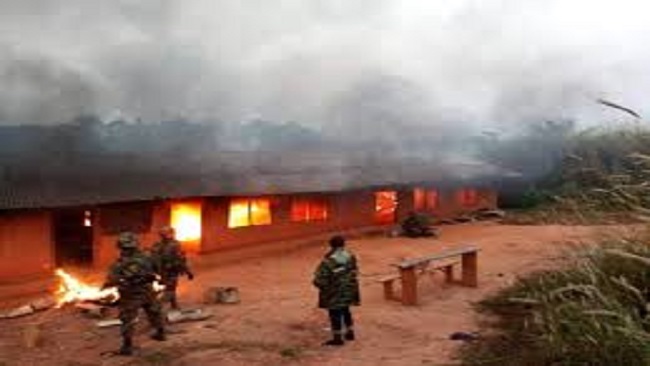
“Responding to increasing attacks by armed Separatist groups, security forces killed scores of people, burned hundreds of homes and other property in villages and cities across the Northwest and Southwest Regions, and tortured suspected Separatists in detention,” the report states.
The report cited the February 6 storming of the Bole Bakundu Market by State security officers, leading to the death of 10 men; the April 4 assault on Meluf village in the Northwest Region, which led to the killing five civilian males, including one with a mental disability, and wounding one woman.
Eighty homes were broken into, looted and some burnt; the May 15 incident in Mankon, Bamenda was cited, where Air Force and BIR soldiers killed three men, and burnt over 70 houses; the September 24 attack on the Bafut Royal Palace, a UNESCO World Heritage site – where soldiers wounded a man and looted the palace museum, taking several precious artefacts; the incommunicado detentions of several people at the State Defense Secretariat, popularly known by its French acronym, SED, where Gendarmes and other security operatives used torture, including severe beatings and near-drowning, as well as other ill-treatment to force suspects to confess crimes or to humiliate and punish them.
The report also stated that: “While the Government maintained it did not tolerate crimes committed by security forces, it failed to demonstrate progress in investigating and punishing them.”
Kidnappings, Torture, Occupation of Schools By armed Separatists HRW’s report also indicted separatist fighters, stating that: “Armed Separatist groups have killed, tortured, assaulted, and kidnapped dozens of people, including students, teachers, clergy, and administrative and traditional authorities.”
Citing particular cases, HRW pointed out the February 16 abduction of 170 students, mostly girls under 18, a teacher, and two guards from a boarding school in Kumbo, who were released a day after; the mid-May torture of a man in an abandoned school in Bali village, Northwest Region; the June 18 incident where over 40 people were beaten and robbed in Bafut; the June 28 abduction of SDF’s Chairman, John Fru Ndi, as well as the abduction of the Bamenda Archbishop, Cornelius Fontem Esua.
Apart from the situation in Anglophone Cameroon, HRW also documented the crackdown on opposition protests, as well as the detention of peaceful protesters. It also recorded the crackdown on sexual relations between persons of the same sex.
The report also cited the lack of transparency in the trial of security personnel accused of carrying out human rights violations. It stated that: “The visible lack of accountability appears to have fuelled abuses, including killings, destruction of property and torture.”
The report mentioned the US’s decision to scale back military support to Cameroon, due to the country’s alarming human rights abuses. It also mentioned Germany’s decision to end its military cooperation with Cameroon, alongside the stance of other international actors, who generally take exception to the many human rights cases of abuse by the Cameroon Government, especially in Anglophone Regions.
Culled from Cameroon Info.Net