23, September 2021
EU to impose universal phone charger, setting up clash with Apple 0
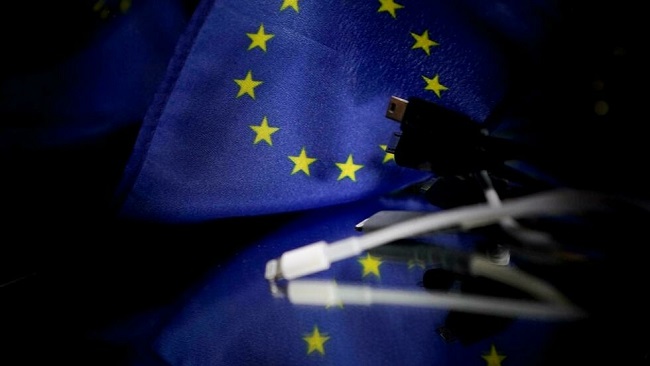
The European Union announced on Thursday that it will impose a universal charger for smartphones, setting up a clash with Apple and its widely used iPhone.
The European Commission believes a standard cable for all devices will cut back on electronic waste, but Apple argues that a one-size fits all charger would slow innovation and create more pollution.
The bloc is home to 450 million people, some of the world’s richest consumers, and the imposition of the USB-C as a cable standard, once approved by member states and European Parliament, would affect the entire global smartphone market.
“European consumers have been frustrated long enough about incompatible chargers piling up in their drawers,” said EU executive vice president Margrethe Vestager in a statement.
“We gave industry plenty of time to come up with their own solutions, now time is ripe for legislative action for a common charger,” she said.
Consumers currently have to decide between phones served by three main chargers: “Lightning” for Apple handsets, the micro-USB widely used on most other mobile phones and the newer USB-C that is increasingly coming into use.
That range is already greatly simplified from 2009, when dozens of different types of chargers were bundled with mobile phones, creating piles of electronic garbage when users changed brands.
‘Inconvenient’ and wasteful
The EU said the current situation remained “inconvenient” and that European consumers spent approximately 2.4 billion euros ($2.8 billion) annually on standalone chargers they bought separately.
Thierry Breton, the internal market commissioner also pushed back against the industry’s argument that innovation would be harmed.
He told reporters that US tech giants “are always making this argument, that (EU law) is against innovation … It is not against innovation. It is for European consumers, it is not against anyone.”
Apple, which already uses USB-C connectors on some of its iPads and laptop computers, insists legislation to force a universal charger for all mobiles in the European Union is unwarranted.
“We remain concerned that strict regulation mandating just one type of connector stifles innovation rather than encouraging it, which in turn will harm consumers in Europe and around the world,” Apple said.
‘Ample time’ to switch
Some in the industry argue that phones already in use with a legacy charging cable will lose their resale value if it cannot be replaced, and add to the glut of digital waste.
The European Commission had long defended a voluntary agreement it made with the device industry that was set in place in 2009 and saw a big reduction in cables, but Apple refused to abide by it.
In the commission’s proposal, which could yet be considerably changed before ratification, smartphone makers will be given a 24-month transition period, giving “ample time” for companies to fall in line, the commission said.
Apple said that it believed the two-year transition period was a worry for the industry and too short to prevent the sale of existing equipment.
EU consumer group ANEC cautiously welcomed the proposal but urged that the plan be expanded to wireless charging systems, which are increasingly being adopted by phonemakers.
“It is therefore important to avoid any fragmentation in this area as well,” the group said.
Source: AFP























26, September 2021
Bexit: Britain to issue up to 10,500 temporary visas to ease chronic staff shortages 0
Britain will issue up to 10,500 temporary work visas to lorry drivers and poultry workers to ease chronic staff shortages, the government announced Saturday, in a U-turn on post-Brexit immigration policy.
The short-term visas, to run from next month until late December, come as ministers grapple with a huge shortfall in drivers and some other key workers that has hit fuel supplies and additional industries.
A tanker drivers shortage has caused large queues at petrol stations in recent days, as people ignore government pleas not to panic-buy fuel after some garages closed due to the lack of deliveries.
The decision to expand the critical worker visa scheme is a reversal by Prime Minister Boris Johnson, whose government had tightened post-Brexit immigration rules insisting that Britain’s reliance on foreign labour must end.
It had resisted the move for months, despite an estimated shortage of around 100,000 heavy goods vehicle (HGV) drivers and warnings from various sectors that supplies would run short.
Transport Secretary Grant Shapps nevertheless insisted he was taking action “at the earliest opportunity” and that a broader package of measures announced would ensure pre-Christmas preparations “remain on track”.
“The industries must also play their part with working conditions continuing to improve and the deserved salary increases continuing to be maintained in order for companies to retain new drivers,” he added.
But one business leader dismissed the new measures as inadequate.
Millions of pounds for ‘skills bootcamps’
“This announcement is the equivalent of throwing a thimble of water on a bonfire,” said Ruby McGregor-Smith, president of the British Chambers of Commerce.
The additional testing would take time to impact while new visa numbers were “insufficient” and not “enough to address the scale of the problem”, she added.
The new measures will focus on rapidly expanding the number of new domestic drivers, and include deploying Ministry of Defence driving examiners to help provide thousands of extra tests over the next 12 weeks.
Meanwhile the education ministry and partner agencies will spend millions of pounds training 4,000 people to become HGV drivers, creating new so-called “skills bootcamps” to speed up the process.
Nearly 1 million letters will also be sent to all drivers who currently hold an HGV licence, asking any not currently driving to come back to work.
Johnson has been under increasing pressure to act, after the pandemic and Brexit combined to worsen the haulier shortage and other crises emerged, including escalating energy prices.
As well as threatening timely fuel supplies, the lack of lorry drivers has hit British factories, restaurants and supermarkets in recent weeks and months.
US burger chain McDonald’s ran out of milkshakes and bottled drinks last month, fast-food giant KFC was forced to remove some items from its menu, while restaurant chain Nando’s temporarily shut dozens of outlets due to a lack of chicken.
Supermarkets are also feeling the heat, with frozen-food group Iceland and retail king Tesco warning of Christmas product shortages.
‘It’s ridiculous’
This week it was the turn of the fuel sector, with growing lines of cars clogging the approaches to petrol stations following some closures and panic-buying, particularly in southeast England.
Drivers appeared less than reassured Saturday, as queues again formed for fuel.
Mike Davey, 56, had been waiting more than half an hour to fill up at a petrol station run by the supermarket chain Tesco in Kent, southeast of London.
“I just want to get some fuel to get to work. People are just like filling up jerry cans – it’s ridiculous,” he told AFP.
“Maybe they need to bring some army drivers in,” Davey added.
The government has so far resisted calls to deploy soldiers to help deliver petrol directly.
As part of the measures announced, taxpayers will also help pay for some adult HGV license applications in the next academic year – which can cost thousands of pounds – through an adult education budget fund.
Source: AFP