
10, June 2021
War in the Central African Republic: French role in escalating the conflict 0
Prosecutors in Bangui on Wednesday charged a French national of espionage and conspiracy but the French government that abandoned one of its own Atangana Thiery in a French Cameroun jail in Yaoundé for 17 years is now claiming that its former colony is siding with a Kremlin disinformation campaign.
Our senior political commentator in Yaoundé says the French government’s take on the happenings in the Central African Republic is shameful, disgusting and disgraceful and serves only French selfish interest in the CEMAC region.
France left the mineral-rich nation poverty-stricken and unstable since independence 60 years ago while French multinationals stayed behind and have been looting the country ever since.
Thousands of its citizens have died and more than a quarter of the population of 4.9 million have fled their homes in fighting aimed at control of mineral resources. Of these, 675,000 are refugees in neighbouring countries in the so-called CEMAC region.
Correspondingly, Juan Remy Quignolot the French director of all operations that is destabilizing the Central African Republic was arrested in the capital Bangui on May 10 and has been placed in protective custody pending an inquiry by an investigating magistrate.
Central African Republic prosecutor Eric Didier Tambo who confirmed the arrest of Mr. Juan Remy Quignolot told a press conference in Bangui that Juan Remy has been aiding several French backed armed militias fighting the elected government in the Central African Republic.
Contrary to reports that Eric Didier Tambo made no reference to any country or organisation for whom Quignolot allegedly worked, Cameroon Intelligence Report gathered from a Cameroonian gendarmerie officer serving with the UN in Bangui that Juan Remy Quignolot works for the French Secret Service and that the Cameroonian military leadership in MINUSCA-United Nations Mission in the Central African Republic knew him and nicknamed him Bob Denard.
At the time of his arrest, Quignolot was in possessing a huge quantity of combat weapons and passing himself off as a journalist with a press card.
In an attempt to bully Bangui to submission, France reportedly froze cooperation with the Central African Republic over what Paris described as an anti-French disinformation campaign and pointed a finger at Russia-a world power that is in the Central African nation to help build its institutions and police force.
French speaking African aid workers were quick to say that Mr. Quignolot had worked occasionally as a security guard for several organizations in the Central African Republic. But many in Bangui are finding it difficult to accept that a man who joined the French army at a teenage age would end up as a security guard in their country.
– French anger –
Photos circulating on social media on the day of Quignolot’s arrest showed him with his hands bound behind his back, sitting on some steps before an arsenal of weapons, ammunition and military clothing.
Two days later, France lashed the arrest and the pictures as “clear manipulation.”
It said “disinformation networks” were being used, “promoting well-identified interests who are used to targeting France’s presence and actions” in the CAR.
Quignolot’s arrest was notably conveyed on Twitter by Valery Zakharov, a Russian who is a close advisor to CAR President Faustin Archange Touadera.
On Monday, France suspended budgetary aid and military cooperation with the CAR.
“The CAR authorities have several times made commitments which they haven’t upheld, both politically with regard to the opposition and in its behaviour towards France, which is being targeted by a massive disinformation campaign,” the French foreign ministry said.
“The Russians are involved, but the CAR is an accomplice at best.”
France has long played a key role in the CAR since the impoverished landlocked country gained independence in 1960.
It intervened militarily to help still a bloody conflict that erupted along sectarian lines after the then president, Francois Bozize, was toppled by predominantly Muslim rebels in 2013.
The mission, Operation Sangaris, ended in 2016 following elections.
– Russian role –
But in past months, tensions have grown over the Russian presence in the chronically unstable country.
In 2018, Russia sent weapons and a large contingent of “instructors” to train the CAR’s beleaguered armed forces.
It has also stepped up investment in the CAR’s mining sector. The country’s riches include gold, diamonds, copper and uranium.
Last December, Moscow, as well as Rwanda, sent hundreds of military personnel to help shore up Touadera as a coalition of armed groups mounted an attempted coup ahead of presidential elections.
The reinforcements have helped Touadera to regain control over much of the country, which had previously been mostly in the hands of militias.
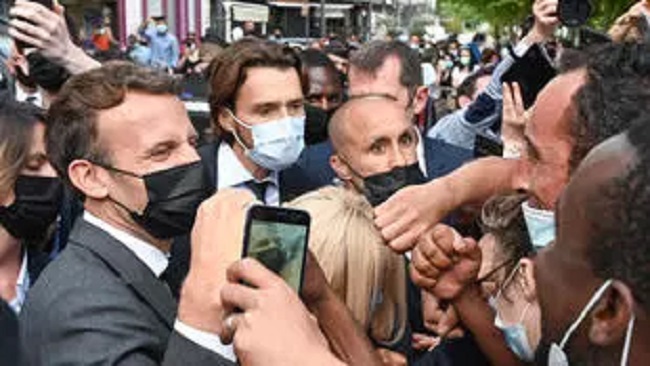
On May 30, in an interview with France’s Journal du Dimanche newspaper, French President Emmanuel Macron said “anti-French talk has provided legitimacy to predatory Russian mercenaries at the apex of the state, with a President Touadera who today is a hostage of the Wagner group.”
The Wagner group is the name given to Russian paramilitaries that operate under the orders of the Kremlin.
Last December, Facebook removed two networks of fake accounts based in Russia and one linked to the French military which it said were being used for interference campaigns in Africa, including in CAR.
Reported by Cameroon Intelligence Report and AFP












10, June 2021
Southern Cameroons Crisis: Interim Gov’t warns of mass deaths in Bui and Akwaya 0
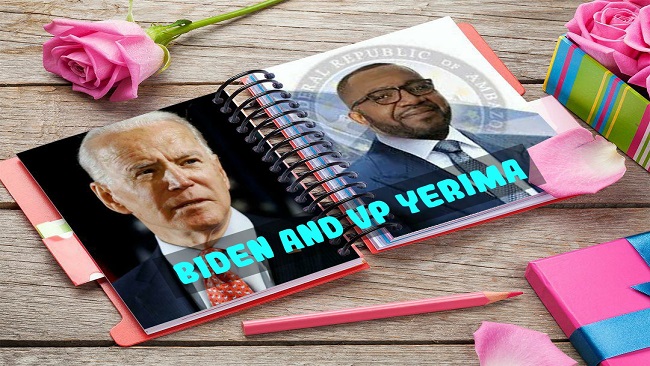
The Vice President of the Southern Cameroons Interim Government, Dabney Yerima has warned of mass deaths from Cameroon military operations in Bui Division and Akwaya Sub Constituency in Manyu where fighting goes on between Ambazonia Restoration groups and troops loyal to the Biya Francophone regime in Yaoundé.
In Bui Division and Akwaya, clashes have escalated in recent days. Locals contacted by Cameroon Concord News said Cameroon government army soldiers fired artillery shells that landed in villages in the two Southern Cameroons administrative units bordering the Federal Republic of Nigeria.
Vice President Yerima on Wednesday stated that brutal, indiscriminate attacks against the peace loving people of Southern Cameroons-Ambazonia are threatening the lives of thousands of men, women and children in the rural areas.
The exiled Ambazonian leader called on the Southern Cameroons diaspora to commit immediately to the “Big Rubbergun Project” saying mass deaths and atrocities being committed by the French Cameroun army needs immediate action.
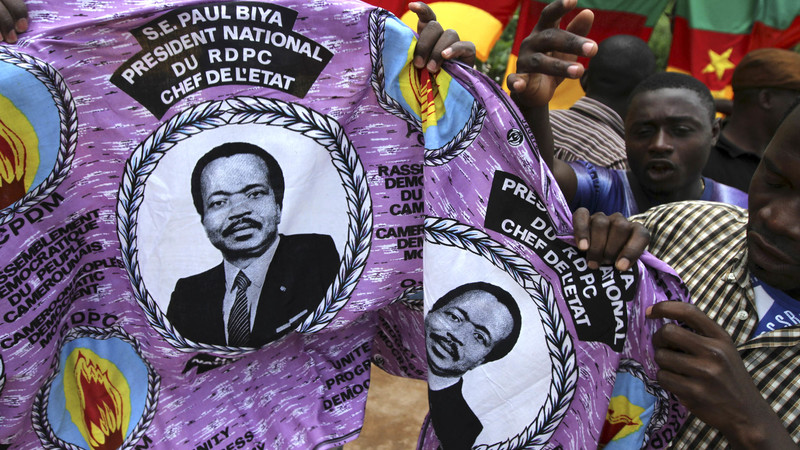
The Francophone military is struggling to impose order in Southern Cameroons ever since the 88-year-old President Biya declared war against the English speaking people of Southern Cameroons. The Ambazonia leader President Sisiku Ayuk Tabe and his top aides are currently serving a life sentence in French Cameroun where tension is also reportedly mounting over plans to get Biya’s eldest son to succeed him as head of state.
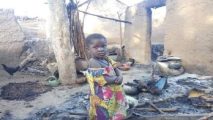
The War in Ambazonia has already claimed at least 40 000 lives, almost all of them civilian children, men and women, murdered by Cameroun troops in a series of targeted killings, organized massacres, and killings by fire in over 400 villages burnt down to ashes across Ambazonia. Over half a million people have been forcibly displaced as refugees living in various countries and especially in refugee camps in Nigeria. Over another half a million people have become IDPs hiding in forests, caves and hills due to forced displacement. Additionally, over 1.5 million people are facing a humanitarian disaster.
Republique du Cameroun uses not only arson and the destruction of food, livestock, and crops in the fields as weapons of war. It also uses rape. Rape of Ambazonian women and girls by Cameroun troops is systematic and widespread. This agonizing situation is compounded by the fact that a high percentage of Cameroun troops are HIV positive and also has other STDs. When they rape they infect the women and girls. This appears to be part of the genocide agenda of Cameroun. Reports are now emerging of scores of school girls raped, impregnated and infected by Republique du Cameroun’s troops. This poses a nightmare not only of the HIV and STD infections but also of rampant teenage pregnancies. Cameroun troops have burnt down health facilities and killed health workers in rural and semi-urban areas. Accessing health facilities or health practitioners is a huge challenge for rural and semi-urban folks.
By Isong Asu