17, January 2020
Russia’s Mikhail Mishustin: the unknown tax chief surprisingly promoted to Prime Minister by Putin 0
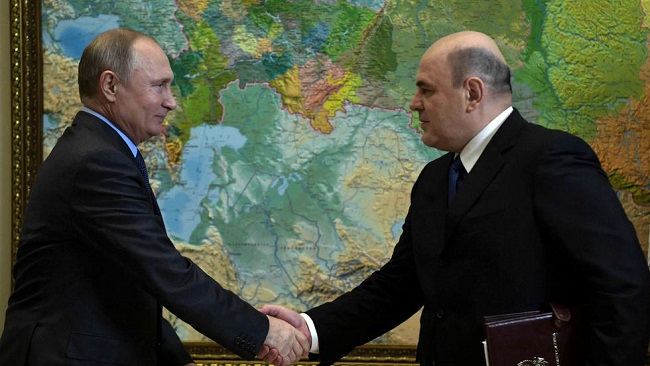
President Vladimir Putin nominated a new prime minister on Wednesday 15 January after the shock resignation of Dmitry Medvedev, who has been at the head of the government since 2012. Medvedev will be succeeded by Mikhail Mishustin, who until now was a barely known tax chief with no political clout.
After announcing a profound overhaul of Russian institutions and a reform of the constitution in his annual State of the Nation address, Putin proposed Mishustin as the new head of government, following the surprise resignation of the prime minister in office for nearly eight years, Medvedev.
Mishustin had been the head of the Russian tax service since 2010 until Medvedev’s bombshell announcement propelled him to the position of PM.
Russia’s lawmakers quickly approved Mishustin as prime minister on Thursday in a vote in the Duma, or the lower house, less than 24 hours after Putin had nominated him.
Mishustin received 383 votes of 424 cast, with no votes against and 41 abstentions in a victory that had been all but assured when he won the unanimous backing of his party, United Russia, which has a strong majority in the chamber.
Mishustin will have a week to propose a new government and ministers.
He told United Russia that some changes in the cabinet would be made but did not elaborate, lawmaker Viktor Vodolatsky told Interfax.
‘Surprise nomination’
Mishustin, a 53-year-old Moscow civil servant who shares a passion for ice hockey with Putin, is little known by the general public.
Known as a technocrat who loves new technologies and has remained well out of the Russian political arena, his appointment has shocked some experts. “The appointment of an obscure second-rate unknown is a surprise,” reports Nick Holdsworth, FRANCE 24’s correspondent in Russia.
“Commentators had instead put forward other names, including Sergey Sobyanin, the mayor of Moscow who is known to be loyal to President Putin.”
An engineer and economist by training, Mishustin is described by Russian state media as an efficient servant of the state and the creator of the “best tax collection system in the world”, according to the Russia-24 television channel.
On the website of the Russian Presidency, the results of his service and his work are duly praised by the head of state in the reports of his annual meetings with Putin.
‘Forged in the system’
Married with three children, Mikhail Mishustin joined the Russian administration in 1998. He served as Deputy Minister of the taxation department and worked in several government agencies. He is described by political scientist Ekaterina Schulmann to AFP as “an ideologically neutral figure”.
After a two-year stint in the private sector at the head of an investment fund, UFG Asset Management, he was appointed head of the tax department in 2010 with the task of thoroughly modernising it.
A promoter of the digitisation of the Russian economy, Mishustin is behind the creation of a centralised database designed to improve the efficiency of tax collection and to be accessible to all administrations.
“This is certainly an unexpected appointment, but that doesn’t mean it will be rejected. He has a great deal of experience behind him,” said Ilyas Umakhanov, vice-president of the Council of the Federation, the upper house of parliament, before Mishustin had been approved. “He is someone who has been forged in the system.”
During his presidential terms from 2000 to 2008, Putin had already appointed officials who were unfamiliar to the public – like Mikhail Fradkov in 2004. Their key qualities included that they never sought to overshadow the Russian President.
The announcement of major constitutional reforms and the change of government announced on Wednesday are seen by analysts and opponents as an indication that Putin is now looking very seriously at his political future after the end of his last term as President in 2024.
Some suggested 67-year-old Putin, who is two years into his fourth presidential term and has steered the country since 1999, could be laying the groundwork to assume a new position or remain in a powerful behind-the-scenes role.
Independent political analyst Maria Lipman said to AFP that Putin’s announcement indicated that he wanted to “stay on as number one in the country, without any competitors”.
She said he could be deliberately weakening the presidency before relinquishing the role.
Russia’s opposition also said the proposals indicate Putin’s desire to stay in power.
Opposition leader Alexei Navalny said on Twitter that Putin’s only goal was to “remain the sole leader for life”.
(FRANCE 24 with AFP)

















17, January 2020
Southern Cameroons Crisis: French parliamentary delegation in search of truth concludes mission 0
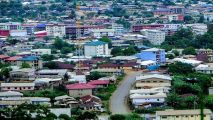
Members of a French parliamentary delegation that traveled to Cameroon on January 14, 2020 to seek the truth and get a feel of the reality on the crisis in Southern Cameroons have reportedly come to the end of their stay in the country.
The MPs Rodrigue Kokouendo from Seine-et-Marne who also moonlights as the Vice-president of the Committee for Foreign Affairs of the French National Assembly was in Yaoundé with Didier Quentin, MP for Charente-Maritime.
The French parliamentarians revealed earlier today that they were sent on a mission by the president of the foreign affairs committee to Cameroon to get an understanding of the crisis in Southern Cameroons.
Both men hinted that they met officials of the Biya Francophone regime, leaders of French Cameroun political parties represented in the National Assembly, civil society actors and members of the clergy.
“We came to Cameroon to inquire about the situation in order to report to our colleagues in the national assembly,” said MP Rodrigue Kokouendo.
“The fact of having come to the field gives us a lot of very useful information,” added Didier Quentin.
Ever since the French Cameroun dictator, Paul Biya declared war against the English speaking people of Southern Cameroons-Ambazonia, the fighting has left more than 20,500 dead and more than 530,000 displaced, according to NGOs and the Ambazonia Interim Government.
The Biya regime has rejected these figures claiming that human rights groups are swelling them up to get more help and precipitate foreign armed intervention in Cameroon.
By Chi Prudence Asong