
20, November 2017
Shifting alliances among Southern Cameroons figures in the US is making political initiatives inconsistent 0
Molyko in the Buea County of the Federal Republic of Ambazonia is a street of contrasts, with hotels, cafes and an old Art Decor University of Buea campus intermingled with hoops of razor wire that cordon off private buildings. The first anti French Cameroun government action resulting from the Southern Cameroons revolution took place here about a year ago. Anglophone citizens from all walks of life—young and old, men and women, secularists, teachers and lawyers, members of trade unions and employers unions—all united to denounce successive Francophone regimes that have not met the needs of Southern Cameroonians for over 56 years.
The people of Southern Cameroons have drafted a new constitution, meant to be a new social contract for its society. The process is still going on and has not been smooth. The Governing Council that has legitimate authority in Southern Cameroons has renamed the territory as the Federal Republic of Ambazonia. Negotiations between the interim government and other Southern Cameroons groups stopped when few of the opposing sides could not reach agreement. But after the new nation was shaken by a series of French Cameroun killings, massive arrests and detentions, the President of the Federal Republic of Ambazonia, Sisiku Ayuk Tabe and a cream of other Southern Cameroons leaders observed the chaos currently going on in La Republique du Cameroun and decided that, despite their differences, they shared a common need to forge ahead with the struggle for an independent Southern Cameroons.
The 4th Conclave that produced the draft constitution, grappled with three contentious questions: the role of political parties in the Southern Cameroons society, gender equality, and limits on executive power. Professor Carlson Anyangwe and the legal think tank purposely used precise language in the constitution to set forth principles for the Federal Republic of Ambazonia. To be sure, the 4th Conclave was a potent reminder of the United States’ constitutional process in 1789, when setting down words defined values for a nation.
Seeing the violence against our people and the sufferings of thousands that have escaped to neighboring Nigeria should bring everyone together with a renewed understanding of the urgency to come to agreement. We of this publication believe and fervently too that you are either with the interim government or with the Biya Francophone regime.
The interim government pointed in the draft constitution that the Federal Republic of Ambazonia is a civil state that is based on citizenship, the will of the people, and the supremacy of law. The draft constitution declared that women and men have equal rights and duties and we understand this will reflect in the upcoming cabinet.
The greatest challenge was how to prevent a return to dictatorship. The Federal Republic of Ambazonia’s draft constitution places limits on executive power, protects civil liberties and freedom of the press, and guards due process. It is the only constitution in West and Central Africa to grant “freedom of conscience.” The draft constitution included provisions for presidential term limits, elections, a constitutional court with power to impeach, an independent judiciary, and independent constitutional bodies with responsibility for issues such as combating corruption and human rights.
Based on this draft constitution, Southern Cameroonians should all rally behind the interim government and participate in the political process including the struggle for complete and total independence. Governance will not been smooth. But we as a people will get to Buea. Bloody attacks by French Cameroun forces have undermined the tourist industry, the bedrock of the Ambazonia economy. Consequently, shifting alliances among leading Southern Cameroons figures in the US and Europe is making political initiatives inconsistent.
Thanks to the interim government, Southern Cameroons has maintained its peaceful revolution. Nigeria is helping with support to our refugees in the Cross River State and several other measures. Ambazonia is slowly but surely becoming a priority for the UN, the EU and the African Union. Keep the faith in the interim government.
By Soter Tarh Agbaw-Ebai
Cameroon Concord News Group
















21, November 2017
230 parliamentarians vote to impeach Mugabe 0
Impeachment proceedings against Robert Mugabe will start on Tuesday after 230 members of the ruling Zanu-PF party voted in favor of the motion in Harere on Monday.
Simon Khaya Moyo, Minister of Information and Media said: “They just concluded that was attended by 230 Zanu-PF members of parliament out of 260 members has endorsed the impeachment.”
Mugabe was initially expected to resign on Sunday after the Zanu-PF central committee voted to sack and replace him with his former Vice President Emmerson Mnangagwa.
However, Mugabe refused calls to step down and vowed to stay on as president in a defiant TV address to the people of Zimbabwe on Sunday.
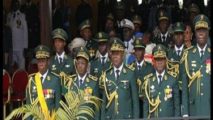
Mugabe’s sacking comes after the army seized the state broadcaster on November 15 and placed him under house arrest.
Source: Presstv