28, January 2023
Biya regime told to accept Canada’s peace mediation offer 0
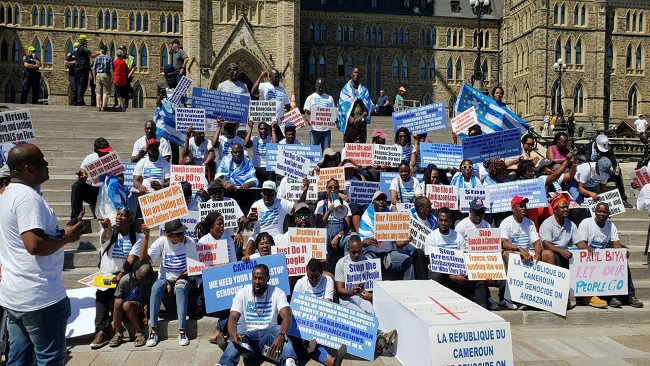
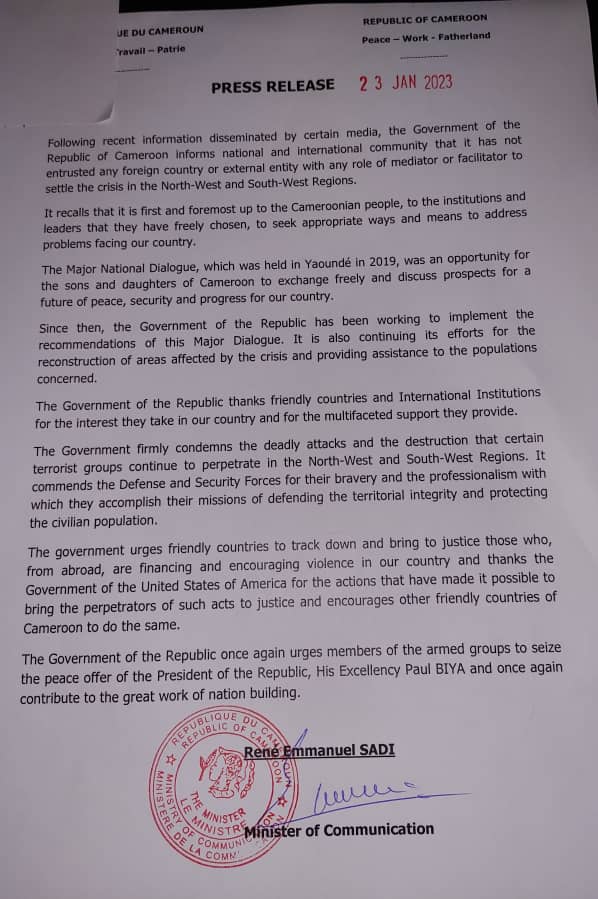
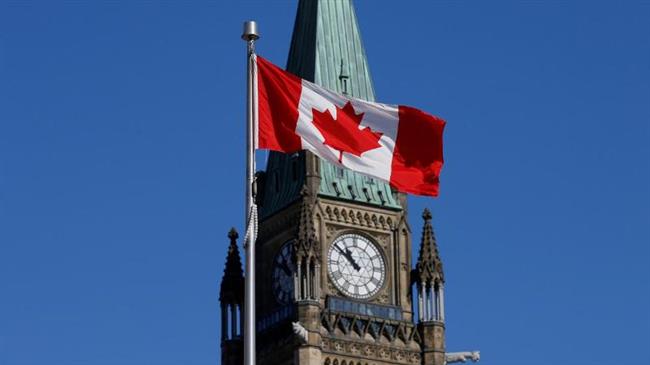
The Global Campaign for Peace and Justice in Cameroon has called on the African country’s government to accept the offer of mediation made last week by Canadian authorities with a view to a possible agreement with Anglophone separatists that would end a conflict that has left more than 6,000 people dead since 2017.
The current situation of the process is confusing, because the Canadian government presented itself as a mediator last Friday but days later the Cameroonian authorities rejected any involvement of Ottawa in negotiations with the separatists.
In this scenario, the NGO calls on the Government of Cameroon “to renew its commitment to the Canadian process” since “the killings, lawlessness, destruction and impunity prevailing in the conflict zones have only generated more violence and insecurity”.
“In this regard, the solidarity of the government of Cameroon with the Canadian process is vital,” the group added in a statement posted on its website.
Canadian Foreign Minister Mélanie Joly did not exactly comment on the Cameroonian government’s refusal but assured that the warring parties have already held three meetings in Ontario and Quebec. “The Cameroonian government approached us and we also invited a UN representative present during the mediation,” the minister assured on Tuesday.
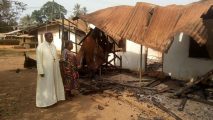
Cameroon’s Anglophone regions–Northwest and Southwest–have been rocked by conflict following the crackdown on separatist movements after Ambazonia’s self-proclamation of independence on October 1, 2017.
The previous year, this area–once part of British colonies in Africa but which decided to join French Cameroon–was the scene of peaceful protests to demand greater autonomy or independence arguing discrimination by central authorities, also on language issues.
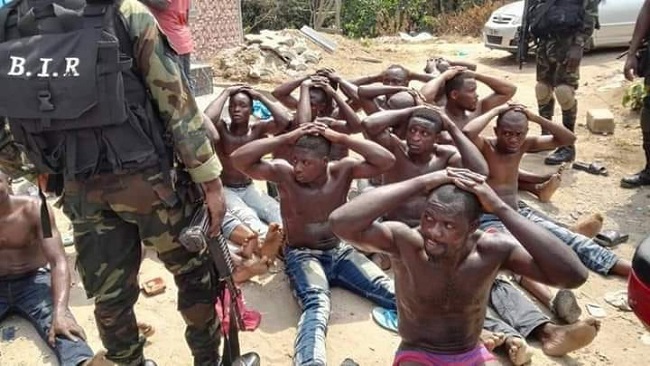
Since then, armed groups have proliferated and support for the separatists, hitherto rather marginal, has increased. The government has responded with a harsh crackdown, during which human rights organizations have accused the security forces of committing atrocities.
Source: EUROPA PRESS












9, February 2023
Journalist Martinez Zogo’s murder may trigger regime change in Yaoundé 0
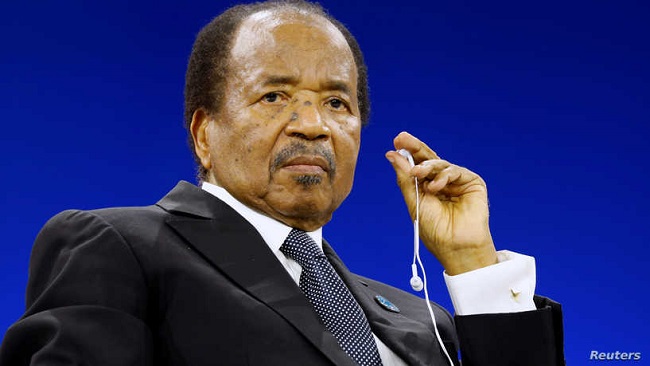
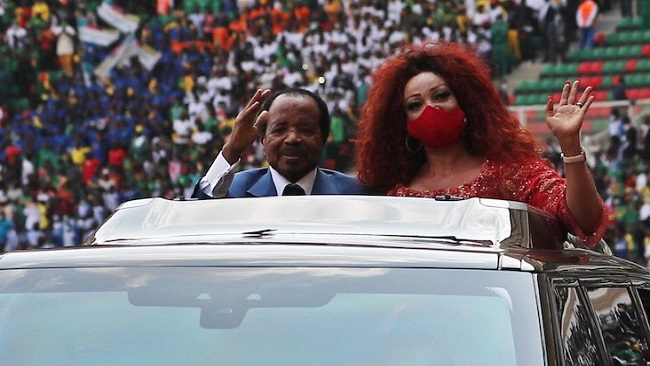
The nation has been run by the same man, Paul Biya, for decades. But as the 89-year-old fades from public view, high-stakes maneuvering is underway, which may have led to the brutal murder and mutilation of a well-known journalist.
Martinez Zogo was a journalist at Amplitude FM, an independent radio station in Cameroon’s capital, Yaoundé — and he became well-known for denouncing corruption. On Jan. 22, Zogo was found dead at the age of 51 — his body was severely mutilated.
From the moment the killing was reported, this central African nation of 27 million has been plunged into fear and a deep, potentially fatal regime crisis.
On Monday, one of Cameroon’s most prominent businessmen, Jean-Pierre Amougou-Belinga, was arrested at his home by about 100 security agents, who first had to neutralize his ten or so bodyguards. Amougou-Belinga is suspected of being the mastermind behind the journalist’s murder.
But that was just one in a series of arrests made in recent days, including the head of Cameroon’s counterintelligence service, as well as several members of the intelligence services. Reporters Without Borders, which has been investigating the case, reports that it has seen the statement of the Director of Special Operations of the counterintelligence service, Justin Danwe, who acknowledges his involvement. The Paris-based organization for the protection of journalists thus issued a statement that Zogo’s murder was a crime of the state.
Other journalists were reportedly threatened, including Haman Mana, director of the daily newspaper Le Jour, whom Martinez Zogo had visited a few days before his disappearance and who’d been told he would be next “on the list.”
Threat of instability in a key African country
If this were only a matter of settling scores over corruption, it would already be quite sordid; but everything seems to indicate that it goes far beyond that, that we instead are witnessing the war of political succession taking place in Cameroon.
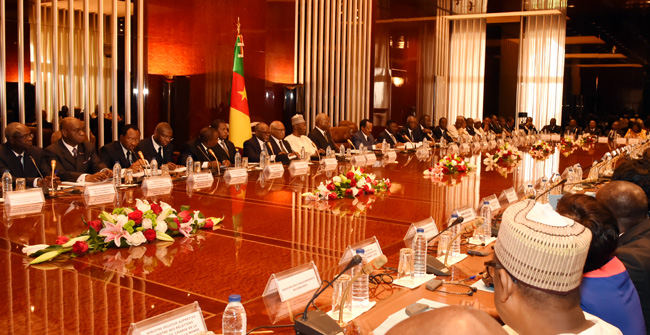
The country’s President, Paul Biya, who will soon be celebrating his 90th birthday, has run the country for more than 40 years — a record! For a long time now, he has been an “interim” president, passing lengthy stays in Switzerland, meeting only once or twice a year with the Council of Ministers.
The country could be one of the continent’s engines of growth.
This transition has thus left a lot of room for officials to compete for influence, including the all-powerful Secretary General of the Presidency, Ferdinand Ngoh Ngoh. It is still too early to know how this murder and subsequent arrests fit into these maneuverings, but it appears that the stakes are clearly high enough to kill, denounce and betray.
Cameroon is a key country in central Africa, and it is in no one’s interest to see it sink into even greater instability as the end of Biya’s long reign continues to drag out.
Boko Haram and oligarchs
The northern part of the nation, bordering Lake Chad, continues to face the threat of Boko Haram jihadists. The English-speaking West is in the grip of a civil war that has been going on for years, due to failures by the central government to keep its promises. All the while, much of Cameroon’s wealth is being captured by a predatory oligarchy.
And yet, it is an oil-rich, agricultural and modestly industrial country that could be one of the continent’s engines of growth. Its fate is of sufficient concern to its partners that French President Emmanuel Macron went there last summer, at the risk of appearing to support Biya, whom he has also criticized on repeated occasions.
Last week, several Cameroonian personalities from the diaspora as well as from within the country called for a national dialogue in an article in the French daily Le Monde before, they said, “a catastrophe occurs.” With the latest news, one wonders if the catastrophe has not already begun.
Source: Worldcrunch