27, July 2024
Bishop Bibi urges Catholic Women in Cameroon to live Christian Faith “in all aspects” 0
Bishop Michael Miabesue Bibi of Cameroon’s Catholic Diocese of Buea has called upon members of the Catholic Women Association (CWA) in the Central African nation to be consistent in practising their Christian faith, allowing it to influence all aspects of their lives.
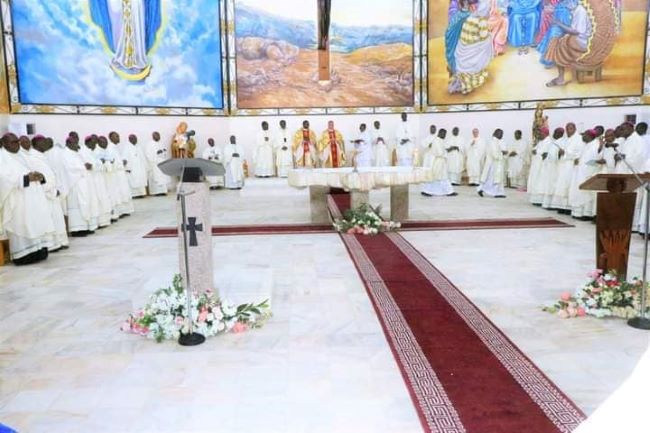
In his homily during the opening Mass of the 10th CWA National Congress, Bishop Bibi urged the Catholic women to “work diligently to foster the mission and piety of CWA.”
“We are called to live out our faith in all aspects. Our faith should be seen in all the deliberations we carry out in this congress,” he said during the Friday, July 26 Eucharistic celebration at Regina Pacis Small Soppo Cathedral of Buea Diocese.
He lauded CWA members in Cameroon for being “a new model of faith for our contemporary world” and appealed, “You must persevere in your faith. You must make sure that you do not allow the distractions of this world to come between you and your faith.”
Despite the difficulties and challenges in society, Bishop Bibi noted, CWA members need to “always remain consistent, trusting that God, our Heavenly Father, will continue to accompany you in this journey that you have undertaken.”
Reflecting on the 60th Anniversary of the existence of CWA in Cameroon, the Local Ordinary of Buea Diocese said, “It is the gift of faith that has sustained the Catholic Women Association in its mission since 1964.”
The Cameroonian Catholic Bishop, who has been at the helm of Buea Diocese since December 2019, first as Apostolic Administrator, and since February 2021 as the Local Ordinary, thanked God for the diverse gifts and blessings CWA members have received over the past six decades.
“The CWA as an apostolate has done a lot in strengthening the faith of Catholic women in our country and in the diaspora,” he said during his July 26 homily.
The July 24-28 congress at Bishop Rogan College in Cameroon’s Buea Diocese has been organized under the theme, “CWA Women: Artisans of Human Fraternity for World Peace in Church that Goes Forth.”
Participants in the national event that has brought together over 500 Catholic women from across Cameroon are to elect new leaders for the association.
In his July 26 homily, Bishop Bibi underscored the importance of electing servant leaders, saying, “This Congress is an opportunity to craft out methods of providing good leadership for the entire Catholic Women Association.”
“Let us take our time to prayerfully choose leaders who act after the heart of God and foster the growth and holiness of the CWA wherever they are found,” the Catholic Church leader, who started his Episcopal Ministry in March 2017 as Auxiliary Bishop of Cameroon’s Bamenda Catholic Archdiocese said.
He implored, “May the Blessed Virgin Mary, our mother and model of faith help us. May she protect us so that the deliberation of this Congress may benefit families and society at large.”
Source: aciafrica


2, August 2024
Bamenda Ecclesiastical Province: Archbishop Nkea highlights six levels of Communion 0
Archbishop Andrew Fuanya Nkea of Cameroon’s Catholic Archdiocese of Bamenda has outlined six levels of communion, which he said Catholic Priests share in their Priestly ministry.
In his Wednesday, July 31 homily during the opening Mass of the General Assembly of Priests of Bamenda Ecclesiastical Province (BAPEC), Archbishop Nkea highlighted Communion with the Trinity, Communion with the Church, Hierarchical Communion, Communion in the Eucharistic Celebration, Communion in the Exercise of Ministry, and Communion in the Presbyterate as vitally important in the ministry of Priests.
He described the July 31 – August 2 meeting as a “wonderful encounter of faith and fraternity”, and added, “The Priesthood is the strongest brotherhood in the world.”
“We are linked by that special fraternity which flows from the mystical oil of Chrism with which we were anointed during our Priestly ordinations, and nothing can weaken or separate us from this divine brotherhood,” the Cameroonian Catholic Archbishop said at St. Thomas Aquinas Major Seminary Bambui (STAMS) in Bamenda Archdiocese.
Communion with the Trinity
“The communion of the Priests is fulfilled above all with the Father, the ultimate origin of all his power, with the Son, in whose redemptive mission he participates, with the Holy Spirit who gives him the power for living and fulfilling his pastoral charity,” Archbishop Nkea said.
The Local Ordinary of Bamenda, who doubles as the President of the National Episcopal Conference of Cameroon (NECC) advocated for “pastoral charity” on the part of Priests.
“Far from being reduced to a series of techniques and methods serving the functional efficacy of the ministry,” he said, pastoral charity “refers to the nature proper of the mission of the church for the salvation of humanity.”
Communion with the Church
“The ecclesia communion of the Priest is lived in diverse ways. In fact, through Sacramental Ordination, he develops special bonds with the Pope, the Episcopal body, his own Bishop, other Priests, and the faithful,” he said.
Communion with the Church, the Archbishop of Bamenda emphasized, “is of utmost importance because without the Church the Priest cannot exist. We are Priests, and we can only experience this Priesthood in its fullness by being in communion with the Church.”
Hierarchical Communion
“Taking form in said ministerial communion are also some precise ties, first of all with the Pope, the college of Bishops, and Priests’ own proper Bishop,” he said referring to communion from the hierarchy viewpoint.
The 58-year-old Catholic Archbishop, who started his Episcopal Ministry in August 2013 as the Coadjutor Bishop of Cameroon’s Mamfe Diocese explained, “There can be no genuine Priestly ministry except in communion with the Supreme Pontiff, the Episcopal College, especially with one’s own Diocesan Bishop who deserves that filial respect and obedience promised during the right of ordination.”
“The Priesthood has absolutely no meaning if it is separated from that of the Bishop in whose Priestly ministry we share,” Archbishop Nkea said.
Communion in the Eucharistic Celebration
“Hierarchical communion is most meaningfully expressed in the Eucharistic prayers,” Archbishop Nkea said.
He explained, “When the Priest prays for the Pope, the College of Bishops and his own Bishop, he expresses not only a sentiment of devotion but attests to the authenticity of his celebration as well.”
“The Eucharistic celebration manifests the unity of the Priesthood of Christ in the plurality of his ministers as well as the unity of the sacrifice of the people of God,” he added.
Holy Mass, the Cameroonian Catholic Church leader said, “contributes to the consolidation of the ministerial fraternity existing among Priests. Without the Eucharist, the Priesthood has absolutely no meaning.”
Communion in the Exercise of Ministry
“Each Priest is to have a deep, humble, and filial bond of obedience and charity with the person of the Holy Father and adhere to his Petrine ministry of magisterium, sanctification and governance with exemplary docility,” he said.
Filial union with a Priest’s “own vision is also an indispensable condition for the efficacy of the Priestly ministry,” the Local Ordinary of Bamenda Archdiocese added.
“Priesthood without communion in ministry has no meaning. In this province of Bamenda we have a provincial pastoral plan that binds us in the exercise of our ministry, and therefore we share commitment in the exercise of ministry through this common pastoral plan,” he said.
Besides being an expression of maturity, Archbishop Nkea said, “This adhesion which entails proceeding in unison with the mind of the Bishop, contributes to the education of that unity in communion which is indispensable for the work of evangelization.”
Communion in the Presbyterate
“By virtue of the Sacrament of Holy Orders, each Priest is united to the other members of the Priesthood by specific bonds of apostolic charity, ministry and fraternity,” Archbishop Nkea said.
Priesthood, he said, is “a true family, in which the ties are not of flesh or of blood but come from the grace of Holy Orders.”
“Belonging to a specific Presbyterate always takes place within the context of a particular church, and not for reasons of incarnation, which in no way alters the fact that the Priest too, as a baptized person, belongs in an immediate manner to the universal church,” he explained.
Archbishop Nkea described the Priesthood as “a moving signpost”, and went on to explain, “The signpost stands on one place and indicates the road to heaven. But the Priest is a moving signpost. You are moving as you show the people the way to heaven.”
“You are also moving towards heaven. You cannot be showing the way to heaven, and you are moving towards hell,” he added.
Archbishop Nkea called upon Priests to “give up everything so as to enter heaven at the end of our lives. It will be a total catastrophe and a waste of life if we direct people to go to heaven and we find ourselves outside heaven.”
Source: aciafrica