
11, September 2025
Buea: Bishop Bibi laments spiraling violence in Southern Cameroons 0
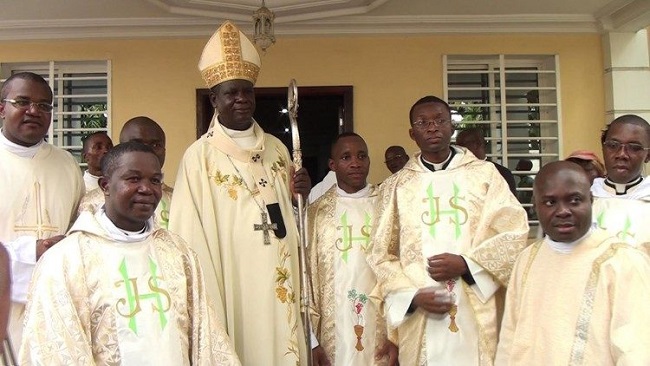
Days after suspected separatist fighters killed nine Cameroonian soldiers in the South West region, Bishop Michael Bibi of Buea condemned the relentless bloodshed plaguing Cameroon’s English-speaking regions.
On Friday, the separatist group Fako Unity Warriors claimed responsibility for an explosive device near Malende that killed the soldiers. This attack underscores the elusive nature of peace in the Anglophone regions — a reality deeply troubling to the bishop.
“War is not something to be encouraged,” the cleric told Christians during a Sunday teaching. “God did not create us to fight each other and to kill each other,” Bibi said.
“Human life is sacred because it has its source and origin in God. When it comes into existence, it continues to have a relationship with God,” Bibi said referencing the Catechism of the Catholic Church.
“Only God, who gives human life, has the right to take it away,” the bishop emphasized.
“Those who fight and take life must know this is wrong. That is why the Church calls us to be advocates of justice and peace, ensuring our communities are free from fighting and killing,” he said.
Cameroon’s English-speaking regions have been embroiled in conflict since 2016. What began as peaceful protests by teachers and lawyers against perceived marginalization by the Francophone-dominated government descended into a brutal separatist war following a harsh government crackdown.
This conflict, however, is deeply rooted in Cameroon’s colonial past. Once a German colony, the territory was divided between Britain and France after Germany’s defeat in World War I. The two powers administered their respective regions — first as League of Nations Mandates and later as United Nations Trust Territories — until independence. In 1961, a UN-supervised plebiscite led to the reunification of the two Cameroons under a federal system. This federation, however, was short-lived. In 1972, it was abolished in favor of a unitary state, concentrating power in the Francophone-dominated central government.
For Anglophone Cameroonians, this dissolution marked the beginning of systemic marginalization. The grievances that fueled the 2016 protests were not spontaneous; they were the culmination of decades of pent-up frustration over the erosion of their political autonomy, cultural identity, and economic opportunities.
The human cost of the war that has been going on now for nearly nine years is staggering. Beyond the recent soldier casualties, the conflict has claimed at least 6,500 lives according to the International Crisis Group. About a million others have been forced to flee their homes to escape indiscriminate violence, burning villages, and widespread human rights abuses committed by both sides.
There are legitimate fears that more violence lies ahead as the school year begins, given separatists have long made a school boycott a cornerstone of the separatist struggle, and as the country heads to a presidential election in October.
Already, separatists have imposed lockdowns, saying they want to disrupt the new school year as well as the October presidential poll.
“Apart from the Monday lockdowns [for long, separatists had imposed lockdowns in the two regions every Monday], the ‘boys’ have said that beginning Monday September 8 when schools reopened for the 2025/2026 academic year, the two regions will be on a complete lockdown until the election in October,” taxi man and Catholic Christian, Ernest Shu Tegha told Crux.
“How do I survive for over a month if I cannot work,” he said.
Catholic bishops in the two regions have continued to plead with the separatists to allow kids back in school.
Archbishop Andrew Nkea Fuanya told Crux that “it is unethical for Children to be used as a weapon of war.”
“We continue to plead that our children should be allowed to go back to school,” he said. Government officials have also been front and center in the effort to get kids back to school in the two regions.
“It is the right of every child to be educated; to have free, equitable and inclusive education,” said Dr. Asheri Kilo, the Secretary of State for Basic Education, in an interview of the Cameroon state broadcaster, CRTV.
“Why would anybody want to stop that,” she asked.
For some time, there had been an uneasy calm in both regions. In an exclusive interview on local Television channel, Equinox, Nkea said “a bit of social life has been returning to Bamenda.”
The archbishop said four years ago, the streets went quiet before 6 Pm every day. Today however, “you can see people drinking right up to ten PM. People are now free to organize funerals and weddings,” he said, but warned that such moments should not be confused with a return to peace.
“The situation is still very volatile,” Nkea said.
“I have made this distinction before. The fact that people are coming back, the fact that shops are opening more and more, the fact that people are beginning to celebrate funerals, more marriages openly and go right into the night does not explain the end of the crisis,” he explained.
“It is simply telling us that either people are getting used to the crisis or there is an uneasy detente. There’s an uneasy calm and we don’t know what can happen at any time. Let us not be deceived by social life returning to our communities and interpret that as the end of the crisis,” the archbishop added.
That warning is now materializing with the current lockdowns.
Source: Crux











18, September 2025
Yaoundé: Religious leaders urge peace as presidential election nears 0
Cameroon’s churches and mosques are intensifying efforts to promote calm and civic responsibility as the country prepares for its 12th October presidential election, amid fears that rising tensions could trigger violence.
The Central African nation has been rattled by years of unrest, including a separatist insurgency in its English-speaking regions and widespread allegations of corruption. Economic hardship and deepening mistrust in state institutions have heightened anxiety ahead of the polls, with analysts warning that online hate speech and political rivalries could inflame unrest before or after results are announced.
Catholic bishops have been among the most vocal religious voices calling for peace. In August, Bishop Barthélemy Yaouda Hourgo of the Diocese of Yagoua ordered all parishes to ring bells daily at 12:30pm for the Angelus prayer, calling on the faithful to pray for stability.
“As pastor of this diocese, I ordain that all the faithful recite the Angelus together each day to ask God for peace and entrust the elections to the Virgin Mary,” Hourgo said, adding that peace “is a gift from God but also the fruit of our daily commitment.”
Archbishop Samuel Kleda of Douala used his pastoral letter to denounce what he called “anti-Gospel acts,” including corruption and bad governance, which he said are fueling public discontent.
“Our country is thirsty for social justice expressed through respect for human rights,” he said. “Every Cameroonian must resolve to do his or her bit in the fight against the many ills that are destroying the country.”
During Bafoussam’s annual Peace Pilgrimage, Bishop Paul Lontsié-Keuné reminded Christians that their prayers must translate into action. “If we are sincere and really Christians, our prayer for peace must inspire our action – and our action must also be prayer,” he said.
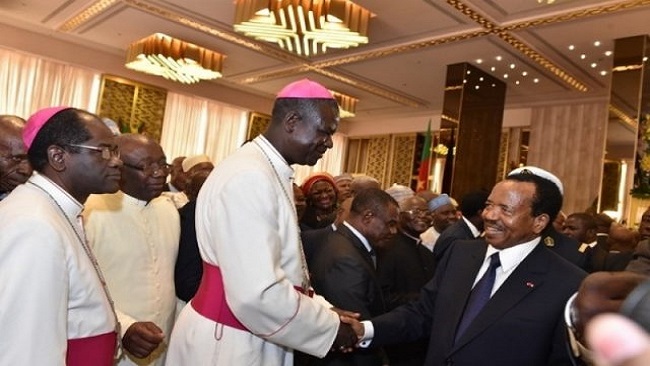
The Council of Protestant Churches of Cameroon (CEPCA) has pledged to mobilise congregations against hate speech and promote peaceful participation in the vote. In late August, a 15-member delegation led by Rev Hamadina Salomon met with Minister of State Ferdinand Ngoh Ngoh at the Unity Palace. Ngoh Ngoh, representing President Paul Biya, praised the initiative and urged clergy to act as “apostles of peace” and “guardians of stability.”
Muslim leaders have also organised a national “peace and stability” conference and collective prayers for unity, encouraging worshippers to see peaceful participation in the election as a religious duty.
Pastor Emmanuel Ngang, a traveling preacher in Cameroon’s western region, has been holding services in both city churches and rural chapels to spread a simple message: unity is stronger than division.
Ngang said he keeps his message brief and practical so congregants can take it to heart. “I remind people that peace starts with each of us,” he said. “We must speak carefully, vote honestly and keep the country together.”
His visits often include meetings with youth groups, where he encourages young people to avoid spreading inflammatory posts online.
“Many of them fear what will happen if things turn violent,” he said. “I tell them fear can paralyse us, but faith can guide us.”
Observers say that religious leaders play an outsized role in Cameroon’s public life, often serving as moral voices in a country where political trust is low. But they also walk a fine line: some critics argue that their close contact with government officials risks undermining their independence.
Still, analysts agree that their combined influence could help shape the tone of the electoral period. Faith leaders say they are not endorsing candidates but trying to keep the peace.
“My task is not to tell people who to vote for,” Ngang said after a recent service. “It is to remind them that Cameroon will still be here the day after the election – and we will still need to live together.”
Source: sightmagazine