9, December 2019
Football: Riquelme beats Maradona as Boca Juniors elect new president 0
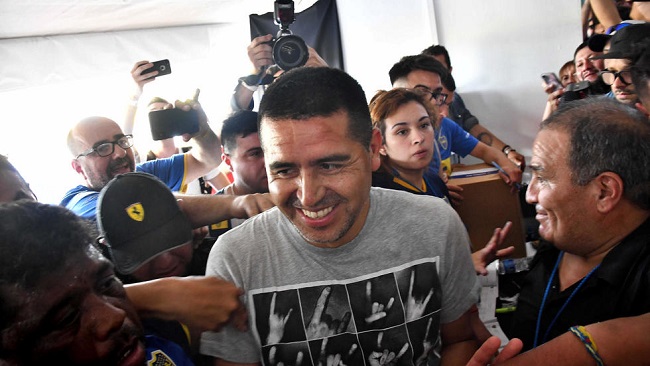
Former Argentina playmaker Juan Roman Riquelme has won a three-way battle with bitter rival Diego Maradona and Gabriel Batistuta after his group won the elections at Boca Juniors, striking a big blow against his old foe Maradona.
The list headed by Jorge Ameal, who was club president between 2008 and 2011, won 52.8 percent of the vote from Boca’s 84,000 members, bringing Riquelme into the 33-time Argentine champions’ hierarchy.
The 41-year-old stood alongside Ameal as prospective second vice-president and helped see off the faction supported by Maradona and powerful outgoing president of Argentina Mauricio Macri, which was led by Christian Gribaldo and only gathered 30.6 percent of the vote.
The list supported by Batistuta came in a distant third with 16.1 percent.
“It was a big party. Our fans voted for the love of the club colours, I’m satisfied,” said Riquelme after his side’s victory.
There has been bad blood between the pair since Riquelme snubbed Maradona, then Argentina’s coach, by refusing to come out of retirement for the 2010 World Cup, making it clear the refusal was personal.
Maradona, who is a hero in Argentina but won little with Boca, warned fans against voting for Riquelme’s faction, saying results would worsen on the pitch.
There was also a concerted effort by the previous club administration, backed by Macri, to block out Riquelme’s presence in the campaigning.
A photo showing him wearing the Boca number 10 was banned from the ballot paper, and the club warned fans ahead of election day that anyone wearing a Riquelme T-shirt would not be allowed to vote at the club’s Bombonera stadium.
However Riquelme’s support was key to Ameal’s victory as a highly successful playmaker for the capital city club.
He scored three times in the 5-0 aggregate win over Gremio to win their last Copa Libertadores in 2007, Riquelme’s third for the club and Boca’s sixth overall.
Boca reached the Libertadores final again last year only to lose to fierce rivals River Plate in a controversial final that saw the second leg moved to Madrid following fan trouble. River also eliminated Boca in this year’s semi-finals.
The new board’s priority will be to bring back the international lustre that Riquelme experienced as a player for one of South America’s biggest clubs.
The loss was second defeat for Macri in less than two months. He was Boca president from 1995 to 2006 and used that as a springboard to nationwide political success.
He became president of Argentina in 2015 as the head of his centre-right Cambiemos party, but his rule will end on December 10 after losing October’s presidential elections to leftist Alberto Fernandez.
Source: AFP













10, December 2019
Russia calls Olympics ban over doping ‘politically motivated’ 0
The World Anti-Doping Agency on Monday banned Russia for four years from major global sporting events including the 2020 Tokyo Olympics and the 2022 World Cup in Qatar over manipulated doping data, prompting an angry response from President Vladimir Putin.
WADA’s executive committee, meeting in Lausanne, handed Russia the “robust” four-year suspension after accusing Moscow of falsifying data from a doping testing laboratory that was handed over to investigators earlier this year.
The toughest ever sanctions imposed on Russian state authorities will see government officials barred from attending any major events, while the country will lose the right to host or bid for tournaments.
“For too long, Russian doping has detracted from clean sport,” WADA president Craig Reedie said.
“Russia was afforded every opportunity to get its house in order and rejoin the global anti-doping community for the good of its athletes and of the integrity of sport, but it chose instead to continue in its stance of deception and denial.”
Under the sanctions, Russian sportsmen and women will still be allowed to compete at the Olympics next year and the 2022 Beijing Winter Olympics, but only as neutrals and if they can demonstrate that they were not part of what WADA believes was a state-sponsored system of doping.
Russia will still be allowed to compete in qualifiers for the 2022 football World Cup, but WADA director general Olivier Niggli added that should they progress to the finals in Qatar, “the team there will not be representing the Russian federation”.
Russia’s participation in Euro 2020 — and Saint Petersburg’s hosting of four matches — is not affected by the ban because it is not defined as a “major event” for anti-doping purposes.
Speaking in Paris, Putin slammed the decision as a “politically motivated” ruling that “contradicted” the Olympic Charter.
“There is nothing to reproach the Russian Olympic Committee for and if there is no reproach towards this committee, the country should take part in competitions under its own flag,” Putin said.
Russian Prime Minister Dmitry Medvedev also said the ban was politically motivated. “This is the continuation of this anti-Russian hysteria that has already become chronic,” Medvedev told domestic news agencies.
‘A tragedy’
The significant extent of state-sponsored doping in Russia, notably between 2011 and 2015, was revealed in the independent report by sports lawyer Richard McLaren, released in 2016.
It led to the Russian Anti-Doping Agency (RUSADA) being suspended for nearly three years previously over revelations of a vast state-supported doping programme.
Full disclosure of data from the Moscow laboratory was a key condition of Russia’s controversial reinstatement by WADA in September 2018.
RUSADA’s supervisory board is set to meet on December 19 to take a decision on whether to appeal against the ban at the Court of Arbitration for Sport.
Yury Ganus, the head of RUSADA, told AFP Monday that his country had “no chance” of winning an appeal.
“There is no chance of winning this case in court,” Ganus said.
“This is a tragedy,” he added. “Clean athletes are seeing their rights limited.”
Documents released Monday show WADA’s Compliance Review Committee (CRC) believes “deletions and alterations” to Russia’s doping data “materially prejudiced the ability to pursue cases against 145 of the 298 athletes” whose doping controls between 2011 and 2015 WADA thought to be suspicious.
About one third of the 145 athletes are still active, WADA chief of investigators Gunter Younger said Monday.
The WADA decision was widely predicted, with Reedie having made a presentation Saturday to the Olympic Summit, participants of which “strongly condemned those responsible for the manipulation of the data from the Moscow laboratory”.
“It was agreed that this was an attack on sport and that these actions should lead to the toughest sanctions against those responsible,” the IOC said, asking that the Russian authorities deliver the “fully authenticated raw data”.
Positive doping tests contained in data leaked by a whistleblower in 2017 were missing from the laboratory data supplied in January 2019, which prompted a new inquiry.
Source (AFP)