4, October 2022
North Korea fires ballistic missile over Japan, some residents warned to take cover 0
South Korea’s military and Japan’s Coast Guard say North Korea has fired a ballistic missile, which has flown over the northern part of Japan, prompting a warning for residents to take cover and a temporary suspension of train operations.
According to both countries, the launch that took place early Tuesday marked Pyongyang’s first missile to fly over Japan in five years.
South Korea’s Joint Chiefs of Staff said it appeared to have been an intermediate-range ballistic missile (IRBM) launched from North Korea’s Jagang Province. North Korea has used that province to launch several recent tests, including multiple missiles that it claimed were hypersonic.
Tokyo urged residents to shelter themselves and suspended train operations in the area, which was overflew by the North’s projectile.
The missile fell into the Pacific Ocean after flying “over and past” Japan’s territory, the Japanese government said.
North Korea fires ballistic missiles, marking fourth in a week
South Korea’s Joint Chiefs of Staff, meanwhile, said the South’s military was “maintaining a full readiness posture and closely cooperating with the United States while strengthening surveillance and vigilance.”
“North Korea’s series of actions, including its repeated ballistic missile launches, threaten the peace and security of Japan … and pose a serious challenge to the entire international community, including Japan,” Japan’s top government spokesperson Hirokazu Matsuno, told a news conference.
The test prompted East Japan Railway Co to suspend train operations in the northern regions, Japanese broadcaster NHK reported. Matsuno said there were no reports of damage to aircraft or ships from the missile.
He said the North’s missile flew 4,600 kilometers (2,850 miles) to a maximum altitude of 1,000 km.
The new missile launch came less than a week after South Korea, Japan, and the US staged anti-submarine drills.
Days earlier, Washington and Seoul’s navies conducted large-scale exercises in the waters off the Korean Peninsula. North Korea considers such drills to be rehearsals for an invasion on its territory.
Last week, Pyongyang fired short-range ballistic missiles on four occasions, including just hours after US Vice President Kamala Harris flew out of Seoul.
US President Biden’s predecessor, Donald Trump, took unprecedented steps towards apparently fraternizing the North by initiating several rounds of dialog with it, and even walking a number of steps into the country alongside North Korea’s ruler Kim Jong-un.
However, Washington blew what Pyongyang called a “golden opportunity” at mending the situation by insisting too much on the North’s denuclearization. The emphasis prompted Pyongyang to discredit all the steps that had been taken by Trump as not being genuine and go back to its fiery discourse towards Washington.
Culled from Presstv


4, October 2022
Leading Roman Catholic cleric says Amba crisis – now in its sixth year – has become “about money” 0
Father Humphrey Tatah Mbuy, the head of the communications department of the bishops’ conference, told a local television station on Oct. 2 that “when money is concerned, it is very difficult to detach a person from his source of income, even if that source is human blood.”
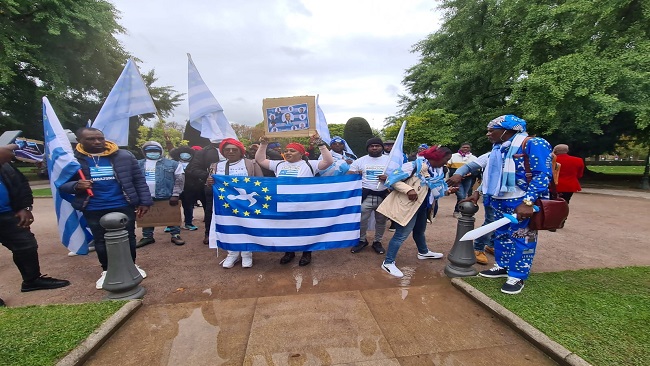
Cameroon is 80 percent French-speaking and 20 percent English-speaking, a result of the country being divided by France and Britain during the colonial era. The two English-speaking North West and South West regions continued to use the British education and common legal systems, but faced marginalization by the Francophone majority for decades.
In 2016, a series of protests by English-speaking teachers and lawyers were violently suppressed by the central government, leading to the present separatist insurgency. So far, over 4,000 people have been killed, and over 700,000 people displaced.
“The conflict…has become what the Frenchman calls ‘L’economie de la Guere.’ It is now a war economy,” Mbuy told the television station.
The priest said the war has turned into a fight for economic benefits, not only by separatists, but by those in government as well. There have been reports of government soldiers arresting people and only releasing them upon the payment of a bribe.
Meanwhile, kidnapping for ransom has become an important way to raise funds for the separatist forces.
On Sept. 16, 30 unidentified gunmen kidnapped five priests, a nun, and three laypeople in the village of Nchang the country’s South West Region.
“The bishop has not been able to get the priests released,” Mbuy said, noting the church has refused to pay the $50,000 ransom demanded by the kidnappers.
The priest said this “war economy” means the parties don’t want to negotiate, making it difficult for the church to work for peace.
Mbuy noted the Catholic Church has played a key role in trying to resolve the crisis from the beginning. In 2016, the bishops of the Bamenda Ecclesiastical Province, which covers the two Anglophone regions, wrote an open letter to the central government tracing the origins of the problem and how best to resolve it.
The priest then lamented the fact that clergy and religious have been targeted in the conflict by both sides, both because of the peacemaking efforts and also for their ransom value.
“This armed conflict in the North West and South West Regions – which should never have been in the first place – is taking on a very wrong approach in conflict management.” Mbuy said.
“You do not touch the person who could help you resolve your problem. If you go for the person who in the end can help you resolve your problem and who has the capacity to help you resolve your problem, then you are shooting yourself in the foot, because the church at the moment, and I can say that without any fear, has the unique moral force to help resolve the armed conflict in the North West and the South West,” he said.
“You can’t force somebody to sit down and talk. You can only discuss with somebody who is ready for a discussion,” Mbuy said.
He also expressed his regret that despite the neutrality of the church, both sides have a history of accusing the church of supporting their opponents. However, the priest reiterated the church’s impartiality in matters of conflict.
“The aggressor and the aggressed are both children of God and the role of the church is that of mother and teacher. When your children are fighting, as a mother you try to bring them together for reconciliation. You do not come as a teacher and take on one side without showing where the truth is. So the church, as a teacher, has to show the truth,” he explained.
Meanwhile, a series of peace marches has been taking place in the capital city Yaoundé to mark the anniversary of the Major National Dialogue that took place Sept. 30-Oct. 4, 2019.
The peace conference resulted in greater autonomy for the Anglophone regions, including the creation of regional assemblies, but separatist groups refused to participate in the dialogue and have not accepted the results.
Source: Crux