26, December 2021
South Africa’s Archbishop Desmond Tutu dies at 90 0
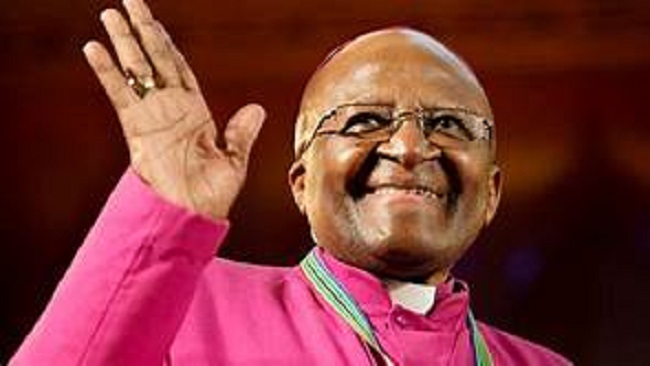
South African Archbishop Desmond Tutu, who died Sunday at the age of 90, was the moral compass of his beloved “Rainbow Nation”, never afraid to speak truth to power, whatever its creed or colour.
A tireless activist, he won the Nobel Peace Prize in 1984 for combatting white minority rule in his country.
“The passing of Archbishop Emeritus Desmond Tutu is another chapter of bereavement in our nation’s farewell to a generation of outstanding South Africans who have bequeathed us a liberated South Africa,” President Cyril Ramaphosa said in a statement.
Famously outspoken, even after the fall of the racist apartheid regime, Tutu never shied away from confronting South Africa’s shortcomings or injustices.
“It’s a great privilege, it’s a great honour that people think that maybe your name can make a small difference,” he told AFP shortly before his 80th birthday in 2011.
Whether taking on his church over gay rights, lobbying for Palestinian statehood or calling out South Africa’s ruling African National Congress on corruption, his high-profile campaigns were thorny and often unwelcome.
None at the top were spared — not even his close friend, late president Nelson Mandela, with whom Tutu sparred in 1994 over what he called the ANC’s “gravy train mentality”.
Yet “the Arch” brought an exuberant playfulness to all his endeavours.
Quick to crack jokes — often at his own expense — he was always ready to dance and laugh uproariously with an infectious cackle that became his trademark.
It was Tutu who coined and popularised the term “Rainbow Nation” to describe South Africa when Mandela became president.
At the time, Tutu was serving as the first black Anglican archbishop of Cape Town.
Ordained at the age of 30 and appointed archbishop in 1986, he used his position to advocate for international sanctions against apartheid, and later to lobby for rights globally.
‘Moral titan’
Along the way, he won a host of admirers.
“I believe that God is waiting for the archbishop. He is waiting to welcome Desmond Tutu with open arms,” said Mandela, who stayed at Tutu’s home on his first night of freedom in 1990, after 27 years in apartheid jails.
“If Desmond gets to heaven and is denied entry, then none of the rest of us will get in!”
The Dalai Lama called Tutu his “spiritual older brother”.
Irish activist and pop star Bob Geldof praised him as “a complete pain in the arse” for those in power, and US President Barack Obama hailed him as “a moral titan”.
Among Tutu’s critics were Zimbabwe’s veteran former president Robert Mugabe, who described him as an “evil and embittered little bishop”.
Even with his global celebrity, his faith remained an integral part of his life.
His family’s road trips included quiet time for prayers, and his missives blasting the evils of apartheid were signed off with “God bless you”.
“I developed tremendous respect for his fearlessness. It wasn’t fearlessness of a wild kind. It was fearlessness anchored in his deep faith in God,” said apartheid’s last leader, F.W. de Klerk.
Tutu was diagnosed with prostate cancer in 1997 and underwent repeated treatment.
He had retired a year earlier to lead a harrowing journey into South Africa’s brutal past, as head of the Truth and Reconciliation Commission.
For 30 months, the commission lifted the lid on the horrors of apartheid.
Tutu, with his instinctive humanity, broke down and sobbed at one of its first hearings.
A recipient of numerous awards, his causes ranged from child marriage to Tibet to calls for Western leaders to be tried over the Iraq war, and in later years for the right-to-die.
He also swore he would never worship a homophobic God.
“I would refuse to go to a homophobic heaven. No, I would say sorry, I mean I would much rather go to the other place,” he said.
Post-apartheid frustrations
Born in the small town of Klerksdorp, west of Johannesburg, on October 7, 1931, Tutu was the son of a domestic worker and a school teacher.
Following in his father’s footsteps, he trained as a teacher before anger at the inferior education system set up for black children prompted him to become a priest.
He lived for a while in Britain, where, he recalled, he would needlessly ask for directions just to be called “Sir” by a white policeman.
Tutu believed firmly in the reconciliation of black and white South Africans.
“I am walking on clouds. It is an incredible feeling, like falling in love. We South Africans are going to be the Rainbow People of the world,” he said in 1994.
But post-apartheid South Africa increasingly became a source of his despair, as the high hopes of the early days of democracy gave way to disillusionment over violence, inequality and graft.
Never a member of the ANC, Tutu said in 2013 that he would no longer vote for the party, though President Cyril Ramaphosa — an old friend — re-built bridges after coming to power in 2018.
Tutu made a rare public appearance in May 2021 to receive his vaccine for Covid-19. He appeared outside of hospital in a wheelchair, and waved but did not speak.
He married his wife Leah in 1955. They had four children.
Source: AFP







26, December 2021
Africa Cup of Nations: Mascot wears a bullet proof vest, policeman lynched, fighting escalates 0
A bomb thrown into a classroom, a taxi driver blown up, a policeman lynched… and even the mascot wears a BULLET PROOF VEST! As fighting escalates in Cameroon, Premier League stars are warned THEY could be targets during AFCON
Human Rights bodies have warned top players could be targeted at the AFCON
The little-known conflict has waged for four years but is now escalating quickly
One of the tournament’s stadiums is located in the middle of the conflict zone
Government and separatists are battling for power in the English speaking west
Cameroon military struggle to contain separatists who have warned foreign stars not to come to the Central African country, or risk harm
Activists highlight appalling suffering which has caused 700,00 people to flee
Escalating violence in Cameroon will threaten the safety of Premier League stars when the Africa Cup of Nations begins next month, human rights activists have warned.
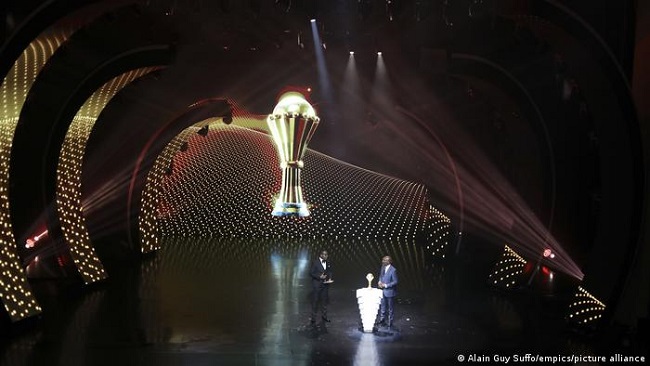
The African showcase includes 24 teams from across the continent and is set to open on January 9, but there are now calls for it to be postponed because of the conflict.
The competition is likely to feature more than 40 players from the English top flight, including Thomas Partey, Nicolas Pepe and Mohamed Elneny, from Arsenal; Trezeguet from Aston Villa; Chelsea’s Edouard Mendy; Crystal Palace’s Wilfried Zaha; Manchester City’s Riyad Mahrez and the Liverpool trio of Mohamed Salah, Sadio Mane, Naby Keita.
Despite the growing fear that teams and the tournament could be targeted in an increasingly bitter and violent conflict, there is no sign that the event will be postponed or even the plans changed to reduce the risk.
Most of the discussion surrounding the tournament has focused on the release date for Europe’s elite players and the risk of contracting Covid.
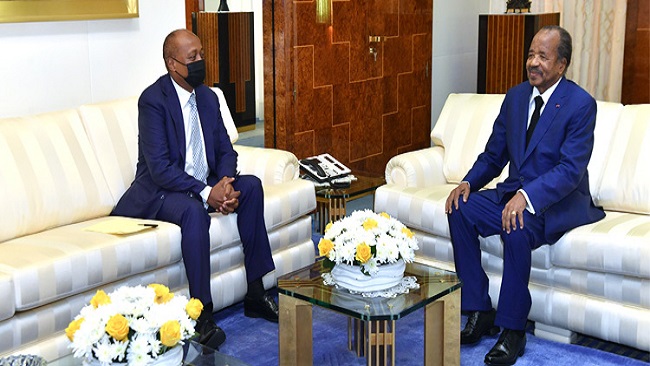
This week, the Confederation of African Football (CAF) President Patrice Motsepe met with Cameroon President Paul Biya and insisted the showpiece would go ahead as planned.
However, human rights organisations have told Sportsmail they believe there is a real risk for players and staff and the tournament should be postponed, or at the very least, matches moved from the South West region, which is considered the most dangerous.
Violence first flared four years ago between separatist groups in the English speaking west of the Central African country, known as the ‘anglophone zone’, and the Government of the largely French speaking, francophone, Cameroon.
The conflict has intensified dramatically this year and human rights activists say there have been 80 bombs detonated in the anglophone region since January, and there have been many deaths, including policemen, soldiers, civilians and a five-year-old girl.
A large area of south west Cameroon is now under a night-time curfew.
Even the tournament’s mascot, Mola the lion, wore a bullet-proof vest over his Cameroon strip as he toured the conflicted region last week.
Mola, which is a convivial name, meaning friend, elder or uncle, was also escorted by a detachment of heavily armed troops.
‘There are now mounting calls to delay the AFCON competition until the warring parties call for a ceasefire and enter peace negotiations,’ Rebecca Tinsley, a human rights researcher and a member of the Global Campaign for Peace and Justice in Cameroon told Sportsmail.
‘We are saying postpone the tournament because all of this threat could be removed if the government just said, “yes, we will have peace talks”.’
There appears to be little chance of that with the Government determined to show no weakness in the face of the threat from its South West and North West regions.
One of the six tournament stadiums, Limbe, is the only one located in the contested ‘anglophone zone’, although two more at Bafoussam and Douala are hard on its borders and it is feared they could also be targeted.
‘There is a real risk of… attacks in all AFCON venues, especially in Limbe,’ observed Tinsley.
With a capacity of 20,000, the Limbe Stadium is set to host six group matches.
Among the six teams due to play in the group stage in Limbe, 190 miles from the capital Yaounde, are Mali, for whom Brighton’s Yves Bissouma and Southampton’s Moussa Djenepo, are expected to play.
However, the town is also slated for two round of 16 games, which could see any four of the 24 participating countries forced to play in the conflict hotspot.
‘English clubs should be really cautious about sending their players into a very unstable situation. There are real dangers,’ Tinsley added.
‘You only have to look at the record of the armed militias and separatist groups. They have exploded more 80 improvised explosive devices and they are becoming increasingly sophisticated in their tactics.
‘This should alarm any football club thinking of sending players into the region.’
The European Club Association has already written to the CAF, but predominantly to highlight the risks of Covid and threatening to block the release of players.
However, those with knowledge of the country suggest conflict and violence is a far greater concern.
Threats have appeared widely online warning the Cameroon authorities not to play matches in the west of the country, an area the separatists call, Ambazonia.
And separatists warn players not to come.
One commentator, Mark Bareta, an author and activist for the cause, based in Belgium, who describes himself in his Twitter profile as ‘standing for the people of the Former British Southern Cameroons (Ambazonia)’ posts warnings on Twitter and celebrates the defeat of Government soldiers.
‘Cameroun is at war with Ambazonia,’ he wrote in one post. ‘Players taking part do so at their own risks.’
The conflict in the Central African country of Cameroon is largely hidden from international audiences.
In global terms, it is not a geopolitically significant dispute, but for the millions of people whose lives are blighted, ruined, or ended by the violence, it is defining.
Now international football has run into the fray and suddenly it takes on more significance in the wider world.
The problem crystalised in 2016. English-speaking areas of Cameroon (anglophone) felt they were marginalised by the French-speaking (francophone) majority.
The anglophone regions of the South West and North West, which the separatists call Ambazonia, account for about one fifth of the 20 million population.
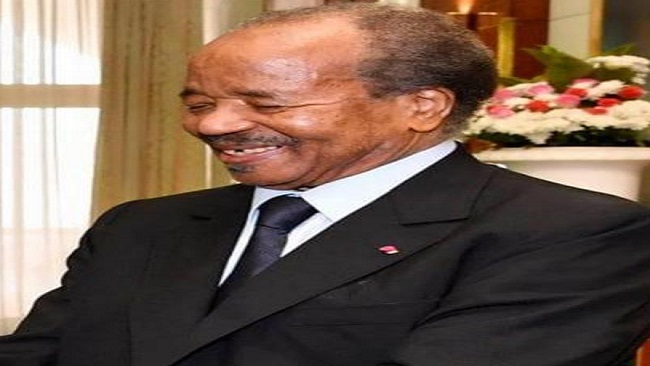
They felt the Cameroon government under President Paul Biya, 88, who has ruled since 1982, was trying destroy their traditional education and legal system, which was based on English traditions and common law.
In 2016, lawyers and teachers protested peacefully but according to human rights organisations a heavy-handed government crushed their dissent.
The argument became radicalised. Now, there are multiple armed groups who claim to represent the western reaches of Cameroon. For four years conflict has intensified with militia targeting soldiers and policemen, but also civilians who do not demonstrably back them.
One move has been to demand schools remain closed to create leverage on the francophone government. Education is at the heart of the conflict.
As a result, most schools have been closed for years and 700,000 children have been deprived of an education, while Human Rights Watch has reported how student and teachers have been horribly abused, mutilated and killed.
But according to activists, the government has also committed atrocities and abuses. It has sent thousands of soldiers west, but they seem unable to stop the separatists and have not won the confidence of the locals.
The failure has resulted in 700,000 people fleeing from this corner of Africa, which is about to stage the continent’s Cup of Nations.
While human rights groups disagree on how best to manage Afcon, they are clear that the world needs to wake up to a cruel and devastating conflict, which they say, may also threaten the safety of some of Europe’s most famous footballers.
In another post on his Twitter account, which has 19,000 followers, Bareta wrote: ‘All visitors are called upon not to risk their lives to travel to Ambazonia.’
CAF PRESIDENT WILL ATTEND WITH FAMILY
The President of the Confederation of African Football (CAF), Patrice Motsepe, has insisted the Africa Cup of Nations will go ahead as planned next month after he met with the President of Cameroon, Paul Biya, this week.
Motsepe said he would be attending the opening game and final with his wife and children, after European clubs expressed concern about the tournament going ahead during a pandemic.
‘I will be in Cameroon on January 7 with my wife and kids to witness this incredible competition,’ he said.
‘You can see that there’s a huge commitment and a focus to make sure that there’s good progress.
‘We are going to host with the people of Cameroon an exceptional tournament. It will be the most successful Afcon. We are ready to show the world the best of African football and African hospitality.
‘This tournament is important for the people of Africa and I’m so proud and so excited with the work done.’
Motsepe gave reassurances about Covid protocols but the threat from the ongoing conflict in Cameroon has hardly been discussed.
‘Nobody is writing about this and it is tragic because it is a huge mess,’ Rebecca Tinsley, a human rights researcher and a member of the Global Campaign for Peace and Justice in Cameroon told Sportsmail .
Human rights activists insist the threats are not just sabre rattling, they are real and the separatists will do whatever they can to breach security at stadiums, hotels and restaurants to abduct a player.
‘They are incredibly serious,’ one human rights activist, who did not want to be named, told Sportsmail. ‘They see this as their one opportunity when the world’s media will be in their neighbourhood.
‘They use terror and intimidation. Kidnapping and IEDs. And they are serious about disrupting the tournament, because they know it would bring attention.
‘All of this would be manageable if government forces were competent, but they are not.’
In January, the Limbe Stadium was targeted during the African Nations Championship, a smaller competition that features players from Africa’s domestic leagues. Vehicles were blown up in the vicinity of the arena.
One of the epi-centres of the conflict is the city of Buea, less than 13 miles from Limbe.
Improvised explosive devices have been increasingly used during the last year, particularly in the last two months, as the violence has stepped up.
A bomb was thrown into a lecture theatre at the University of Buea injuring eleven students, another killed a taxi driver, while a child, Caro Louise Ndialle, 5, was shot dead by a policeman in October, who was then lynched by a mob in the riot that followed.
As tensions spiralled, a civilian was shot dead by police and separatists, who often turn on their own people if they consider them not to be loyal to the cause, separatists have reportedly hijacked public buses, beating and torturing the passengers.
Further west, in the town of Ekondo Tiki, gunmen attacked a school in November killing three students and a teacher.
A little more than 50 miles from Buea, just outside the anglophone zone, is the French-speaking town of Douala, where the 50,000 capacity Japoma Stadium will host Ivory Coast in the competition’s groups stages.
The Elephants announced their squad on Thursday and it includes Manchester United’s Eric Bailly, Burnley’s Maxwel Cornet, Crystal Palace’s Wilfried Zaha, Wolves’ Willy Boly and Arsenal’s Nicolas Pepe.
The North West region of Cameroon, which borders the South West, is also racked by violence, with Amnesty International documenting horrific abuses by separatists and the army, including killings, beheadings and the destruction of home and property.
WHY DO EUROPEAN CLUBS OBJECT?
Former Barcelona, Everton and Chelsea striker Samuel Eto’o has questioned why European clubs and media are raising concerns over the Afcon.
The four-time African Player of the Year, who was elected president of Cameroon’s FA earlier this month, criticised reports that the tournament may not take place.
He was speaking after the European Club Association raised concern about the risk to players from Covid-19 at the African showpiece.
‘If the Euros took place in the middle of the pandemic, with full stadiums in several cities in Europe and there was no problem, why wouldn’t AFCON be played in Cameroon?’ the former striker told French station Canal+.
‘Or are you trying to say that like we’ve always been treated, we Africans aren’t worth anything so we have to put up with it?
‘I don’t see why AFCON wouldn’t take place. The Cameroon FA that I represent will defend hosting this competition to the end.’
Eto’o also said in a statement: ‘The Cameron Football Federation assures players and supporters of the 24 qualifying countries and those amateur footballers who wish to visit Cameroon, that all sanitary and safety measures have been taking by the government to guarantee the competition goes ahead successfully.’
European clubs have also questioned release dates for players, hoping to retain their services for longer amid a hectic season.
It was here in the North West town of Bamenda that Mola the Lion was photographed in his bullet proof vest.
Just across another regional border and only 50 miles down the road, is a third host stadium at Bafoussam. The Kouekong Stadium, which holds 20,000 spectators, will host Senegal, whose squad boasts further array of European-based stars.
Among them are Liverpool’s Sadio Mane, Chelsea’s Edouard Mendy, Crystal Palace’s Cheikhou Kouyaté, Leicester City’s Nampalys Mendy and Watford’s Ismaila Sarr.
Human Rights Watch has documented many of the abuses in western Cameroon, which have led to the exodus of 700,000 people, who fled to neighbouring countries.
The group has serious concerns over safety at Afcon, particularly in relation to Limbe, and it believes no games should be played there. Human Rights Watch would like to see those matches relocated to a safer location.
‘[We] documented incidents of violence in the South West region and the state of Cameroon and CAF have a responsibility for ensuring the safety of the tournament, stadiums, players and officials,’ said Ilaria Allegrozzi, a senior researcher for Human Rights Watch, who specialises in Cameroon.
‘If the determination is made that any of the locations in the South West state are a substantial risk those games can be moved to another venue, which is safer,’ she told Sportsmail.
However, despite its concerns, Human Rights Watch does not support further postponement of the tournament. In 2019, Cameroon was not ready to host and the Afcon was relocated to Egypt. It returned to Cameroon in 2021, but it has been delayed from the summer because of the coronavirus pandemic.
‘The tournament is a celebration of African football,’ said Allegrozzi. ‘The [European] clubs and others should take this opportunity to learn more about the country and the situation in the anglophone regions.
‘Let’s talk about Cameroon but in a different way, not by excluding Cameroon from the Afcon, not delaying or cancelling, but reflecting what is going on in the country, the suffering, the displacement, the humanitarian crisis.’
Source: Daily Mail