13, April 2021
Yaoundé: CPDM Crime Syndicate launches COVID-19 vaccination campaign 0
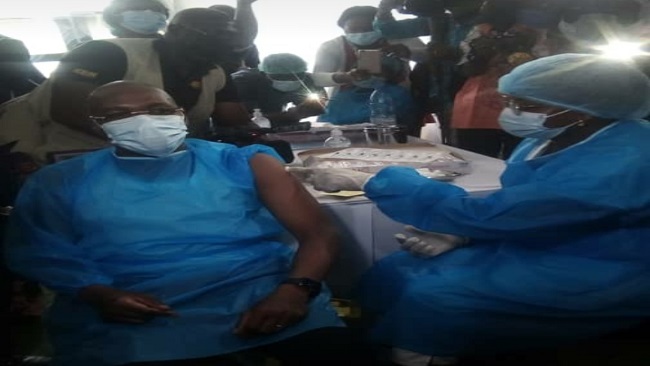
Cameroon on Monday launched the vaccination campaign against COVID-19, a day after receiving its first batch of vaccines donated by China.
The campaign started at the Specialized Covid-19 Care Centre in the capital Yaounde, with the country’s Minister of Public Health Malachie Manaouda being the first to take the vaccine.
“I feel good. There is no problem,” Manaouda said shortly after he received the first shot with the presence of many local officials and health professionals.
“The vaccine is safe,” he added.
The vaccination campaign will prioritise health workers in the first round of the campaign, the minister said.
The vaccines should be “available all over the national territory by latest tomorrow,” he added.
The first batch of China’s Sinopharm vaccines arrived in Cameroon Sunday evening as the country is struggling with a new surge of COVID-19 infections.
It is the first batch of COVID-19 vaccines arriving from outside the central African country, where the pandemic broke out in March last year.
Source: Xinhuanet











14, April 2021
Yaoundé: MPs to debate solution to the Southern Cameroons Crisis 0
In a bid to continue deceiving the people of Southern Cameroons that the Social Democratic Front party of Ni John Fru Ndi is still a force within the Biya Francophone political setting, Yaoundé has announced that the crisis in Southern Cameroons will be on the agenda of the next parliamentary session, four years after the conflict began.
The information was made public by the regime after secret service officers reported that ghost town operations put in place all over Southern Cameroons by the Ambazonia Interim Government is paralyzing the economies of many towns and cities including those in French Cameroun and hampering the flow of Ambazonia money into the French Cameroun treasury.
A highly placed official inside the Etoudi palace was quoted by Le Jour –a French Cameroun newspaper as saying “The crisis that is shaking the North-West and South-West regions will finally be put on the National Assembly’s agenda next June”.
Fru Ndi’s man in Yaoundé, Hon. Joshua Osih has reportedly confirmed the CPDM French Cameroun decision and told Le Jour that “We have always fought for a debate on the crisis in the North West and South West regions. This has been agreed and could be put on the agenda for the June session. I think we will come back to this issue in June and to the budgetary orientation debate. This session was dense. We are going home with the feeling that we have played our role well. It is important to know that the sessions follow each other and are not alike.”
SDF boycotted the opening of the November 2017 session, to force the Biya Francophone government to include the Southern Cameroons Crisis on the agenda for discussions. Nothing was done. Former SDF Member of Parliament Hon. Joseph Wirba, one of the first parliamentarians to raise this issue when the conflict was still in its infancy, ended up resigning from the assembly out of sheer exhaustion and threats to his life.
By Oke Akombi Ayukepi Akap in Glasgow with files from Rita Akana