
6, October 2019
Southern Camerons Crisis: Will the National Dialogue make any difference? 0
Life in Cameroon’s two English-speaking provinces has been brought to a standstill by three years of conflict, which has cost about 3,000 lives and forced 500,000 from their homes.
The dispute had been simmering for decades, but boiled over in 2016, when teachers and lawyers started to protest against the use of French in schools and courts.
The government in the majority French-speaking country responded with lethal force, provoking rebels to declare independence for the region they call “Ambazonia”, which in turn led to an even stronger military crackdown.
In an attempt to end the crisis, President Paul Biya called for talks, dubbed the National Dialogue, this week.
Some were encouraged by this, but others dismissed it as a sham. So what has it achieved?
The National Dialogue made a series of proposals:
- the adoption of a special status for the two Anglophone regions
- the restoration of the House of Traditional Chiefs
- the election of local governors
- the immediate relaunch of certain airport and seaport projects in the two regions
- the rapid integration of ex-combatants into society
- the name of the country be returned to former name, the United Republic of Cameroon
- implement the law that government officials declare their assets, in order to tackle corruption
Why do these proposals matter?
A return to the name United Republic of Cameroon is significant as it would go some way towards recognising the different histories of the different parts of the country.
At independence, the Southern Cameroons (colonised by Britain) voted in a UN-organised plebiscite to be united with the Republic of Cameroon (formerly colonised by France).
The new country the two entities created was called the Federal Republic of Cameroon. But the federation was scrapped in 1972 in a controversial referendum, giving rise to the United Republic of Cameroon.
“It is the abolition of this federal structure that lies at the core of the Anglophone problem,” opposition leader John Fru Ndi told the BBC.
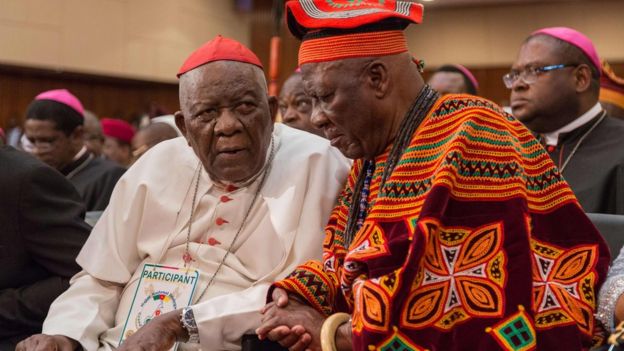
In 1984, President Paul Biya worsened the situation by scrapping the word “united” from the name of the country, and it became known simply as the Republic of Cameroon, which was the same name given at independence to the part of Cameroon colonised by France.
“What that meant was that the Anglophone entity had been annexed,” Mr Fru Ndi said.
What difference would they make?
A return to the United Republic of Cameroon has been welcomed, although Mr Fru Ndi would have preferred a return to a federal system of government.
The prospect of electing local governors has also been welcomed by many. Jean Emmanuel Pondi, a professor of political science, told the BBC that “for Anglophones, it is a return to normalcy”.
He said that locally elected officials would mean decisions being taken closer to the people.
“It used to be an administration of proximity where things are done by the people, for the people, and in the right moment,” Prof Pondi said.
“The problem with the centralisation of power is precisely that things are done miles and miles away, by people who have no idea of the consequences of the decisions they are taking.”
He said giving more autonomy to the regions would also “accelerate their dimension of good governance, because you have to be accountable immediately, or else, you are not elected”.
The proposals will be forwarded to President Biya, with the expectation that he will order them to be implemented.
Cameroon – still divided along colonial lines:
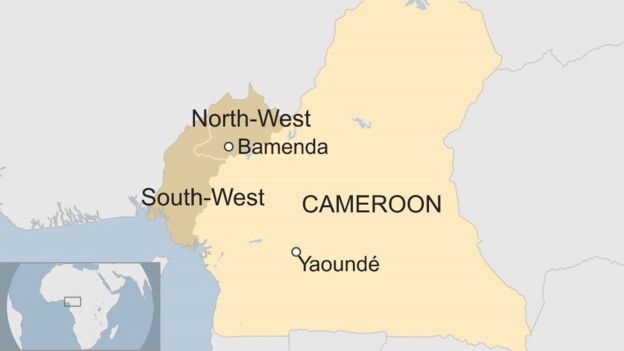
- Colonised by Germany in 1884
- British and French troops force Germans to leave in 1916
- Cameroon is split three years later – 80% goes to the French and 20% to the British
- French-run Cameroon becomes independent in 1960
- Following a referendum, the (British) Southern Cameroons join Cameroon, while Northern Cameroons join English-speaking Nigeria
What has the reaction been?
Opinion has been sharply divided.
Backers like Elvis Ngolle Ngolle, a senior figure with the ruling party, thinks that it is a “decisive step in the right direction”.
“It will enhance participatory development across the country,” he told the BBC.
“We believe that these proposals will calm down minds and restore peace.”
But Akere Muna, a political leader and former Cameroon representative of Transparency International, walked out of the talks in protest over what he said were attempts to stifle debate.
“Speakers were pre-arranged. You couldn’t even ask a question. It was stage-managed. So they were actually looking for spectators, not participants,” Mr Muna told the BBC.
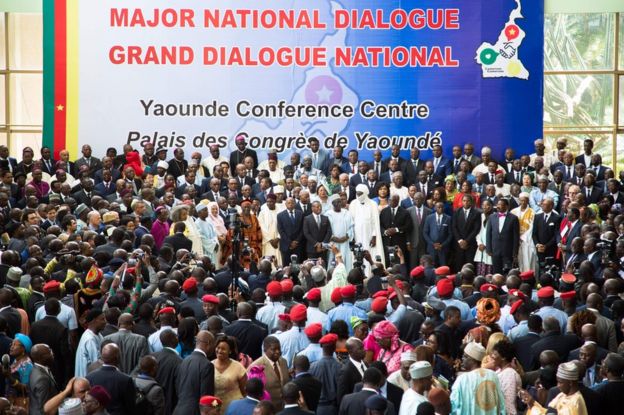
Noting that the debate in the two English-speaking regions was about “secession and separation,” he questioned why there was no commission to examine those alternatives.
“So, I thought that the prescription had nothing to do with the illness,” he said.
On Thursday, in what appeared to be a goodwill gesture President Biya ordered all charges dropped against more than 300 people detained in connection with the Anglophone crisis.
But the decision failed to appease critics who say thousands more are locked up on trumped-up charges.
What do the separatists say?
They have pledged to keep fighting until “Ambazonia is freed”.
Ivo Tapang, a spokesman for 13 armed groups called the Contender Forces of Ambazonia, has made it clear that the concessions made so far are not enough to deter them from their fight for freedom.
“We will not accept an olive branch from someone whose troops are still in our territory,” he said. “We will intensify our struggle with guns and bullets.”
Source: BBC










7, October 2019
BEN MUNA: A TRIBUTE TO A COLOSSUS GONE HOME IN DIRE TIME OF NEED 0
The phone call from my dear sister and friend Bibiana Taku once more announced the sad news of the death of Ben Muna. This phone call announcing the death of Ben Muna, replicated in some regards, that which announced the death of my friend Bate Besong which is a painful loss from which I have never recovered.
Some months ago, Ben Muna and our distinguished colleague Paul Chiy flew in from London to the Hague to discuss important professional matters with Karim Khan QC and me. The contributions of Ben Muna in that profound professional discussion will remain indelible in my memory.
I have known Ben Muna for so many years. Barely four years in my professional career, I contested and was elected a member of the council of the Cameroon Bar Association. Ben Muna was the President of the Bar Council then. Shortly on being elected, I became his close partner in several battles for the enthronement of the rule of law and a just social order.
We fought against the politicization of justice and the militarization of constitutional rights that was imposed on the citizenry by a power cartel of power mongers. Ben was a passionate advocate of justice with a human conscience and mobilized lawyers and the citizenry to join him in this crusade.
Ben led a delegation of lawyers to the biannual conference of the African Bar Association in Abuja Nigeria in 1991, where Chief MKO Abiola presented the keynote address. My distinguished learned colleagues Chief Eta Besong Jr, Mrs M.N Weledji, Peter Monthe Tumnde, Mrs Helen Ebai, Charles Eno, and many others were in the delegation.
There, African lawyers gathered in that conference witnessed the leadership skills of Ben Muna. In a potentially tense election battle that was about to erupt, Ben took the microphone and urged the attendees, “learned colleagues, why this pushyfooting? Why not give Mr Charles Idehen the President of the NBA a mandate to move this great continental association to higher heights?”. There was an acclamation and Roger Chamba the Hon Attorney General of Zambia who was the outgoing President, after consultation, reconvened and the choice of Ben was endorsed by a near majority as the President of the NBA. My late friend Kamni Ishola Isobu remarked to me the end of the day’s proceedings that Ben Muna was, indeed, a great lawyer capable of providing the type of continental leadership that Chief Abiola had advocated in his keynote address.
When we last met in Stockholm last year, the first time since the African Bar Association Conference in 1991, Hon. Roger Chamba and I recalled the memorable intervention of Ben Muna in that conference. It is regrettable that several attempts to reunite Ben and Charles Idehen did not materialize because of the bad telephone network communication.
Ben led us to valiantly defend the erstwhile President of the Cameroon Bar Council Yondo Black and the venerable Albert Mukong and others before a court-martial in Yaoundé Cameroun, for asserting a constitutional right to pluralist democratic governance. From thence, I forged an enduring alliance with Albert Mukong for the struggle for freedom and human dignity leading to the creation of the Human Rights Defence Group.
Ben mobilized lawyers and human rights defenders to defend my friend Puis Njawe and Celestin Monga whose only crime was the publication of articles exposing and condemning the endemic corruption that has destroyed the economic and moral foundation of Cameroun. Through this and other cases, Ben provided the platform for the establishment of civil society advocacy in the fight to liberate the people from the bondage and abuses of dictatorial political brigandage. In this regard, the fearless legal luminary provided unprecedented leadership in the fight for justice and civil liberties that permeated his national and international law career.
By the verdict of fate and destiny, we met again at the International Tribunal for Rwanda in Arusha where he was the Deputy Prosecutor and I was a Lead Counsel for one of the accused persons. I found myself alone on the defence bench while Ben, Carla Deponte and five other Prosecutors were on the prosecution bench to argue an interlocutory appeal, I filed before the Appeals Chamber of the ICTR. I stood my ground and responded to the alternate submissions by all the members of the prosecution team. At the close of the session, Ben moved across to me and we briefly laughed at the fact that Ben was back where he began his law career as a Prosecutor. Persons present watched as we discussed courteously and pleasantly only a few minutes after we were subjected to intense legal combat with ammunitions provided on both side by the very erudite judge Shahabuddin now of blessed memory and his four colleagues in the panel. Little did they know that although a prosecutor, Ben was indeed, a champion of fair trial rights for accused persons before the courts.
Ben ended his time on earth, defending largely abducted victims of atrocity crimes and the arrogance of power before a court-martial. His memorable prophetic submissions will inform the conscience of a nation at battle with its soul about the consequences of trivializing human rights, human dignity and politicization of justice. The enduring consequences of these violations may never be reversed. But no one will ever say that Ben Muna the prophetic voice of reason and the conscience of true justice did not caution and provide an opportunity for the abatement of the madness that has led to the collapse of an imposed house of cards.
May the justice of the Lord, the Guarantor of true justice and all life, grant him a place of choice in God’s heavenly kingdom
May his soul rest in peace.
By Chief Charles A. Taku