
15, November 2018
Southern Cameroons Crisis: The killing intensifies 0
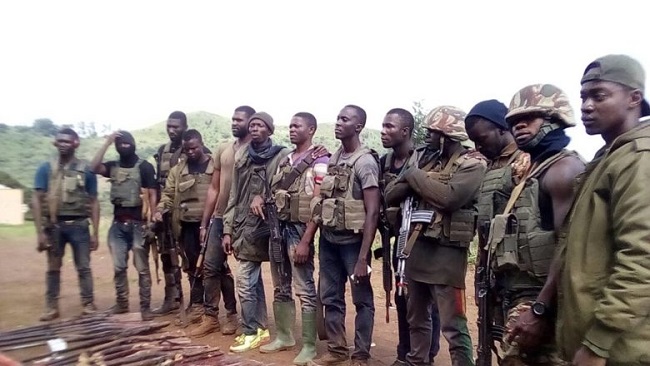
The fighting in the country’s two English-speaking regions has intensified, leading to huge casualties. Over the last two days, more than 50 people have been killed in the region, including some 15 army soldiers. In Bui Division, some 20 separatist fighters were ambushed and killed by government troops on Tuesday.
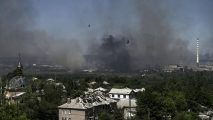
Kumbo, the capital of Bui Division, has over the last two days witnessed some bloody fighting. Pictures published online showed that there was intense fighting as heavy smoke could be seen bellowing from many houses. On Wednesday, some 10 army soldiers have been killed by separatist fighters in Ndu Sub-division where lots of fighting has been going on between government forces and separatists.
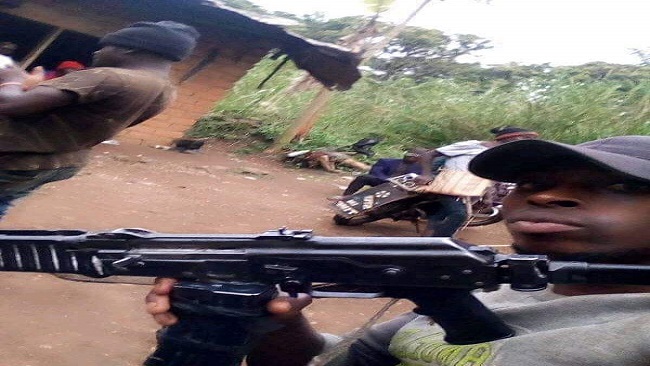
From the number of soldiers being killed by separatist fighters, it is clear that the separatists have finally taken possession of their most cherished weapon, the AK-47, which is reputed around the world for its capacity to inflict a lot of damage.
In Lebialem Division, the red dragons have been celebrating the arrival of their consignment and they have promised to give army soldiers a run for their money. The same applies to fighters in the Northwest region who are bent on spreading death and destruction among government soldiers, especially after the killing of some 20 fighters by government troops.
It is being rumored that the killing of some 20 Southern Cameroonian fighters by government troops in Bui is an act of betrayal. Separatist fighters are investigating the matter and have vowed to take their revenge on anybody who was involved in the betrayal.
It is also being reported that government troops have run amok in the region and they are arresting people for no reason and are asking for money. Many of those who have been arrested and cannot pay the money requested by government soldiers are being threatened with death.
It should be underscored that Cameroonian soldiers have been given a shoot and kill order and this has enabled them to establish a business niche in the region. Their strategy consists in accusing innocent civilians of being part of the separatists and then imposes levies on them. The levies range from CFAF 200,000 to CFAF 1,000,000.
Since there are no control mechanisms in place, the soldiers are robbing the people blind and this is further radicalizing the people. According to a civilian in Kumbo, the fighting might never come to an end as the population is very bitter and the people want to take their revenge on the soldiers who have been killing and maiming innocent civilians.
He added that the most surprising thing is the rapping of women by soldiers who are supposed to be protecting the women and children. Atrocities committed by army soldiers are actually shocking the population and many people in the region are now openly stating that they are with the separatist.
It has even been reported that government troops dropped a child in hot palm oil in Muyengue in the Southwest region when they tried, in vain, to arrest a group of women who were processing their palm oil. The women, who escaped after seeing the troops, left the child behind as they feared for their lives. After returning to the oil processing location, they only found out that the soldiers had messed up their property and dropped the innocent child in hot oil.
These types of stories are pushing many young girls and boys into the arms of the separatists who are being considered as protectors and saviors in the region. The population is now sure that with their new weapons, the separatists can change the course of things in the region.
With this new weapon, it is obvious that the fighting in Cameroon’s two English-speaking regions has entered a new phase. After more than two years, separatist fighters have finally laid their hand on their weapon of choice and this is widely expected to wreak more havoc on government forces.
The fighters, who have been using den guns, have finally received their cherished weapon, the AK-47, and they have been celebrating. The shipment, which came through Nigeria’s Niger Delta, has already brought down more than ten army soldiers in the North West region alone.
The news about the arms shipment was delivered to the Cameroon Concord News Group’s global headquarters in the United Kingdom by a member of the armed separatist group’s inner cycle in a telephone interview.
Speaking on condition of anonymity, the fighter who identified himself as Captain Destroyer said they had had been longing for these weapons and now that they have them, they would make Southern Cameroonians proud.
“We have been dreaming of this day. The government’s fire power has been superior because of the type of weapons its soldiers have. We will be reversing things now that we have got this weapon of mass destruction known around the world as AK-47. With our den guns, we have succeeded to bring down more than 1,300 army soldiers. I think they are in for real trouble. We are very happy with the efforts of our brothers in the Diaspora, especially the efforts of the Interim Government that is not relenting in his efforts to ensure that we liberate our land,” Captain Destroyer said.
“We will keep them busy. They have been working hard over the last two years just to keep us in check. With this weapon, we will tell them that we can make them bite the dust. We know they have killed many of our people. We have seen many houses being burnt. Some of our people have been roasted. But we are not giving in. We must revenge the deaths of our brothers,” he added.
“We are still looking forward to having more sophisticated weapons. The country has very porous borders and their so-called soldiers are poor and easy to corrupt. Many of them are tired and scared of dying. We will deliver them a huge surprise very soon. If we lay our hands on bombs, they will regret a lot. We have seen blood. I have seen comrades being mowed down by army soldiers and this has transformed me into a beast. I am prepared to die, after all, my fate is worse than death,” he stressed.
“In the days ahead, you will be having a huge surprise. Some of our Francophone brothers have crossed the Mungo to join us and they want to take death to their own people. We are still suspicious of them, so we have sent them to Nigeria for training,” he said, adding that “many of them want to engage in sabotage that will bring the government to its knees. The tables are slowly turning. Mr. Biya and his people are in for trouble. They will soon be fighting a war on many fronts. Our partners from East Cameroon say their response will come in the form of a mushroom cloud and they will make sure civilian casualties are minimized,” he said.
“If Mr. Biya thinks it is all over because he has been sworn in, then he is deceiving himself. It is not Prof. Kamto who will be his nightmare, but the population. They may look docile, but when the time comes, the government will not recognize the same people who seem to have been intimidated into silence,” he stressed.
Meanwhile, the fighting has intensified in Kumbo, Bui County, with Southern Cameroonian soldiers destroying all bridges as news is spreading that army soldiers are advancing towards Kumbo. It is therefore challenging now to travel from Kumbo to Bamenda, as the number of checkpoints has increased.
Southern Cameroonian fighters have advised the population in Kumbo to head to the bushes as they prepare for a showdown with army soldiers. The fighters are excited to use their new weapons and they have promised hell to Mr. Biya’s struggling army.
Also, there have been many raids on the homes of Southern Cameroonians living in Yaounde. Many of those suspected by the soldiers have been arrested and taken to unknown destinations. Many Southern Cameroonians who had escaped to Yaounde during the election are already fleeing the capital city due to these raids and high cost of living.
The raids in Yaounde are being orchestrated by Beti soldiers and this has become their stock in trade. They have been arresting young Southern Cameroonians for cash and each person arrested is asked to pay CFAF 200,000 before he is released. Mr. Biya’s army has found a new way to make money and this trade seems to be netting the soldiers lots of cash, especially as the government is looking the other way.
Though Mr. Biya has been sworn in as the country’s president, it is clear that he is not having a good night’s sleep. Cameroon, which was once touted as a safe sanctuary for many people fleeing violence in their countries, has become a dangerous place for its own citizens, especially those who challenge Mr. Biya’s authority.
Meanwhile, pressure is still mounting on the government of Cameroon. The international community is urging the Yaounde government to negotiate a way out of the mess it has created in the two English-speaking regions of the country. Though the regime is still dragging its feet, it is becoming obvious that it will buckle under the pressure as some of its allies are insisting that the war is costing a lot and the government lacks legitimacy.
It should be recalled that Mr. Biya, the country’s president, had lost last month’s presidential election, but the constitutional council which is replete with members of his party did all it could to hand the 85-year-old dictator another 7-year term.
By Kingsley Betek in Yaounde

















15, November 2018
Southern Cameroons War: ‘We live in fear in Bamenda’ 0
We live in fear and are traumatised by the fighting in Bamenda. This once peaceful and lively city in Cameroon has become a battleground between government forces and rebels demanding an independent state for the central African nation’s English-speaking minority.
More than half the city’s population of about 400,000 have fled their homes in the last few months, either to safer neighbourhoods or to mainly French-speaking towns and cities unaffected by the conflict.
Protests over the increasing use of French in courts and schools in Cameroon’s English-speaking heartlands, the North-West and South-West regions, morphed into violence in 2017.
A security force crackdown led to some English-speaking civilians taking up arms against the government, led by the French-speaking President Paul Biya.
‘Shot for smoking marijuana’
Now, the sound of gunfire has become familiar, even to two-year-olds, as has the sight of abandoned corpses on the streets of Bamenda, the city with the biggest English-speaking population in Cameroon.
The image of four boys shot dead by troops just 200m (656ft) from my home has stuck with me.
They were ordinary boys in my neighbourhood who, unfortunately, were caught smoking marijuana, an activity the security forces associate with separatist fighters.
‘Lots of kidnappings’
The security forces are also suspicious of teenagers with dreadlocks or those who look unkempt. It is assumed they have come to the city after receiving military training in the bush.
Even stout men like me arouse suspicion – the logic of the security forces is that if you are well-built, the chances of you being a fighter are greater.
And many parents beg their teenage sons to stop wearing red bandanas or a combination of red and black clothes because the security forces could mistake them for separatist fighters. The colours are associated with the rebels.
Armed groups have sprouted in Bamenda and neighbouring towns. Some of them are made up of separatist fighters, while others are criminal gangs which have exploited the instability.
It is not always clear who is behind attacks, but there are lots of kidnappings of schoolchildren, politicians and other high-profile personalities who, in most cases, are released after a ransom is paid.
Students ‘sneak into schools’
In the latest kidnapping, 80 school pupils, their principal and a teacher were freed after being seized from their school about a week ago.
Separatist fighters denied involvement, but the government blamed them for the abductions.
Tens of thousands of children have been sent by their parents to schools in safer cities and towns.
Separatists have ordered the closure of all schools until the government agrees to hold a referendum on whether the mainly English-speaking regions should become independent.
A few schools have remained open, but attendance has fallen sharply. In schools where there were around 8,000 pupils there are now 700.
The few brave children who still go to school do so surreptitiously. They do not wear uniforms, and stroll down roads as if they are going to the market before sneaking into classrooms.
Last month, an American missionary and a university professor were also killed in the space of three days in Bamenda.
The main mortuary is often full, mostly with the corpses of civilians caught up in the fighting between the separatists and the military.
No neighbourhood is safe, and I cannot remember the last time I visited my friends. It is as though we have been caged. Sometimes, we are forced to stay at home for days because of battles on the streets.
Cameroon – still divided along colonial lines:
We are on edge all the time. I recall returning home from the gym at around 17:45 one day. People were running helter-skelter.
I was perplexed. “Probably there’s a gun battle ahead of me,” I thought, as I advanced cautiously towards the source of the disturbance.
The commotion grew as I approached Nkwen Market, a hotspot in Bamenda. There was a huge traffic jam and I could see people frantically fleeing the streets.
I knew I was taking a risk but had no option other than to go through the market to get home.
I learnt later that the regional governor had changed the time of the curfew. It was no longer from 21:00 to 05:00 but from 18:00 to 06:00.
There was no prior warning, so people were rushing to get home, fearing that they would be shot by the security forces if they were still on the streets at 18:00.
‘Roads cut off’
The curfew is intended to restrict the activities of separatist fighters, who take advantage of the darkness to carry out attacks on the security forces.
The conflict has destroyed Bamenda’s nightlife. Some of the city’s off-licences and nightclubs – which were famed to be among the best in Cameroon – have closed down. Others have relocated to French-speaking cities.
The insecurity is even worse in Kumbo, the largest city in the North-West after Bamenda. The two cities – about 110km (70 miles) apart – have been cut off from each other. Separatist fighters are said to have destroyed a bridge, and have also strewn the road with felled trees and large rocks.
Kumbo gets its supplies from Bamenda and my relatives there tell me that its markets have been shut for more than three weeks following fighting between the security forces and separatists.
‘Working days changed’
The separatists also impose what they call “ghost towns”. They are typically observed on Mondays when nothing functions – markets, courts and offices are shut, and vehicles remain parked.
Many companies have therefore made Saturday a working day to compensate for the lost Monday, but sometimes the separatists order a shutdown for the entire week.
The situation is even worse in small towns like Bafut, Bali, Batibo, Bambui, and Bambili where fierce battles break out, forcing civilians to escape into the bush.
Hundreds of people – civilians, separatists and soldiers – have been killed and about 436,000 have been displaced in the North-West and South-West, with fears that the number will rise as fighting escalates.
I, myself, am under pressure from my family to leave – if not for my sake then for my children’s.
I have resisted the pressure so far, hoping that the government and secessionists make a peace deal so that our lives can return to normal.
Culled from the BBC