
5, February 2022
Queen Elizabeth II attends party on Jubilee eve 0
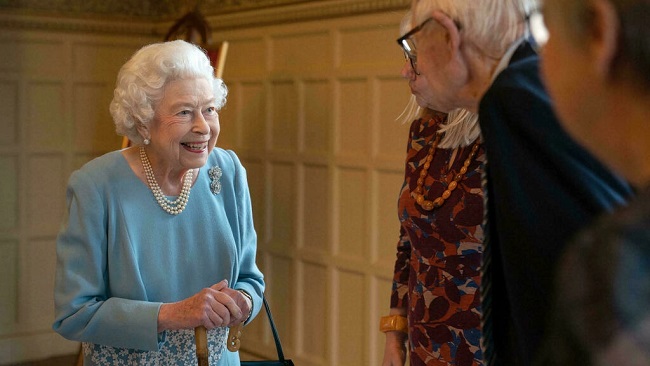
Queen Elizabeth II made a rare public appearance on Saturday, chatting and cutting cake at a party, a day before she enters her 70th year as monarch.
The 95-year-old Queen has rarely appeared in public and has cancelled major engagements since spending a night in hospital for tests last October.
Wearing a blue dress and pearls, the Queen talked to people from local community and volunteer groups at a morning reception at her Sandringham residence in Norfolk in eastern England.
She is about to mark a major milestone in her reign, as Sunday will be the 70th anniversary of the day her father, King George VI, died, and she became queen aged 25.
The nation will take part in Platinum Jubilee celebrations this summer including a four-day weekend.
On Saturday, the Queen cut a cake with the Jubilee emblem iced on top and received a posy of flowers at the reception in Sandringham’s Ballroom, which included a band playing the song “Congratulations”.
The guests included Angela Wood, a woman who helped create the recipe for coronation chicken, first served at a banquet in 1953.
Wood told the BBC in January that she helped fine-tune the recipe for the bright yellow dish of chicken, boned and coated in a curry cream sauce, while a 19-year-old student at a Cordon Bleu cookery school.
The Queen was also photographed out walking out at Sandringham. She has used a stick in public appearances since October, but royal officials said it was not linked to any specific health condition.
The Queen traditionally spends her Accession Day at Sandringham, where her father died of cancer while she was on a visit to Kenya.
She is set to become the first UK monarch to reign for 70 years.
Source: AFP













5, February 2022
Malians storm capital in anti-French mass protest to celebrate envoy expulsion 0
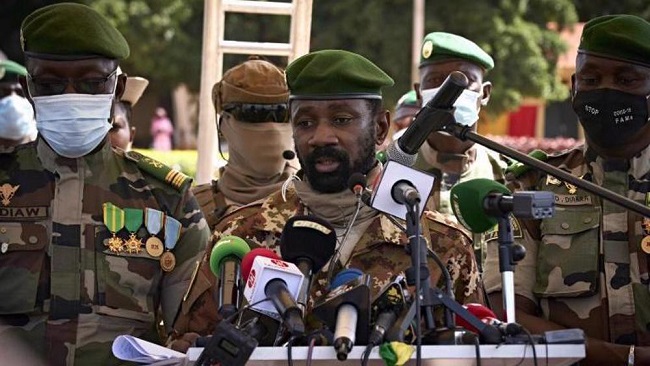
Thousands of anti-French protesters have flocked to the streets in the Malian capital of Bamako to celebrate the expulsion of the former colonizer’s envoy from the African country.
Some 3,000 protesters attended the rally in central Bamako on Friday, waving Mali’s national flags and burning cardboard cut-outs of French President Emmanuel Macron in celebration of the French ambassador’s dismissal.
Mali expelled the French envoy last week over what the country’s transitional government described as “hostile and outrageous” comments by the former colonial power.
Paris pushed economic and other sanctions against the African country after the expulsion, and the European Union also sanctioned on Friday several Malian officials, including the country’s prime minister.
Adama Ben Diarra, a vocal Malian activist and one of those sanctioned by the EU, was one of the organizers of the Friday’s protest. He told the cheering crowd that it was an honor to be on the bloc’s sanctions list.
Diarra said the expulsion of France’s ambassador was an important step and that the next step must be the departure of over 5,100 foreign troops deployed in Mali under the pretext of fighting terrorism and Takfiri outfits linked to Daesh and al-Qaeda.
Relations between Mali and its former colonizer have turned sour after the junta, which seized power following a military coup that ousted President Ibrahim Boubacar Keita in August 2020, ditched previously-planned elections in February and proposed to stay in power until 2025.
France has had more than 50 military interventions in Africa since 1960, when many of their former colonies gained nominal independence.
Anti-French sentiment is on the rise in West Africa as the security situation deteriorates despite the presence of French troops in the troubled region. France recently deployed more troops in the Sahel despite opposition to its presence there.
Mali has become increasingly engulfed in violence since a Tuareg uprising in 2012 was hijacked by extremist militants, who perpetrated ethnic killings and attacks on government forces and civilians.
In 2013, France intervened in Mali to purportedly curb militants who had captured the desert north, before deploying troops across the Sahel. While it has sent more troops and the UN has also its own peacekeeper troops in the African country, violence has continued to intensify and spread in the region.
Nearly 7,000 people died due to the fighting in Mali in 2020, according to the Armed Conflict and Location Event Data Project, while the UN declared late last year that more than two million people had been forced to flee their homes because of the conflict, a number that has quadrupled since 2019.
More than 14 million people in Mali, Niger, and Burkina Faso are now in urgent need of humanitarian assistance.
Source: Presstv