

30, July 2025
Adamawa: How an American NGO is improving rural farmers’ access to modern agricultural technology 0
In an area where many families live off of small farms and as much as 30 percent of staples like fonio, maize, rice, sorghum, groundnuts, cowpea, cotton and yams rot before they get to market, a recent pilot in the Adamawa region has provided technical solution. As per MINADER’s May 2024 survey, fonio losses in Mayo‑Banyo averaged 28 percent; by July, 300 households in 15 rural farming areas reported a 25 percent cut back—some 1.2 tonnes of grain saved from rot.
At the heart of this improvement is AgriSafe, a non‑market Android forecasting tool born of collaboration between the Ministry of Agriculture and Rural Development, the nonprofit Key Farmers Cameroon, and a small team of international volunteers. By combining daily inputs—such as grain moisture and ambient temperature—with Cameroon Meteorological Service forecasts, the app calculates spoilage risk and suggests the optimal window for drying, sealing or selling. Rather than high‑pressure marketing, farmers speak most of the outcomes: better timing for drying and sales that has already translated into steadier incomes.
Seventeen‑year‑old US volunteer Sid Mahajan spent more than 200 hours developing the mathematical engine of AgriSafe and leading hands‑on trainings. Local agronomist Marie‑Claire Tchatchoua then conducted field tests on groundnuts and cowpea, calibrating the models for dry‑season humidity surges.
Graduate of the University of Yaoundé I Grace Nche went village to village, taking feedback and simplifying menus so that women with low literacy levels could also follow preservation alerts. Data scientist Olivier Blackburn tuned the system’s machine‑learning module as real‑time readings flooded in, so that recommendations became increasingly reliable.
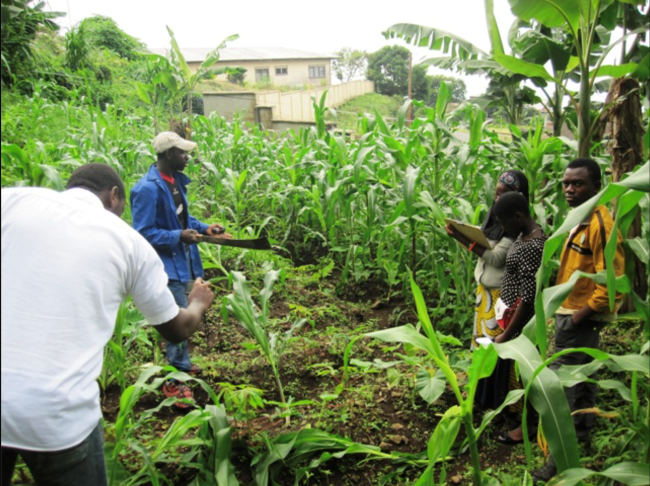
Tignère Cooperative Lead Pierre Tonzo reports that kind of knowledge revolutionized farmers’ interactions with the market. Surplus sorghum or maize used to rot unattended, for example; now villagers coordinate group sales during periods of minimal spoilage risk—and can compare prices from rival buyers. “Last month, our cowpea fetched 15 percent more than it usually does,” he reports.
Key Farmers Cameroon, established in 2004, supplied seed grants, solar chargers and French‑language guides but emphasizes that decision‑making is local. “We brought resources,” states Executive Director Christelle Ngassa, “but it’s farmers, extension agents and volunteers who determine the product’s future.” Logistics coordinator Jean‑Paul Mbuy managed device distribution and workshop scheduling.

To the future, then: MINADER’s Digital Innovation unit plans to introduce the product to 50 farming communities by early 2026, include localized voice prompts and bring in satellite‑based forecasting for rice and yams. For now, rural Adamawa citizens temper optimism with caution: data‑driven recommendations have saved thousands of kilograms of crops already, but long‑term success will come in transcending power and connectivity challenges to reach every farmer.





















30, July 2025
Cameroon’s natural wealth worth $222 billion 0
Cameroon’s natural capital is valued at $222.3 billion, or about 130,000 billion CFA francs, according to a recent African Development Bank (AfDB) report focusing on the country. This represents 39% of Cameroon’s national wealth and a 4.5% rise from the $212 billion estimated previously.
The World Bank’s 2025 report on Cameroon’s economic situation previously stated that national wealth consists of human, physical, produced, and natural capital. It assessed Cameroon’s natural wealth at 331,800 billion CFA francs.
The AfDB notes Cameroon’s natural capital includes renewable resources such as biodiversity-rich forests that are crucial for climate regulation and carbon sequestration. The country also has an estimated 12,000 megawatts of unexploited hydroelectric potential and significant solar potential, with an average insolation of 5.8 kWh per square meter per day, which favors clean energy production. Non-renewable natural capital comprises oil, natural gas, and mineral resources.
Despite this “significant potential, which constitutes a strategic lever for economic transformation and the achievement of sustainable development goals” in Cameroon, the AfDB observed that “the contribution of natural capital to the Cameroonian economy remains moderate, as its potential is underexploited.” The financial institution cited a decline in natural capital’s contribution to gross domestic product as proof. Natural capital rents fell from 6.5% of GDP in 2018 to 4.7% in 2020, reflecting a decline in the effective economic valuation of these resources, the AfDB reported.
The AfDB noted that the 4.5% increase in natural capital over 25 years conceals a marked relative degradation. Natural capital per capita sharply decreased by 47.9%, falling from $16,105 in 1995 to $8,392 in 2020, the AfDB reported. This decline primarily stems from increasing demographic pressure and unsustainable resource exploitation.
Source: Business in Cameroon