18, August 2022
Southern Cameroons Flooding: Biya regime says trade with Nigeria disrupted 0
Cameroonian authorities say record flooding on its western border with Nigeria has killed at least six people, washed away homes, and destroyed thousands of tons of food meant for export.
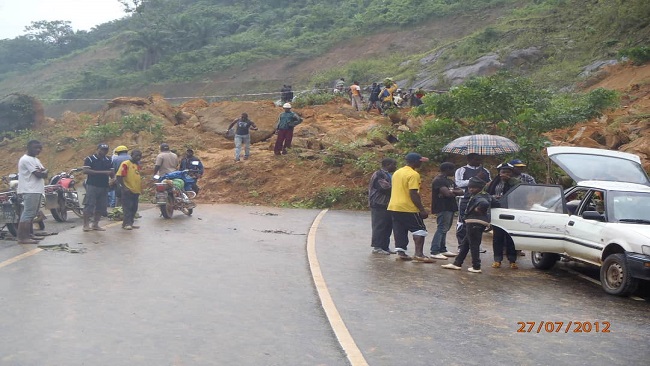
In a video circulated on social media platforms by Widikum council officials, civilians asked the Cameroon government to help clear the road of earth, mud and stones to enable them to leave Widikum.
Among the merchants is Paul Okafor, a Nigerian who buys palm oil and vegetables from Widikum to sell in his country. He said floods and landslides have blocked him in Widikum for five days, and no vehicle has been able to leave or enter because flood waters have covered roads and landslides are pulling down hills on roadsides.
Okafor said the vegetables and tomatoes he bought are beginning to rot, and Widikum vegetable farmers are complaining that their harvest is decaying.
Andoh Stanilos, the mayor of Widikum district, acknowledged that his council staff shared the videos. He said floods that triggered landslides killed six people, left hundreds homeless, and destroyed homes and warehouses.
“The floodplains overflooded and completely swept off houses,” he said. “At the moment I speak, there are over 55 people who are without something to eat. The council is trying to mobilize some resources, so I send this SOS to the government and people of goodwill to come to the assistance of persons who are destitute now.”
The floods destroyed a 36-meter-long bridge on the River Momo, keeping hundreds of merchants and commuters stranded on both sides of the river. Momo, an administrative unit where Widikum is found, is a production basin for palm oil, maize, potato, tomatoes and vegetables.
Cameroon’s National Observatory on Climate Change last month predicted that floods and landslides would hit many Cameroonian towns and villages including Widikum.
Forghab Patrick, deputy director general of the observatory, said homes built in flood-risk areas made the situation even worse.
“People build in marshy areas,” Patrick said. “What happens? Water cannot circulate correctly because the houses block even the waterways and at the end of the day, those living in those homes are all exposed.”
The government said it is educating people to stop settling on risk zones, but has not said if it will provide the food and water-hungry victims are asking for.
Source: VOA













22, August 2022
Wärtsilä to provide automation upgrade for an iconic power plant in Kribi 0
The technology group Wärtsilä will carry out an upgrading project of the electrical and automation systems to ensure optimal reliability of the Kribi power plant in the Republic of Cameroon. The 216 MW plant has been in operation for nearly ten years, operating with 13 Wärtsilä 50DF dual-fuel engines running primarily on natural gas. At the time of commissioning, it was the largest gas engine power plant in Sub-Saharan Africa. Wärtsilä will also support the customer’s operational and maintenance performance with a 10-year long-term service agreement.
The order with Wärtsilä was placed by Kribi power development company (KPDC), a subsidiary of Globeleq, an independent power producer (IPP) and the owner and operator of power generating facilities across Africa. The order will be booked in Wärtsilä’s order intake in Q3/2022.
“The Kribi power plant has a vital role within the African energy sector. It is still today supplying two-thirds of the thermal energy in Cameroon. Cameroon’s energy system relies heavily on hydropower, but has uncertain resources of water. The Kribi plant, therefore, plays a key role in ensuring a supply of safe, cheap, and reliable energy. For this reason we are keen to upgrade the power plant’s automation systems to the latest design to ensure optimal reliability, and to strengthen our cooperation with Wärtsilä, leveraging their competences on a continuous basis within the framework of the long-term service agreement,” commented Gionata Visconti, Chief Operating Officer, Globeleq.
Wärtsilä has a strong regional presence, which enables us to provide valuable technical support that optimises engine performance and maximises the production capabilities of this power plant which has such a significant role in Cameroon’s power supply. We are also in a position to ensure the availability of critical spare parts, and this is an essential element within the long-term service agreement between our companies. All in all, this is a very important project, both for the customer and for Wärtsilä,” said Markus Ljungkvist, Vice President, Services, Wärtsilä Energy.
The project is scheduled to commence in 2023. To ensure the continuity of the plant’s output, the work will be carried out on one engine at a time. The long-term service agreement includes remote operational support, maintenance planning, technical advisory and remote troubleshooting services, as well as spare parts.
Long-term service agreements are an integral part of Wärtsilä’s lifecycle services offering. They are based on utilisation of the latest digital technologies, and supported by the company’s extensive know-how and understanding of power generation installations.
Wärtsilä has altogether supplied 550 MW of generating capacity to the Republic of Cameroon, and 7.5 GW to the whole of Africa, of which more than 25 per cent are covered by Wärtsilä service agreements.